Feds open antisemitism investigation into National Education Association
An employment discrimination case alleges harassment of Jewish members at the country’s largest teachers union
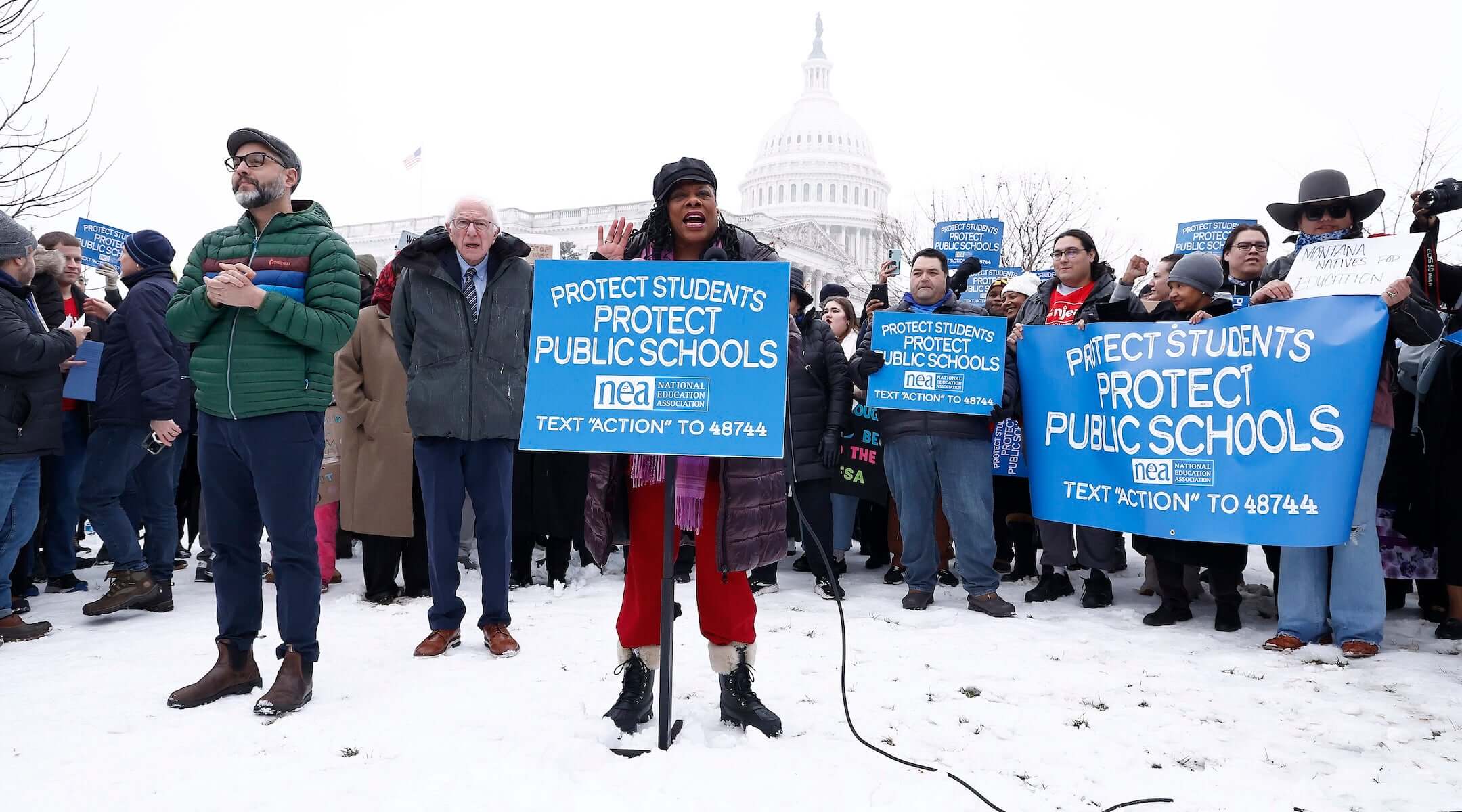
Members of the National Education Association and allies in Congress rally outside Secretary of Education nominee Linda McMahon’s confirmation hearing on February 12, 2025 in Washington, D.C. Photo by Paul Morigi/Getty Images for National Education Association
(JTA) — The Trump administration is launching an antisemitism investigation into the National Education Association, the influential public school teachers union, over purported employment discrimination.
The probe is based on allegations that Jewish members of the NEA were harassed and “physically intimidated” during the organization’s 2025 annual convention, including a reported case of NEA members appearing to cheer at mention of the 2005 attack on a march for Israeli hostages in Boulder, Colorado.
The complaint, based on the accounts of several Jewish NEA members, also spotlighted recent controversies, such as materials from the union that labeled a map of the state of Israel as “Palestine” for Indigenous People’s Day and a handbook that failed to identify Jews as the primary victims of the Holocaust. They further alleged that the union’s diversity hiring guidelines harmed its Jewish members.
The Brandeis Center for Human Rights Under Law, a legal group that has brought several other such antisemitism cases to the Trump administration, filed the complaint that triggered the NEA investigation. The case is being handled through the U.S. Equal Employment Opportunity Commission, whose authority to investigate employment discrimination also extends to union membership.
“We really appreciate the EEOC’s decision to open this investigation,” Marci Miller, director of legal investigations at the Brandeis Center, told the Jewish Telegraphic Agency.
In a statement to JTA, the NEA said, “We take concerns like this seriously and are reviewing the matter through our established processes.” The union added that it “does not tolerate antisemitism in any form and is committed to ensuring that all members and students, including Jewish members and students, can work and learn in a safe and welcoming environment.”
The NEA has previously said its map labeled “Palestine” “does not meet our standards,” and updated its Holocaust handbook in response to the pushback.
Jews in public school education have expressed concern about tensions over the last few years. In 2021, many Jewish groups rallied against NEA proposals to oppose Israel; the measures did not pass. At its 2025 convention, the NEA had voted to boycott the Anti-Defamation League, though its executive committee rejected the vote following pushback from Jewish groups.
The GOP-led House Committee on Education and the Workforce is also investigating the union over antisemitism, citing several of the same instances later outlined in the Brandeis Center complaint.
The EEOC’s NEA case is part of an expansion of the Trump administration’s antisemitism investigations beyond college and K-12 campuses. Last week the U.S. Health and Human Services Department opened its own probe into the American Psychological Association, also based on a Brandeis Center complaint.
In addition to alleged harassment of Jewish members at the convention, Miller said the center’s NEA complaint also involved diversity-based hiring practices at the union: “Jewish members in particular have been harmed by this policy because they have not been recognized as a racial or ethnic group worth counting for purposes of this policy.”
The EEOC has tackled antisemitism cases against other institutions, but its role in such investigations is controversial. The agency’s chair, Andrea Lucas, is currently demanding that the University of Pennsylvania turn over a list of Jews affiliated with the university as part of the commission’s antisemitism investigation into the Ivy League school. Several Jewish groups, as well as the university itself, have argued that such a demand will make Jews less safe.
Some Jewish groups have alleged that the administration has used antisemitism allegations as a pretext to undermine institutions it considers ideologically unfriendly.
One of Lucas’s defenders in the Jewish community is Kenneth Marcus, the Brandeis Center’s founder. Lucas herself is not Jewish but recently defended her legal strategy to Jewish leaders at a campus antisemitism conference.
Asked about this, Miller said the Brandeis Center was providing “dozens” of Jewish witnesses to the EEOC for consensual interviews.
“There’s no demand for anybody else,” she said. “We have plenty of information.”
This article originally appeared on JTA.org.
Did you know that only 2% of Forward readers donate to support our nonprofit newsroom? That 2% make it possible for millions to read the Forward without a paywall or subscription — removing any barriers to the full and fair Jewish story.
But while the Forward is free to read, it isn’t free to produce. Big stories — like deep dives into the antisemitism data, political scoops or reporting trips to college campuses — take months of research and fact-checking. All while we keep you informed of what you need to know each day.
— Rachel Fishman Feddersen, Forward Publisher & CEO
Support our mission to tell the Jewish story fully and fairly.