Remembering Mimi Sheraton: 5 great Jewish recipes
The renowned Jewish food critic, author and Forward contributor has died at age 97

Mimi Sheraton with two of her books on display in 2016 in New York. Photo by Neilson Barnard/Getty Images for the New York Culinary Experience

By Beth Harpaz April 7, 2023
The acclaimed food writer Mimi Sheraton died Thursday at age 97. She was The New York Times’ food and restaurant critic from 1976 to 1983, the author of 16 books, and a contributor to many magazines and news outlets, including the Forward.
Sheraton’s books included The Whole World Loves Chicken Soup: Recipes and Lore to Comfort Body and Soul, and The New York Times Jewish Cookbook. Her discovery that bialys are no longer made in Bialystok, Poland, the town that gave them their name, led to what might be her most poignant work: The Bialy Eaters: The Story of a Bread and a Lost World. She tracked down Bialystokers and their descendants who had settled around the world, and found bakers making crusty bialys in places like Israel and Argentina, as well as around the U.S.
From the Forward archives, here are five of Sheraton’s iconic Jewish recipes.
Schav, a soup for warm weather
Lightly creamy and green, schav is a soup served cold that will be instantly loved by some — and perhaps only gradually embraced by others. Made with sorrel, a long, slender leafy green, it is thickened with beaten egg yolk. Its sour edge is mellowed by a few exquisitely aromatic dried mushrooms.
The secret to great gefilte fish
Let’s be honest: Not everyone loves gefilte fish. But many of the haters have only experienced this much-maligned food packed in a jar filled with gel. Sheraton explains that gefilte fish made from scratch is an entirely different experience. To make what’s essentially a fish dumpling, fish fillets are chopped and poached in a flavorful broth. Using the right type of fish is essential.
Haroset: It’s not just for Passover
Haroset is not just for Seders. Sheraton’s descriptions of Ashkenazi as well as Sephardic-style versions showcase rich fruit spreads deserving of a place on the table year-round.
Latkes: Crispy potato perfection
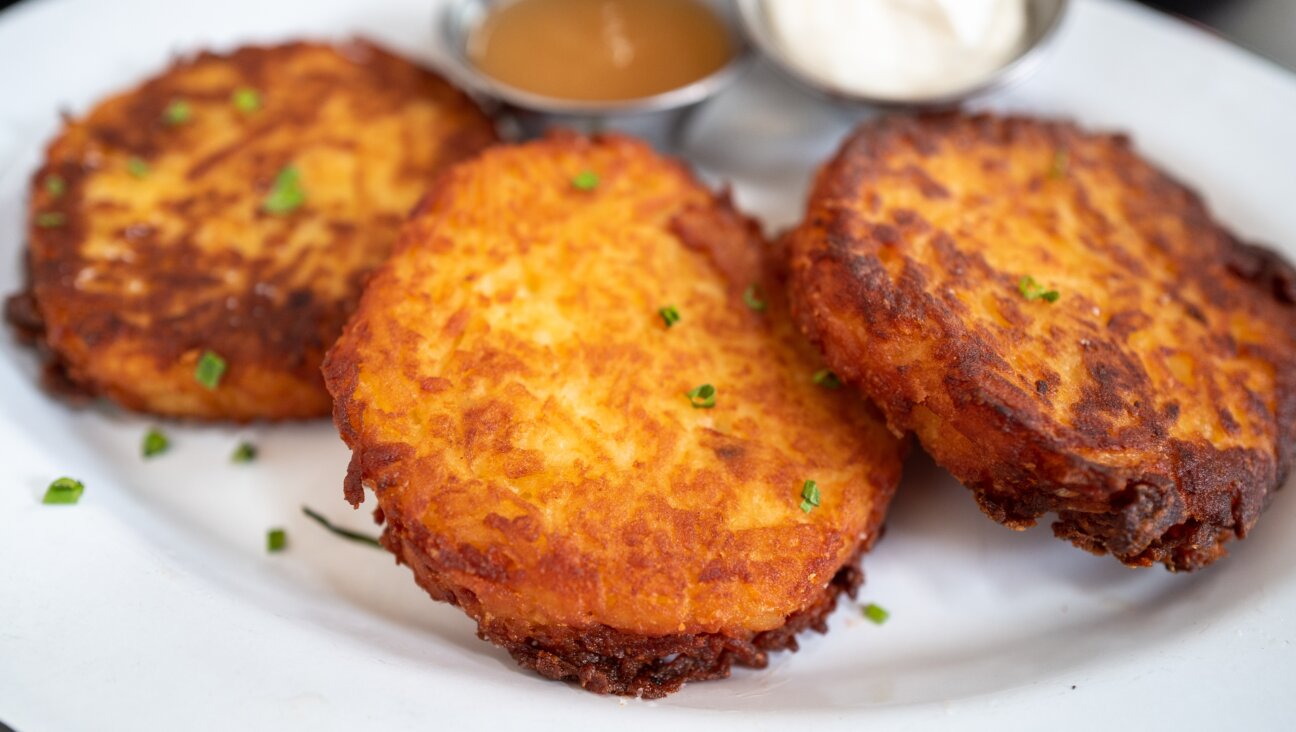
Just as haroset isn’t just for Passover, latkes are a treat that can be made anytime, and not just for Hanukkah. In fact, for those who observe Passover dietary restrictions, latkes are a great Pesach meal — after all, they’re not much more than potatoes, eggs, onions and salt, with a little matzo meal thrown in. The trick to latke perfection is frying them right.
If you’re avoiding chametz this week, this one will have to wait until after Passover — but there’s no rule that says you have to hold off until Rosh Hashanah, when honey cake traditionally served. Dark, moist, made with coffee and spices, it’s a sweet, sticky, aromatic treat, glorious with a schmear of cream cheese.
This is a moment of great uncertainty. Here’s what you can do about it.
We hope you appreciated this article. Before you go, we’d like to ask you to please support the Forward’s independent Jewish news this Passover.
This is a moment of great uncertainty for the news media, for the Jewish people, and for our sacred democracy. It is a time of confusion and declining trust in public institutions. An era in which we need humans to report facts, conduct investigations that hold power to account, tell stories that matter and share honest discourse on all that divides us.
With no paywall or subscriptions, the Forward is entirely supported by readers like you. Every dollar you give this Passover is invested in the future of the Forward — and telling the American Jewish story fully and fairly.
The Forward doesn’t rely on funding from institutions like governments or your local Jewish federation. There are thousands of readers like you who give us $18 or $36 or $100 each month or year.
Support our mission to tell the Jewish story fully and fairly.