No tourists, no income: The collapse of livelihoods in Jerusalem’s Old City
For thousands of workers and store owners in Jerusalem’s Old City market, things haven’t been this bad since the days of the second intifada
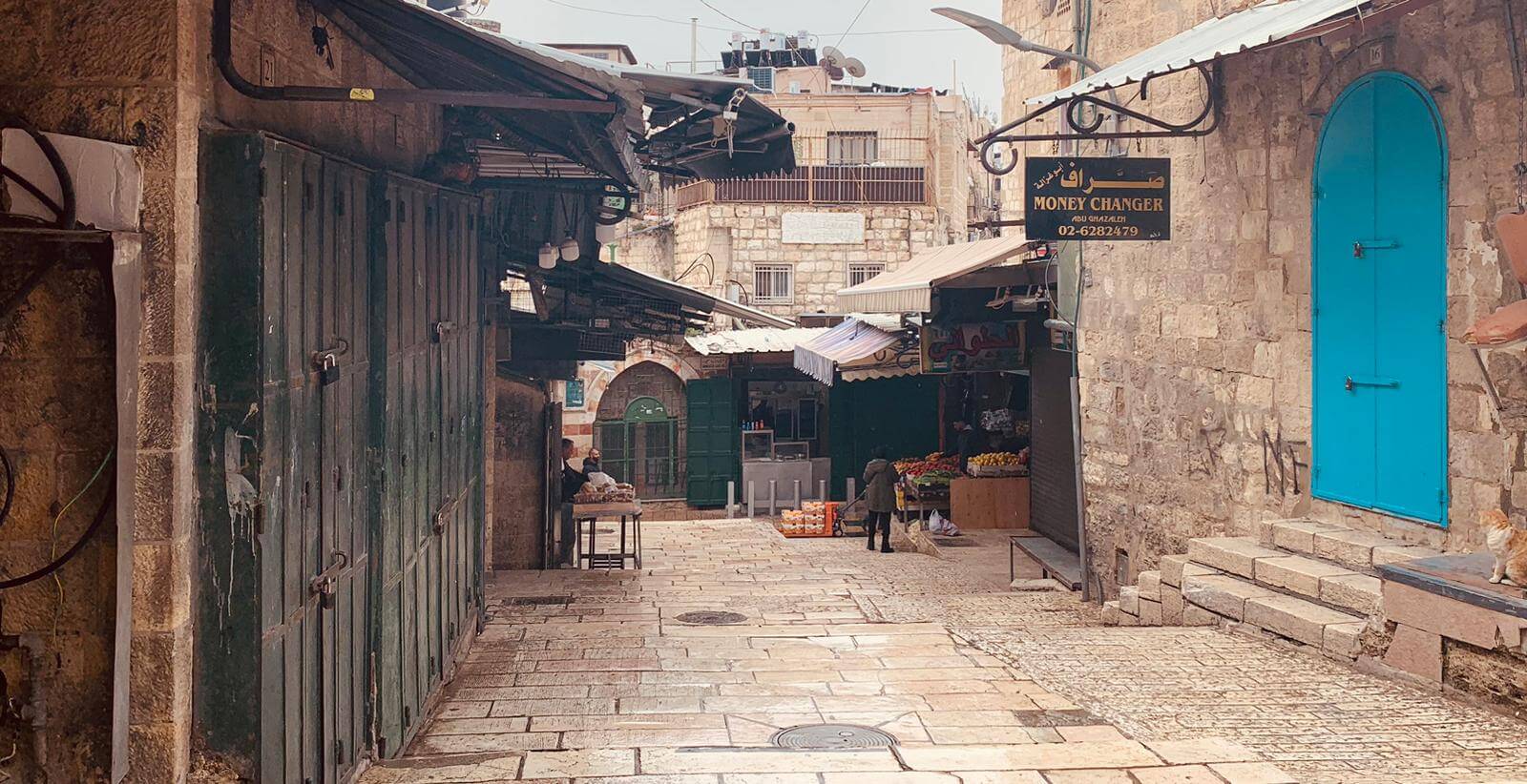
The closed market in the Old City. Photo by Rahma Ali
This article was produced through a collaboration between Shomrim, an investigative outlet, and Wasla, an Arabic-language business news site, and was published on both platforms.
Some people are describing the impact of the latest confrontation between Israel and Iran as one blow too many for the traders and craftspeople who used to make their living in the Old City of Jerusalem’s market. “The situation today is worse than it has ever been before,” says Hijazi Rashq, a member of the Jerusalem Chamber of Commerce and Industry — which is one of the only organizations that keeps track of the conditions facing Palestinian traders in East Jerusalem. “It’s another nail in the coffin of a market that has actually been dead for the past three years.”
According to Rashq, “when the war with Iran began, the market effectively shut down and took on the atmosphere of a military zone. This is during the holy month of Ramadan, the most important time of year for most of the traders, who were hoping to make up for some of the losses they suffered over the past few years. What happened was the exact opposite.” Without any customers, some of the traders decided only to open their stores on Fridays and Saturdays. Even so, they could only do so if the police allowed them (as explained below). Others were forced to find work in the western part of the city — often taking menial jobs in cleaning and maintenance — just to provide an alternative source of income for their families.
“This is the worst period we’ve ever been through,” says 35-year-old Siraj Abu Asab, who runs a store selling souvenirs to tourists. “Even if they were to allow us to open the shop, we wouldn’t earn any money because the Old City is completely empty of visitors. Eighty percent of my business comes from tourism; local sales make up just 20%. Needless to say, tourism has been nonexistent since Oct. 7 and now, because of the war and the curfews, even our local customers have vanished. Before the start of Ramadan, I bought goods valued at 105,000 shekels ($35,000), but as soon as the war broke out, I was ordered to close my store because it doesn’t have a protected space. I only managed to sell 10 items on the internet — but I still haven’t received payment for those sales.”
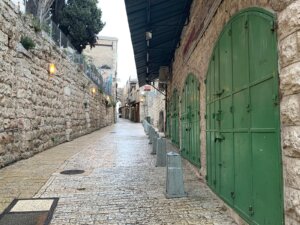
Anyone who visits Jerusalem’s Mahane Yehuda market or walks along Jaffa Street will see a city that is very much alive — despite everything. But if they were to continue walking toward the walls of the Old City and were to pass through one of its gates, they would discover a very different situation: row after row of shuttered stores — dozens, perhaps hundreds. Wrought-iron doors, rusty padlocks and signs hanging in doorways that haven’t seen a paying customer in months. There’s no one around, so owners aren’t even trying to sell anything. The narrow and empty alleyways have turned it into a ghost market.
“We have been running a business in this store for almost 100 years,” says Ahmed Dandis, 60, who owns a toy shop at the entrance to Damascus Gate. His shop was closed for almost the entire war. “The shop has been passed down from generation to generation. We used to sell clothes, but a few years ago, I decided to start selling toys instead. There has been a downturn in commercial activity in the market for the past five years which eventually ground to an almost complete halt. During the recent war, everything was closed.”
If Dandis and the other traders had hopes that an influx of Ramadan visitors would turn their fortunes around, the outbreak of the war with Iran put an end to them. “I bought $25,000 worth of goods and I didn’t sell a single item. Everything is still sitting in the store,” he said. According to Dandis, the relatives he used to employ in the shop have been forced to quit and look for work in the western part of the city.
The financial lifeline for thousands of families
The market in the Old City of Jerusalem is one of the oldest in the world and provides an economic lifeline for thousands of families. While there is no official figure on the number of shops and stalls in the market, estimates vary from 1,000 to 2,000, depending on the definition used. A field survey conducted in 2019 and 2020 found 2,075 stores operating in the market. Previous estimates by the Palestinian Chamber of Commerce in the city spoke of around 1,400 shops, while figures published by Israeli authorities in the 1990s indicated that there were 1,896 businesses there. Whatever the correct number, thousands of people work in the market; unofficial estimates put the number anywhere between 2,600 and 3,700. The vast majority of them are Palestinian residents of East Jerusalem, the Old City or the adjacent neighborhoods.
The question now is what will happen to these people. According to figures from the Association for Civil Rights in Israel, around 75% of the Palestinian families and around 84% of the children in East Jerusalem in 2022 were living below the poverty line. Against the backdrop of the economic collapse described by the market traders and the accompanying statistics, the crisis in the Old City is not just about financial losses; it is also affecting the daily lives of residents. In 2020, the closure rate of stores in the market was around 30%; according to Rashq, “since October 7 and all the security events that followed, that rate has increased significantly.”
Noor al-Daya is 19 years old and lives in Aqabat al-Khalidiya in the Old City’s Muslim Quarter. She says that, during the first few days of the most recent war with Iran, the Old City was under almost complete closure; only residents officially registered as living in the Old City were allowed to enter. This completely disrupted their daily routine. According to al-Daya, in addition to these restrictions, there was also an escalation of tension and violence within the Old City. She also lost her job working at a hotel near Dung Gate after the tourism industry collapsed. “Since losing that job,” she says, “I have nothing to do now.”

She is not alone. Over the years, the Old City has relied on three main types of visitor: tourists from overseas, Palestinians from the West Bank and Palestinian citizens of Israel. Now, the numbers from each of these groups have declined massively. West Bank residents are no longer able to get to Jerusalem, after Israel closed the checkpoints in response to the October 7 massacre. Recent years have also seen an almost total collapse in international tourism. In 2019, for example, some 4.4 million people visited Israel’s capital city; in 2024, that number had plummeted to just 330,000.
Meanwhile, the most recent war with Iran dashed any hope that recovery would come from domestic tourism, in the form of Arab citizens of Israel. “Under normal circumstances,” says one employee of the Waqf — the religious trust responsible for managing Islamic sites in Jerusalem — who asked to remain anonymous, “around 250,000 worshipers visit the al-Aqsa Mosque for Friday prayers during Ramadan. A large proportion of them are Palestinian citizens of Israel. During the last Ramadan, however, restrictions on worshipers entering the compound, because of the war and security concerns, meant that there were almost no visitors.”
According to Raed Sa’ada, chairman of the Palestinian Tourism Association and owner of the Jerusalem Hotel, “there used to be more than 40 hotels and hostels operating in East Jerusalem, owned or run by residents of East Jerusalem or church institutions. Because of the situation in recent years, there are now only 24 left.”
Sa’ada compares the current situation to the days of the second intifada at the turn of the century: “There’s no foreign tourism because of the security situation and there’s no domestic tourism because the al-Aqsa Mosque and the Church of the Holy Sepulcher were both closed during March due to the war. Even activists and foreign journalists have stopped coming.”
No official explanation or cause
Already facing severe practical challenges, Rami Saleh, the director of the Jerusalem Legal Aid and Human Rights Center, claims that Israeli authorities are making life even harder for the Old City traders. He says that several traders have contacted his organization, saying that they were prevented from opening their businesses without being given any explanation or legal cause. “In one of the cases,” he tells Shomrim, “a trader in the Old City market tried to partially open his store, just to sort through his goods — but the police ordered him to close it, arguing that it didn’t have a protected space. The officers even switched the sign on the door to ‘Closed’.”
According to Saleh, the trader claims that he was subsequently banned from reopening his store at all, after which he gave up entirely on such efforts. At the same time, the trader claimed, stores in the Jewish Quarter — only some of which had protected spaces — were allowed to remain open. In other cases, Saleh says, traders were prevented from opening their stores despite no official closure notice being issued. The only stores that were allowed to open were mainly grocery stores and pharmacies.
Shomrim has written extensively about the disparity between public bomb shelter accessibility in the western part of Jerusalem compared to the east of the city: although around 40 percent of Jerusalemites live in the east of the city, they have access to just 10 percent of the city’s public bomb shelters.
Saleh says that his organization has approached the relevant officials in the Israel Police and Jerusalem Municipality to ask for legal explanations for the incidents reported to them. So far, there has been no response. He argues that the situation reflects a widespread use of discretionary authority under the guise of security concerns, lacking clear or consistent criteria. This raises questions about the nature of the policy, particularly as it resurfaces during every round of escalation.
I’m personally matching all gifts to the Forward, up to $36,000. Can I match your gift now?

Hello, fellow Forward reader! I’m Joel Brown, a Forward reader and supporter for more than 15 years, and currently the chair of the board of directors.
I’m an avid Forward reader because it ticks so many of my essential boxes: excellent journalism, Jewish focus and diverse viewpoints. In today’s political climate, what I most appreciate is the Forward’s independence — made possible by the generosity of its membership.
The Forward is committed to bringing you unbiased, nuanced Jewish news. From my position as board chair, I see an exciting future as we expand our position as the definitive independent voice of contemporary American Judaism.
— Joel Brown, Forward board chair
Support our mission to tell the Jewish story fully and fairly.