As Temple Israel, both security training and sacred relationships prepared us for the worst
The executive director of West Bloomfield, Michigan, shares early lessons from last week’s attack
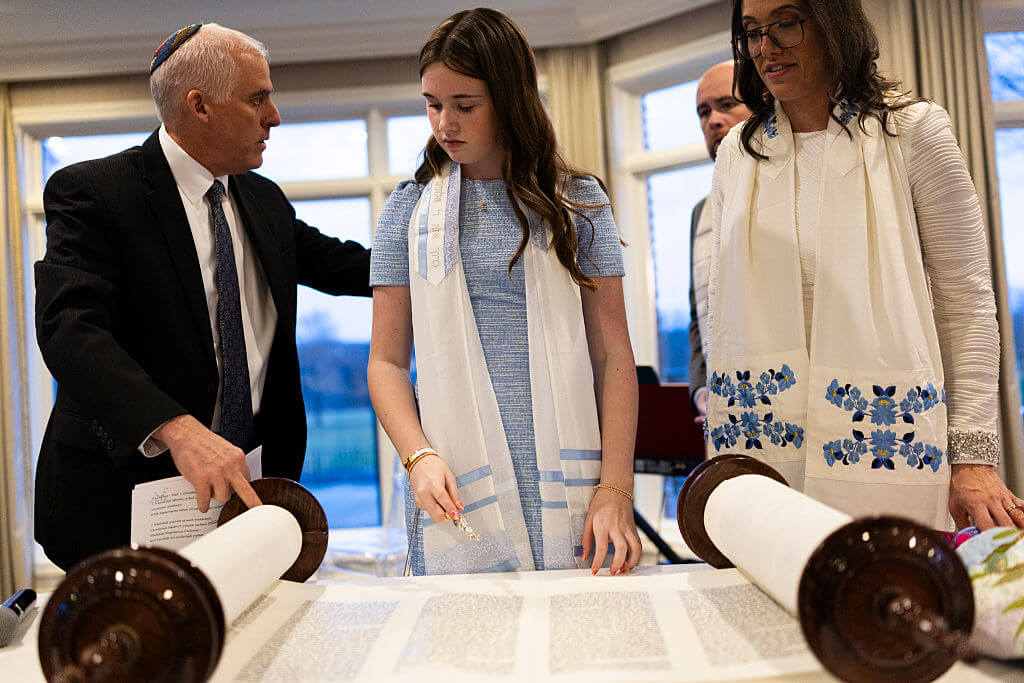
Rabbi Josh Bennett of Temple Israel speaks with Sydney Cox and her mother as they stand beside a Torah scroll ahead of Cox’s bat mitzvah service at Tam O’Shanter Country Club on March 13 in West Bloomfield, Michigan. The ceremony was moved from Temple Israel after a gunman rammed a vehicle into the synagogue and opened fire. Photo by Emily Elconin/Getty Images
(JTA) — As the executive director of a synagogue, I read the daily security briefs from Secure Community Network and engage in regular security updates with my colleagues and friends in Jewish communal spaces across the country.
I never imagined that the security risks we talk about every day would literally be at the entry to our spiritual home.
On Thursday, our synagogue, Temple Israel in West Bloomfield, Michigan, was attacked by an individual with the intention of causing harm to our community.
As my friend Rabbi Brian Stoller of Temple Beth-El of Great Neck shared in his sermon the next evening, “This is a scary time for Jews in America. And sadly, it can feel like a scary time to work in a synagogue.”
Our houses of worship — Jewish or otherwise — should never feel that way.
At Temple Israel, we say that every staff member is part of our temple family. We are extremely fortunate that all of our staff and community members — along with more than 100 children in our early childhood center — returned to the warm embrace of friends, family and the greater community after Thursday’s events.
And we pray for and express great gratitude to our security team, who bravely responded and ran towards the attacker. Their training and experience saved lives that day.
Our temple, like those across the United States, has spent countless hours and dollars in recent years focused on security. At times, the threat facing our synagogues and Jewish community spaces feels abstract. But our experience Thursday is an important reminder that security preparedness is essential to ensuring the safety of our community members, and it is time and money well spent.
Security preparation can alter your instincts and equip you to respond effectively in critical situations, preventing you from freezing when action is required.
Our temple staff faced many different challenges Thursday. We were spread out in different locations, some in groups, others isolated and some so far away that they did not hear the disturbing sounds. However, we all executed our training protocols to protect ourselves and those around us, including the precious children under our care.
Just over a month earlier, the FBI conducted a training session for our staff. These trainings are common culture, and I have sat through dozens of them over the years. The FBI facilitator discussed active shooter scenarios, emphasizing the “run, hide, fight” strategy. Our preschool faculty had undergone similar training in recent months.
Our security personnel also undergoes regular group training, even using federal holidays, when the rest of us are off, to practice their skills and response tactics in our sacred spaces with no one around to watch. It’s one of the many unseen preparation efforts our synagogue takes.
Another essential preparedness tactic is the sacred partnership we have built between Temple Israel and our neighbor, Shenandoah Country Club.
The club’s executive director, Hassan Yazbek, was literally the first person to call me as I was struggling to breathe in the temple parking lot after evacuating due to smoke inhalation. Hassan offered to house, feed and provide shelter for our faculty, staff and children. The country club also served as the initial staging ground for local law enforcement and hosted our Shabbat services this past weekend.
But our community relationships extend much further. The local FBI officials, Department of Homeland Security team members, county sheriffs and township police are all familiar with me and our security team. The same goes for our local West Bloomfield Township leadership and two state legislators that call Temple Israel “home.”
When I was taken into the command center at Shenandoah Thursday afternoon while the events continued to unfold across the street, I realized there was not a top official in the room from the dozens of local and national law enforcement agencies who did not know our security team members.
These are not fleeting relationships; they know us, our building, and our people. These local law enforcement professionals help us navigate special events, keep us informed when we need to be and are present in our community.
We are deeply saddened when any of our communities are affected by hate events and Thursday was our turn at the front of the line.
In Jewish tradition, we hold the sacred value of pikuach nefesh— the sacred responsibility to protect and preserve life. On March 12, our staff, faculty, security team, and the entire community lived out this value.
We are grateful for the security preparedness and the partnerships that enabled us to put our values into action when they were needed. The combination, as we now know first-hand, proved to create the best possible outcome in a situation and for that, my family and others involved in Thursday’s events are grateful.
The views and opinions expressed in this article are those of the author and do not necessarily reflect the views of JTA or its parent company, 70 Faces Media.

Hello, fellow Forward reader! I’m Joel Brown, a Forward reader and supporter for more than 15 years, and currently the chair of the board of directors.
I’m an avid Forward reader because it ticks so many of my essential boxes: excellent journalism, Jewish focus and diverse viewpoints. In today’s political climate, what I most appreciate is the Forward’s independence — made possible by the generosity of its membership.
The Forward is committed to bringing you unbiased, nuanced Jewish news. From my position as board chair, I see an exciting future as we expand our position as the definitive independent voice of contemporary American Judaism.
That’s why I’m paying it Forward, by matching $36,000 of reader gifts. It’s an investment in the Forward’s newsroom, to continue telling the American Jewish story with truth and independence.
— Joel Brown, Forward board chair
Support our mission to tell the Jewish story fully and fairly.