The Voice of Ladino
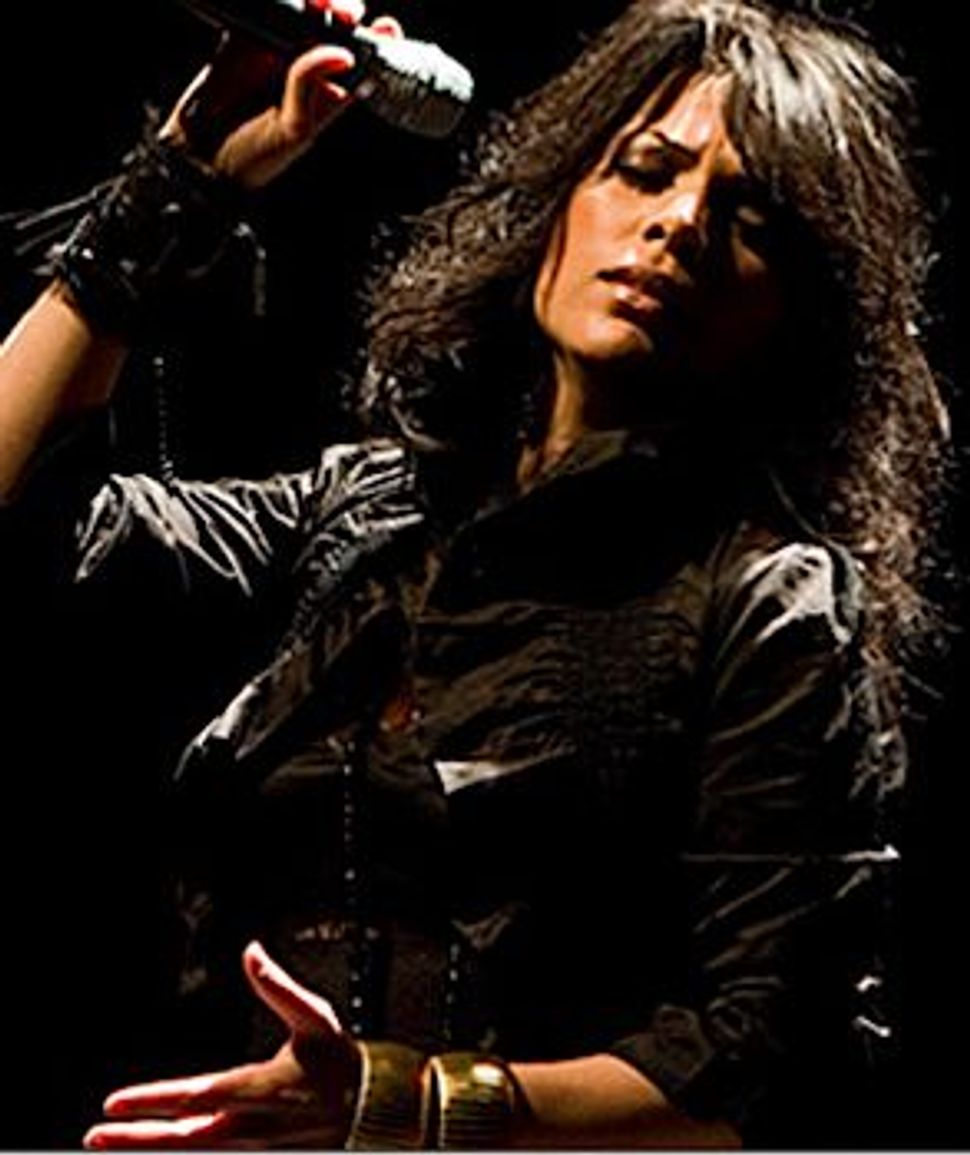
Image by Courtesy Yasmin Levy
Ladino, the language of the Judeo-Spanish Diaspora, has unfairly languished behind Yiddish in the Jewish language popularity sweepstakes. With the release of her 2009 U.K. album “Sentir” in the United States and an accompanying tour, including upcoming shows in New York, Los Angeles and San Francisco, Israeli singer Yasmin Levy joins a bevy of artists trying to change that. Alongside artists like Sarah Aroeste, Judith Cohen and Flory Jagoda, Levy tries to channel a rich, transnational, historical genre for modern audiences. Like those artists, she has succeeded in evoking something distant and foreign. She has failed in similar ways too, producing another Ladino project trapped as a token of the past without bringing anything exciting and new to the table.
“Sentir,” Levy’s fifth album combining Ladino music with Andalucian Flamenco, is a far better exhibition of Levy’s voice that it is of the Judeo-Spanish musical history it weaves through over 12 tracks. Even when the songs blend into each other, melodies failing to distinguish themselves, Levy’s voice is commanding. On the opening track, “Mi Korason,” her voice quivers, slipping elusively behind and under and through the lyrics. On “Londje De Mi” she shows off her vocal mastery, flashily trilling or halting breathily, unfortunately illuminating how lackluster her musicians are by comparison.
Listen to ‘Mi Korason’:
The problem is that Levy is such a vocal talent that her material never seems worthy of her. This is most evident on “Hallelujah,” a Ladino cover of Leonard Cohen’s classic song. Her approach to the song illuminates why “Sentir” never truly takes off. The oft-covered song has been done in a thousand ways — so hushed as to be almost silent on Jeff Buckley’s version, wounded theater from Rufus Wainwright, tart emo-pop from Paramore — that Levy’s version sounds more like a vocal exercise than a necessity. This is a similar problem on the rest of the album, where Levy’s voice consistently sounds like it belongs with other material. I’m starting to wonder whether the fault is with Ladino itself — too distant, too exotic, always coming off a little too much like an ethnomusicological record.
One rare moment of shocking intimacy comes on “Una Pastora” when Levy sings a time-bending duet with her father. He died when she was 1 year old, and the track sounds like a desperate stretch to reclaim something transitory. In this, her personal history and her subject matter comes together to create a beautiful, if too short, piece of music. It holds a promise of what compelling Ladino might sound like; so close it is as if history is folding in on itself.
Listen to Yasmin Levy perform ‘Una Pastora’ with the My Sweet Canary Ensemble:
This is a moment of great uncertainty. Here’s what you can do about it.
We hope you appreciated this article. Before you go, we’d like to ask you to please support the Forward’s independent Jewish news this Passover. All donations are being matched by the Forward Board - up to $100,000.
This is a moment of great uncertainty for the news media, for the Jewish people, and for our sacred democracy. It is a time of confusion and declining trust in public institutions. An era in which we need humans to report facts, conduct investigations that hold power to account, tell stories that matter and share honest discourse on all that divides us.
With no paywall or subscriptions, the Forward is entirely supported by readers like you. Every dollar you give this Passover is invested in the future of the Forward — and telling the American Jewish story fully and fairly.
The Forward doesn’t rely on funding from institutions like governments or your local Jewish federation. There are thousands of readers like you who give us $18 or $36 or $100 each month or year.
Support our mission to tell the Jewish story fully and fairly.