He was president of his synagogue. Now he wants to be LA’s next mayor.
Adam Miller’s Judaism runs deep — but he’s been quiet about it during his campaign
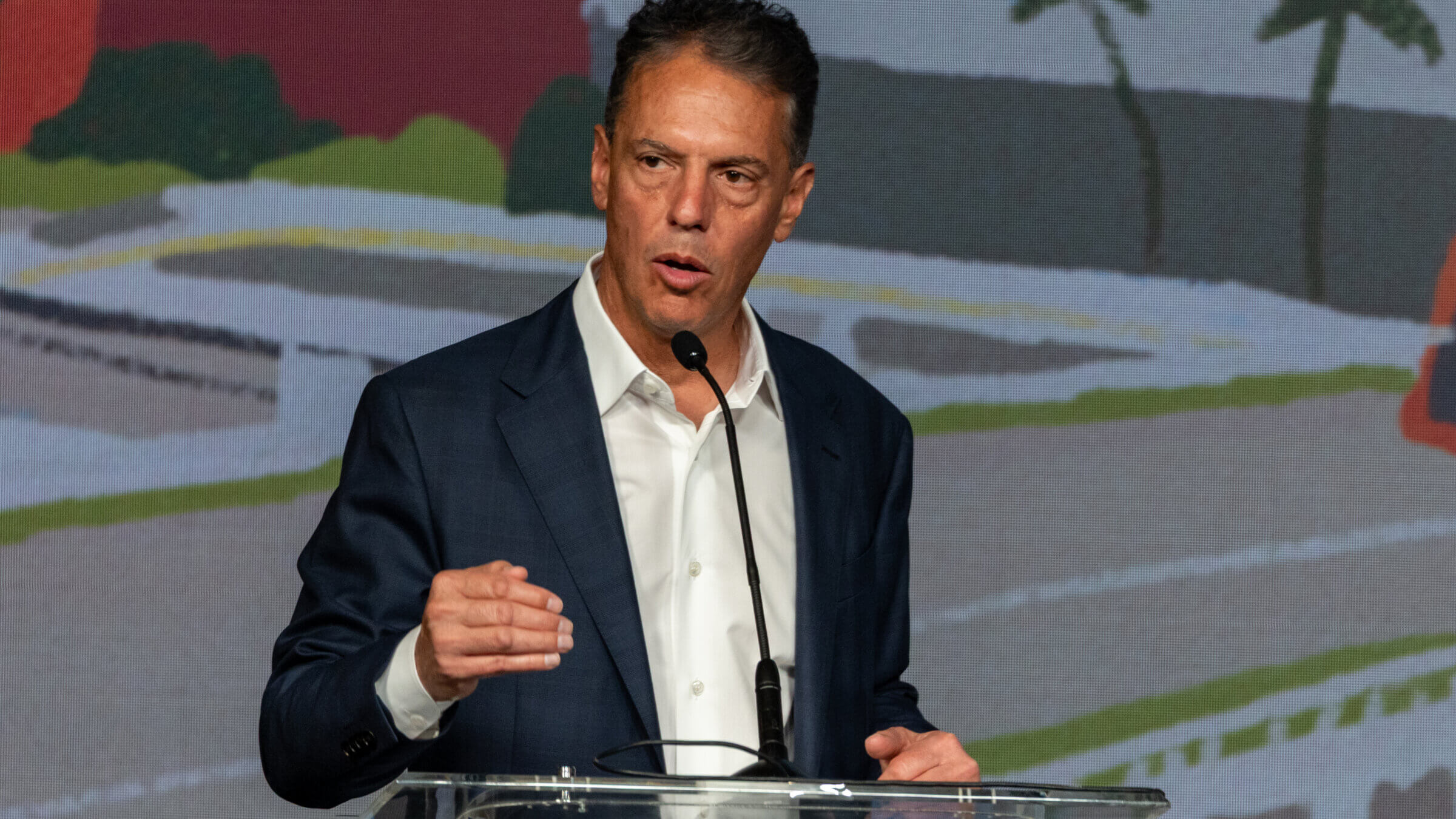
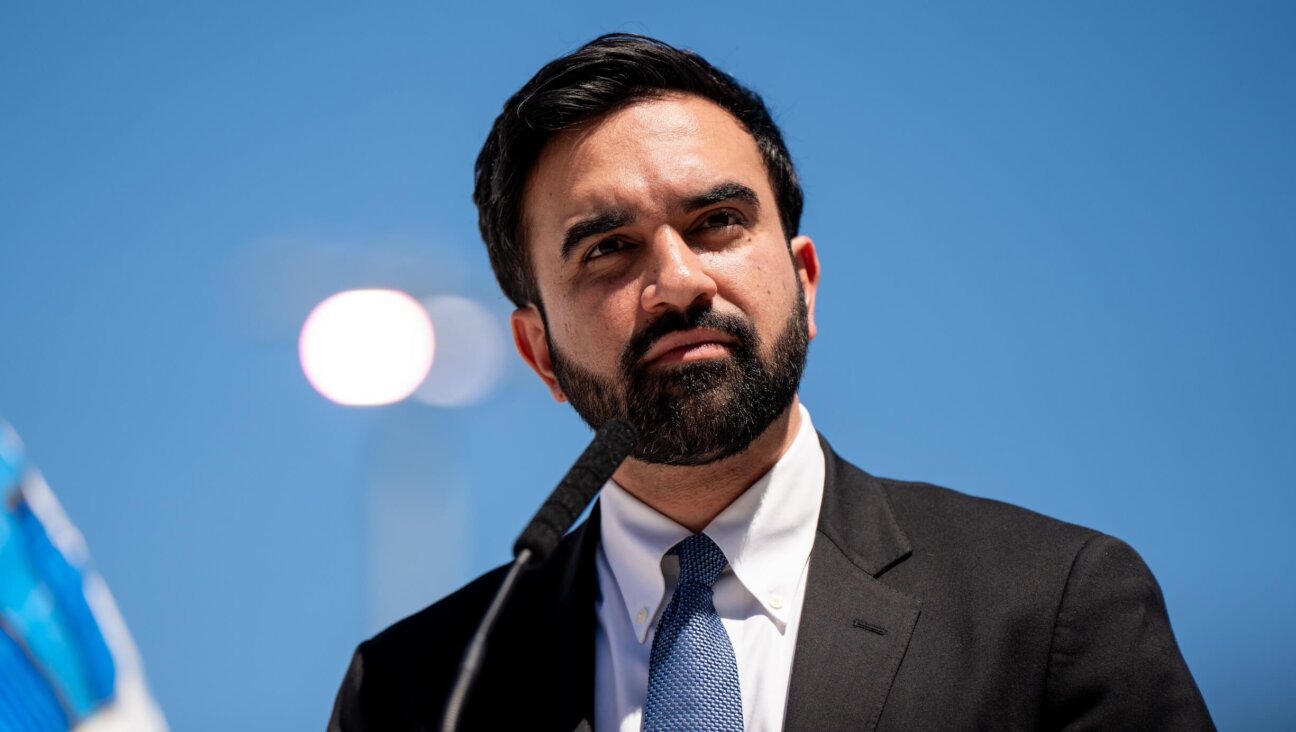
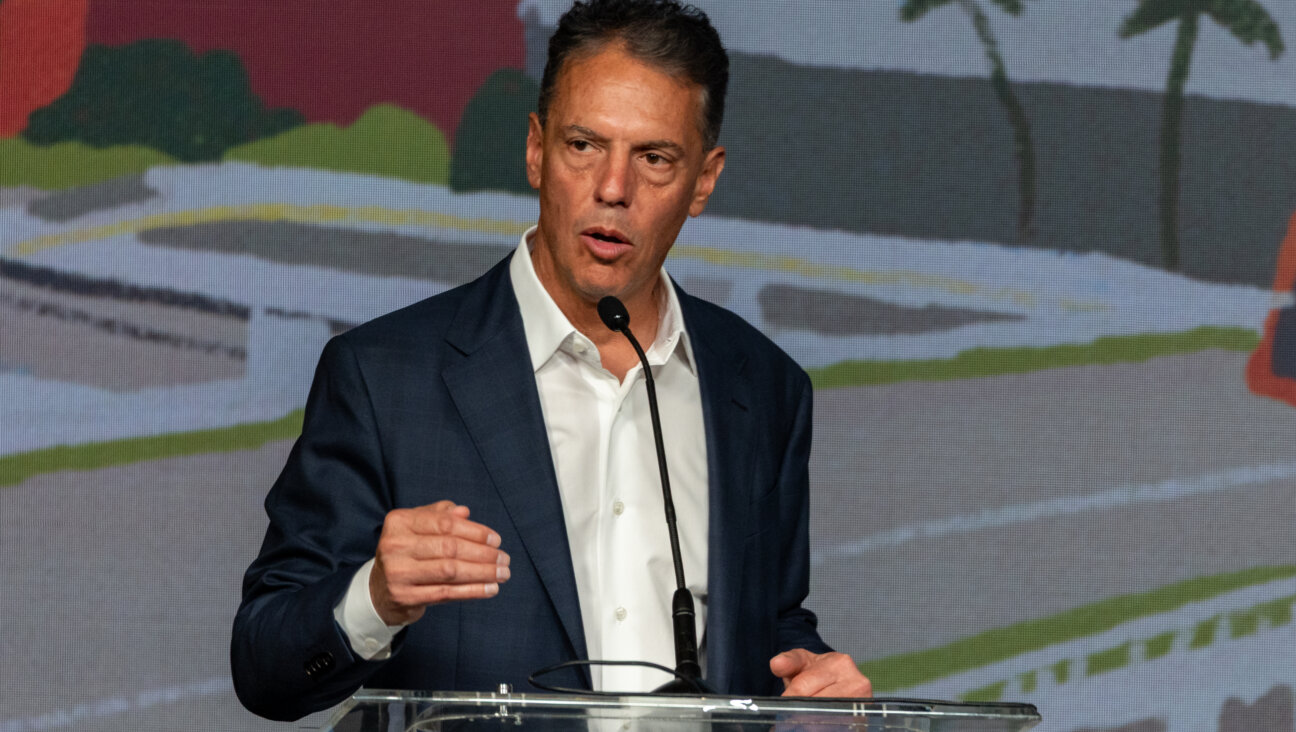
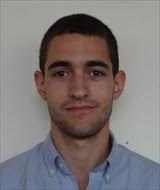
Nonprofit founder and tech executive Adam Miller at a debate among candidates for LA mayor, March 23, 2026. Photo by Jason Armond / Los Angeles Times via Getty Images
By Louis Keene April 30, 2026
LOS ANGELES — Adam Miller volunteered with a Reform social justice movement as a teenager, lived in Israel as a young adult and was and became a leader of one of the country’s most successful synagogues.
But Miller, a businessman who is running for mayor of Los Angeles, hasn’t said much about his Jewish background on the campaign trail. Instead, he has been talking about his entrepreneurial credentials — he sold his software company for $5.2 billion in 2021 — and touting the accomplishments of the nonprofits he started. His campaign site doesn’t mention his Jewish connections at all.
Seated at a cafe in his tony West LA neighborhood of Brentwood, Miller explained why. In today’s political environment, he said, he felt he’d had to downplay his Jewish, pro-Israel identity early in the campaign. But with California’s nonpartisan June 2 primary approaching — with the top two winners going on to the general election — he was ready to open up.
“It pains me a little bit when other candidates are acting like they’re going to position for the Jewish vote,” said Miller, who is running as a Democrat. “They’re acting like all of a sudden they’re very aligned with the Jewish community, when I know as a Jew that’s not necessarily true.”
Miller, who is self-funding his campaign, is currently running third or fourth, depending on the poll, in a race to unseat incumbent Democratic Mayor Karen Bass. More than 40% of voters remain undecided. He’s pitching himself as a get-things-done moderate — and a course correction from the growing influence in City Hall of democratic socialists, members of the same left-wing movement that helped make Zohran Mamdani mayor of New York City. Four Democratic Socialists of America members sit on LA’s City Council. One, Councilmember Nithya Raman, is Bass’ most formidable opponent in the primary.
At debates and in interviews, Miller has focused on the city’s most pressing issues: homelessness, housing, immigration and budget. Yet Miller’s Jewish bona fides may also hold his clearest arguments for leadership of the city. He leaned forward when talking about Ikar, the nondenominational synagogue where he once served as president, and about his identity as a Zionist — “even though it’s a dirty word now,” he said.
And a series of high-profile incidents affecting LA’s Jewish community during Bass’ term had helped clarify for Miller the problems facing the city.
“Look, to the vast majority of Angelenos, antisemitism is certainly not a top issue,” said Miller. “But as a Jew, antisemitism, freedom of speech, protection of religious freedom, is extremely important. And we can do better.”
A year in Israel
Miller’s Jewish story intersects with his journey into politics. As a teenager growing up in New Jersey, he was active in the National Federation for Temple Youth, a Reform youth movement, and was eventually elected social action chair of his region. The position involved traveling to Washington to lobby Congress on key issues — which in the 1980s included fighting apartheid in South Africa.
Miller recounts that he was always primed to be a supporter of Israel, raised with a grandfather who dreamed of living there, and in NFTY as a Zionist organization. After he finished graduate school, he visited the country for the first time, staying in Herzliya.
“I decided, after being there for almost a month, that I was going to give myself 10 days to see if I could get a job in Israel,” he recalled. He got hired at an investment bank in Jerusalem and lived there for a year, attending ulpan in the evenings.
The experience was formative. His company, Cornerstone OnDemand — a human resources enterprise software — later opened an office in Tel Aviv. “We were the No. 1 workplace in Israel for olim chadashim,” Miller beamed, using the Hebrew for new immigrants.
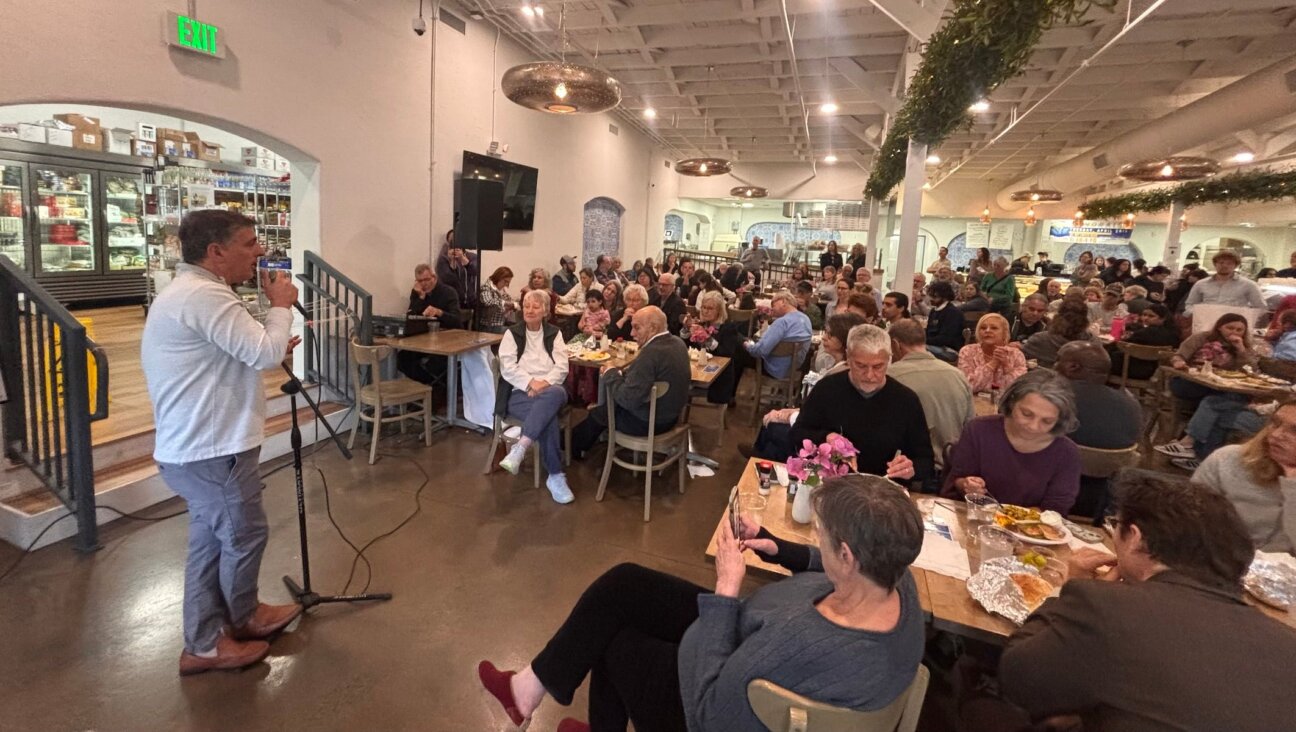
Miller’s involvement with Ikar began when the congregation was meeting in a JCC gym. Enchanted, he asked the rabbi to coffee. That was Rabbi Sharon Brous, then a mostly unknown Jewish Theological Seminary graduate, who invited him to that night’s board meeting. He served as Ikar’s president for a term in the mid-2000s.
In that time, he helped transform the congregation from an experiment in non-movement Judaism into a dynamic religious community that today has 1,200 member families — a directory that includes Steven Spielberg and former LA Mayor Eric Garcetti — and a multimillion-dollar budget.
When Miller stepped down from the board in February after entering the mayor’s race, Brous — now one of the most sought-out rabbinic voices in America — gave him a blessing in front of the congregation. (Brous did not respond to an inquiry.)
Miller, who said he’s reached out to Garcetti for advice about the office, was eager to connect his experience at Ikar to his qualifications to lead City Hall. Both institutions, Miller said, were full of good people with great ambitions, adding that his unique advantage is practical organizational leadership experience — budgeting, development and operations.
“You have to have the right mission, but you also have to have the ability to execute,” he said. “Ikar is a good example. We had great ideas early on. We had a lot of excitement and hope and compassion, but I put in operational structure to make it a reality.”
Two longtime congregants who asked not to be named for publication agreed, crediting Miller for professionalizing the organization when it was still a fledgling startup.
“That understanding and capability,” Miller said, “is what I’ve been able to do over and over again across a number of different organizations, and what I will bring to City Hall. And none of the other candidates have that.”
Campaigning in counterpoint
Miller is likely right that most Angelenos don’t regard antisemitism as a top issue. But the last four years have offered Jewish residents of the city plenty of opportunities to rate the incumbent.
Bass’ term has seen an antisemitic shooting in Pico-Robertson, the city’s largest Jewish neighborhood; a pro-Palestinian encampment at UCLA that drew national attention; and dueling protests outside an Israeli real estate seminar at Adas Torah, an Orthodox synagogue, that devolved into a brawl. More recently, pro-Palestinian protesters entered Wilshire Boulevard Temple to protest an Israeli defense contractor speaking there.
Miller said the mayor’s response in each case reflected the same pattern. “I think the city just generally shows no urgency to any problems,” he said. “We see that with the fires and the slow recovery, we see that with the encampments, we see it with trash and public safety, but we also see it clearly with antisemitism — just not a sufficient response. Period.”
Local Jewish leaders have lobbied for buffer zones outside of synagogue entrances where protesting would be prohibited, a measure Miller sees as a no-brainer. In New York, Mayor Zohran Mamdani has vetoed a bill that would have mandated a police perimeter outside of schools, citing First Amendment protections. (Mamdani meanwhile signed a bill that created such a space around houses of worship, which passed with a veto-proof majority.)
Like many American Jews, Miller was alarmed by Mamdani’s rise, as he was by the rising influence of DSA on local politics, saying the movement, whose platform includes a boycott of Israel, “has been overall antisemitic.” But he hoped Los Angeles, under a Miller mayoralty, would be a counterweight to Mamdani’s militantly anti-Israel stance.
“It’s an enormous opportunity to do that,” he said. “And conversely, if both coasts are run by DSA mayors, I think we put the Jews at real risk.”
It’s our birthday and we’re still celebrating!
We hope you appreciated this article. Before you go, we’d like to ask you to please support the Forward’s independent Jewish news.
This week we celebrate 129 years of the Forward. We’re proud of our origins as a Yiddish print publication serving Jewish immigrants. And we’re just as proud of what we’ve become today: A trusted source of Jewish news and opinion, available digitally to anyone in the world without paywalls or subscriptions.
We’ve helped five generations of American Jews make sense of the news and the world around them — and we aren’t slowing down any time soon.
As a nonprofit newsroom, reader donations make it possible for us to do this work. Support independent, agenda-free Jewish journalism and our board will match your gift in honor of our birthday!
Support our mission to tell the Jewish story fully and fairly.