How Israel became a country where teenagers murder each other in cold blood
A pair of shocking murders in Israel are symbols of a society in danger
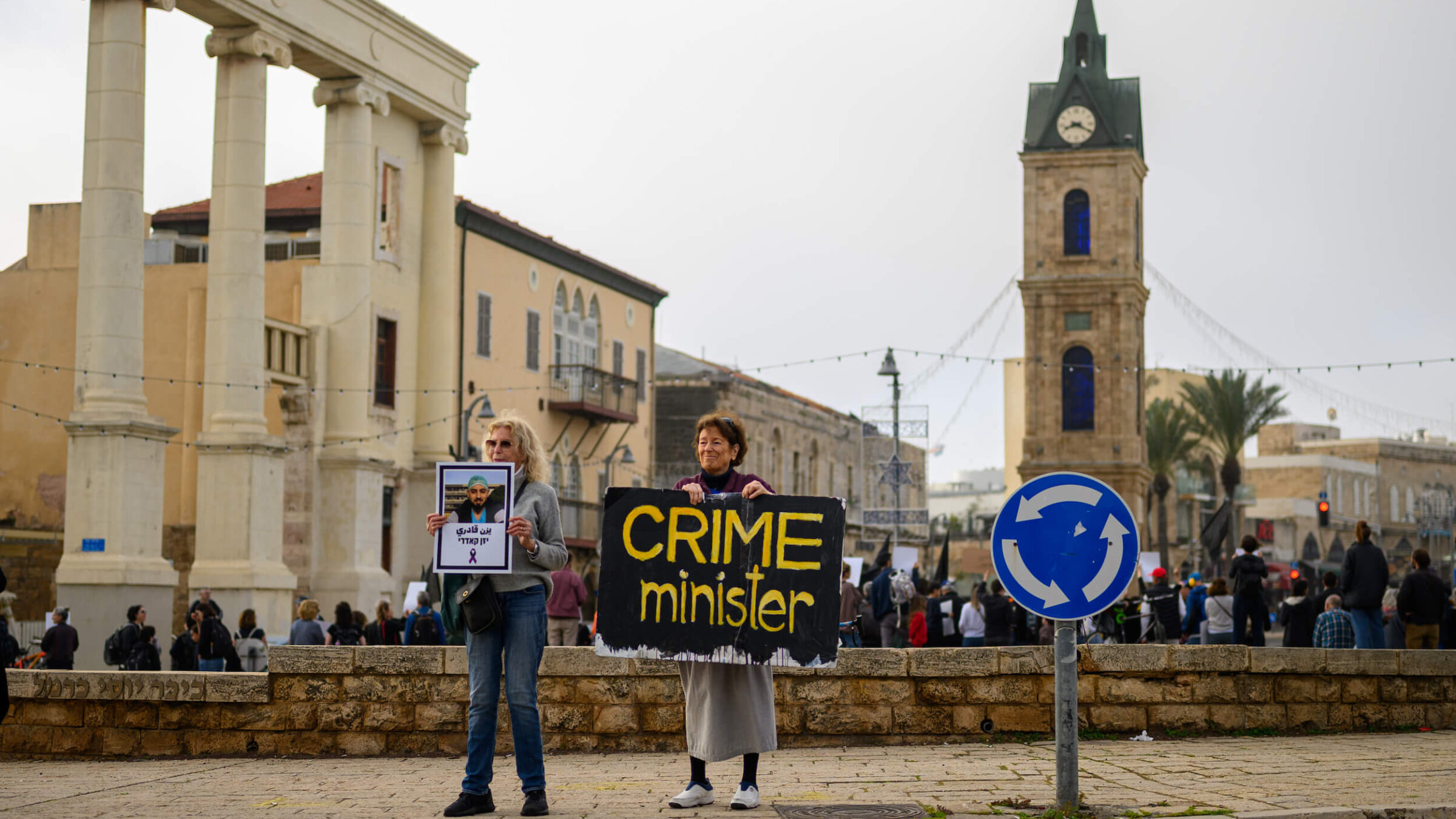
A woman holds a sign reading “crime minister” at a protest against the government’s handling of violence against Israeli Arabs on Feb. 10 in the Jaffa area of Tel Aviv, Israel. Photo by Alexi Rosenfeld/Getty Images

Columnist Dan Perry April 27, 2026
On the evening of Israel’s Independence Day, while much of the country celebrated in the streets, Yimanu Binyamin Zelka, an Ethiopian-Israeli 21-year-old from Petah Tikva, worked a routine shift at Pizza Hut. Or it was routine, until a group of teenage boys entered the restaurant and began harassing customers by spraying party foam inside the store.
Zelka asked them to stop, and then to leave. When his shift ended, that same group of teenagers was waiting for him outside. Security footage from the scene shows that two of them appeared to be holding knives. The group surrounded Zelka, kicking and beating him repeatedly for almost two minutes. He tried to defend himself, alone against a pack intoxicated by violence, adrenaline and, perhaps, the belief that they would face no consequences.
They left Zelka — a quiet young man who had worked from a young age to help support his family, whom friends described as gentle, upbeat and deeply loved — on the pavement, critically wounded. When he was found, he was rushed to a nearby hospital where doctors fought for his life for two days. He died of his wounds.
At least seven suspects, some as young as 12 and 15, have been arrested. Now Israel faces two alarming questions: what should be done about these violent, unhinged, immoral boys — and what kind of country is producing them?
Sure, crimes happen everywhere, and even functional societies suffer horrific murders. But some moments become symbols, and clearly relate to bigger patterns. Two murders — that of of Zelka and that of Destao Tzakul, killed the same week — are such moments, especially as they occurred around Israel’s downcast 78th Independence Day.
Tzakul, a 19-year-old from Beersheba — who was, like Zelka, of Ethiopian Jewish heritage — was stabbed to death on Friday night. So far, three minors have been arrested in connection with his death. According to his family, he received a call from friends asking him to come downstairs from his apartment building. When he did, masked attackers were waiting for an assault seemingly planned in advance.
He was a young man at the beginning of his life. He had completed a pre-military academy program, helped support his family and dreamed of serving in the IDF. His uncle, Adnan Tzakul, said what should be obvious: “We must educate children to stop violence. It solves nothing. It destroys families. You must not take away a person’s entire life.”
These two cases are not identical. But their symbolic impact is aligned. Young men in Israel are being killed by other young men, and sometimes even children, in what seems to be a developing culture of contempt for life and glorification of violence — adding a fresh layer of pain to a deepening sense that Israel is no longer functioning as a coherent state.
Institutions are weakening. Governance is collapsing. Violence is becoming normalized. Human life feels like it has come to be worth less.
This has been most apparent in the government’s failure to adequately respond to an upsurge of violence in Israeli Arab communities, in which the number of murders has surged dramatically in recent years. Last year, more than 250 Israeli Arabs were murdered, most by organized crime — more than doubling the figures from before Prime Minister Benjamin Netanyahu’s latest stint in office. Many Arab citizens feel abandoned. The government clearly despises them — Netanyahu has made veiled threats to try to ban Arab political parties — and appears to have simply decided they are someone else’s problem.
When organized crime flourishes, policing is insufficient, and political urgency over the crisis is absent, the message spreads. When violence becomes something that appears to carry no real price, it proliferates: in Arab Israeli towns, on West Bank hilltops where extremist violence is regularly treated with disturbing leniency, and, eventually, on the sidewalks of Petah Tikva and Beersheba.
“This is part of our disintegration as a society,” said lawmaker Na’ama Lazimi, of the opposition Democrats party.
Not every killing in a country is an indictment of its leader. And it would be simplistic to claim that Netanyahu is personally responsible for every act of street violence. But under Netanyahu, nearly every major state institution has gone through visible erosion, as the prime minister has prioritized political loyalty over professional competence, personal survival over public responsibility, and coalition management over national interest.
Itamar Ben-Gvir, the minister responsible for public security, has turned the police into a political battleground and eroded its reputation as a professional institution. Similar concerns now surround his attempts to exert political pressure over Israel’s most sensitive security bodies, including the Shin Bet and the Mossad.
Decades ago, the Israeli philosopher Yeshayahu Leibowitz warned that if Israel held on to the Palestinian-populated territories it occupied in 1967, the violence needed to keep the population there from rebelling would eventually seep into Israel itself, and undermine its morality internally as well.
“The corruption characteristic of every colonial regime would also prevail in the state of Israel,” he wrote.
The murders of Zela and Tzakul are the latest evidence that Leibowitz was prophetic. A society saturated with the language of force, revenge, humiliation and impunity risks losing its bearing. The images of the teenage mob attacking Zelka, an innocent young man beloved for his infectious smile, will forever be attached to Netanyahu’s degradation of the Israeli state. It may be a little unfair, but he has earned it.
I’m personally matching all gifts to the Forward, up to $36,000. Can I match your gift now?

Hello, fellow Forward reader! I’m Joel Brown, a Forward reader and supporter for more than 15 years, and currently the chair of the board of directors.
I’m an avid Forward reader because it ticks so many of my essential boxes: excellent journalism, Jewish focus and diverse viewpoints. In today’s political climate, what I most appreciate is the Forward’s independence — made possible by the generosity of its membership.
The Forward is committed to bringing you unbiased, nuanced Jewish news. From my position as board chair, I see an exciting future as we expand our position as the definitive independent voice of contemporary American Judaism.
— Joel Brown, Forward board chair
Support our mission to tell the Jewish story fully and fairly.