The de facto annexation of the West Bank is a recipe for utter disaster
The alarming rise in attacks by Jewish extremists is part of a self-destructive state policy
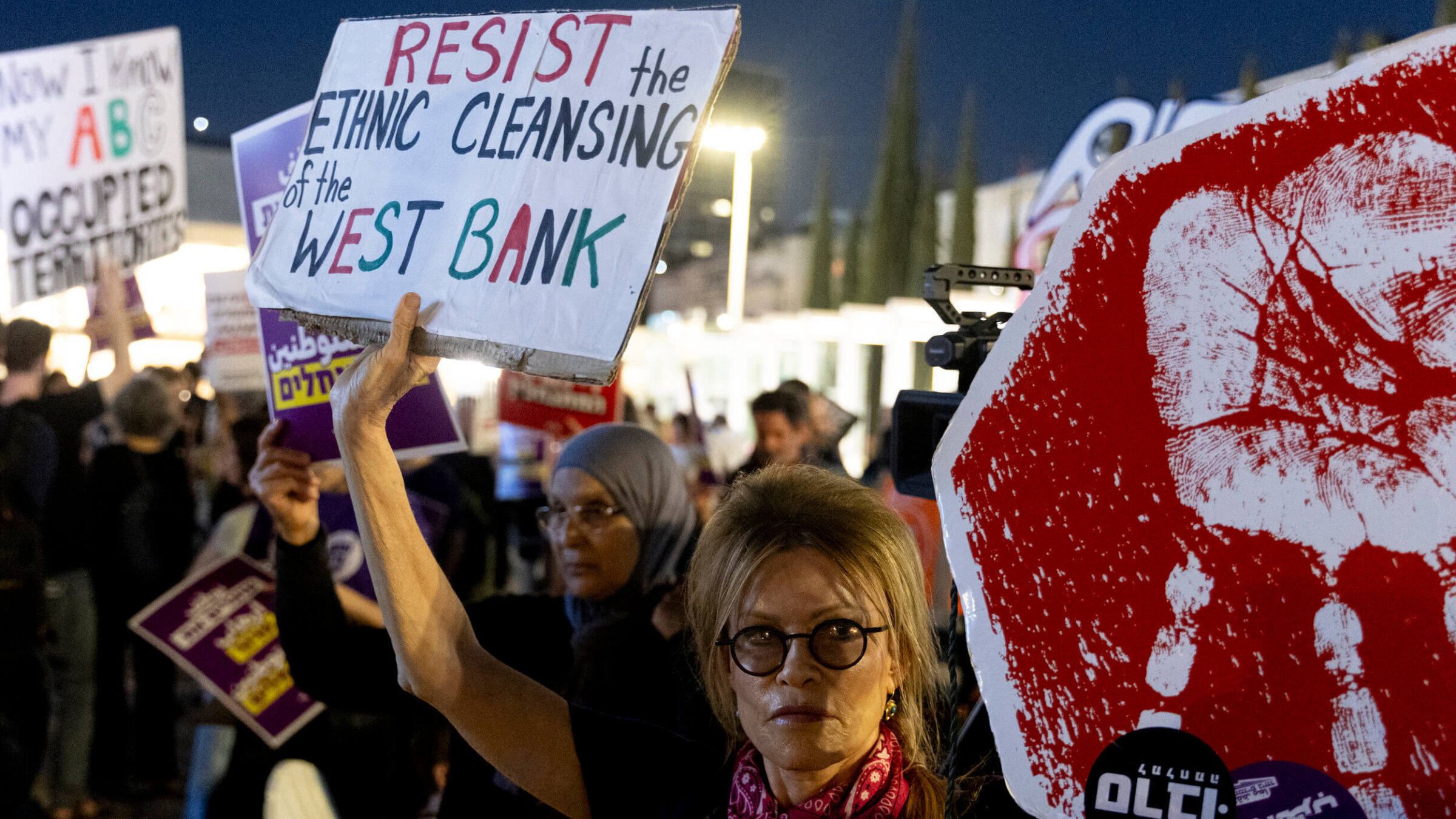
Protesters hold signs during a Tel Aviv rally against settler violence in the West Bank on April 16. Photo by Amir Levy/Getty Images
The disturbing wave of near-daily attacks by Jewish extremists against Palestinians in the West Bank is advancing a quiet but steady effort by the Israeli government to annex the West Bank.
While opposition from President Donald Trump has led Prime Minister Benjamin Netanyahu to step away from threats to formally annex the territory, his government is now taking gradual steps to accomplish the same goal. Turning a blind eye to settler violence — as violent incidents have escalated, the Israeli government has not prosecuted any Israeli perpetrators since 2020 — is perhaps the most visible warning sign, but far from the only one.
In a classified meeting in late March, Israel’s security cabinet approved 34 new settlements — including illegal outposts that were retroactively legalized — in what constituted the largest number of settlements ever approved at one time by any Israeli government.
In February, the government issued new land registration orders in the West Bank for the first time since 1967, enabling vast swaths of land to be declared state property. At the same time, Israel expanded its jurisdiction over parts of the West Bank that have been under Palestinian control since the Oslo agreements.
And in late 2025, Israel approved plans to establish the highly controversial E1 settlement project, which would divide the West Bank into a northern and southern region, effectively rendering the contiguity of any future Palestinian state obsolete.
So, when Netanyahu claims to view the crisis of settler violence “with great severity” and vows to crack down on that violence to “the fullest extent of the law” — as he did in November 2025 — his words ring hollow. Since the start of the year, Jewish extremists in the West Bank have committed more than 200 violent attacks against Palestinians, with six killed in March alone. Yet despite the widening cracks this issue is causing between Israel and its allies, Israel’s leader has not addressed it since December, when he downplayed the problem as being caused by “a handful of kids,” and said the attacks are overblown by the media.
It’s not just a handful of kids. And if a nation as tiny and embattled as Israel can effectively take on Iran and its proxies across the Middle East, it should be able to tackle a problem of its own making that is threatening not only the lives of innocent Palestinians in the West Bank, but also the relationship between Israel and the United States, and the future of the Jewish state itself.
A death knell for the two-state solution
It is not only critics and international observers who have described Israel’s increasing control over the West Bank as amounting to de facto annexation, and noted that it threatens any remaining prospect for a two state solution. Proponents of these policies have characterized their efforts in much the same way.
The architect of the government’s annexation efforts, Finance Minister Bezalel Smotrich, described recent moves as “bringing down the curtain” on the two-state solution, and “killing the idea of a Palestinian state.” Defense Minister Israel Katz, a member of Netanyahu’s Likud party, said “we will continue to kill the idea of a Palestinian state” as he announced the government’s moves in February alongside Smotrich. Katz earlier praised Israel’s “practical sovereignty” over the West Bank.
Eli Cohen, another Likud minister, heralded recent measures for ushering in “de facto” Israeli sovereignty over “Judea and Samaria,” the biblical name for the West Bank that is often used in Israel. (That name was used internationally prior to the region’s renaming under the Jordanian occupation that began in 1948.)
Smotrich, who was given oversight of a newly created settlements administration within the defense ministry as part of his coalition agreement with Netanyahu in early 2023, has overseen record levels of settlement construction and expansion. He has also argued that Israel should encourage Palestinian migration from the West Bank, a policy that would amount to ethnic cleansing.
Out-of-control attacks
The IDF Chief of Staff recently called the dramatic escalation of attacks by settlers on Palestinians in the West Bank “morally and ethically unacceptable,” saying they are causing “extraordinary strategic damage to the IDF’s efforts.”
For the first time in its history, the IDF was recently forced to divert troops away from an active war zone — in this case, fighting Hezbollah in Lebanon — in order to confront violent settlers in the West Bank. That development was, alarmingly, reminiscent of those that preceded the Hamas attack of Oct. 7, 2023, when IDF battalions were disastrously moved away from the Gaza border to the West Bank for the very same reason.
Smotrich and others have often framed attacks by settlers as acts of self-defense. But this year has seen more violence perpetrated by Jews in the West Bank than by Palestinians. And while Palestinian violence against Jews is treated as terrorism, attacks by Jewish extremists are no longer being handled with the seriousness they once were. According to Israeli rights group Yesh Din, between 2020 and 2025, more than 96% of police investigations into settler violence in the West Bank ended without indictments. Only 2% concluded with full or partial convictions.
That’s likely in part because the Israeli police force, which is tasked with combating the rise in attacks by Jewish extremists, has since 2022 been overseen by National Security Minister Itamar Ben-Gvir, a man who spent most of his career as an attorney defending violent Jewish extremists.
Ben-Gvir has worked to ensure that various tools law enforcement agencies once used to deal with Jewish terrorism are no longer available. The use of administrative detention was suspended for Jewish suspects; the Shin Bet’s Jewish extremism department has been sidelined; and Ben-Gvir has effectively outlawed the government from using the term “terrorist” to apply to Jews.
More bad signs: David Zini, the man Netanyahu tapped to replace the previous head of the Shin Bet — whom he fired — is from the same far-right movement as Ben-Gvir and Smotrich.
A policy of de facto control
The fact that the government is effectively allowing these attacks to continue on a near-daily basis with virtually no accountability points to a clear and unsettling conclusion: permanent Israeli control of the West Bank, home to 3.8 million Palestinians and half a million Israelis, is part of the government’s agenda.
Proponents of annexation often describe it as a necessary response to terrorism that will keep Israel safer. Annexation, they insist, would send a strong message to those who seek to destroy the Jewish state.
But in reality, annexation is itself a threat to the Jewish state.
The founders of the state of Israel were very clear: it would not only be a democracy, but the world’s only country with a Jewish majority. Annexing the West Bank would effectively mean that Israel is no longer a majority Jewish state. And if Palestinian residents were not given the full rights of citizenship — unlikely, under the most far-right government in Israeli history — it would mean that Israel was no longer a democracy.
The idea that annexation would somehow stop terrorism or keep Israelis safer is delusional. Not only would it increase tensions and violence, but it would also empower Israel’s harshest critics, weaken its crucial international alliances, further erode its dwindling support among Americans and bitterly divide the Jewish diaspora. Polls have consistently shown that a majority of Americans — and American Jews — support a two-state solution to the conflict and oppose annexation efforts.
Israel itself is not currently an apartheid state. All citizens of Israel — whether they are Arab, Jewish, Muslim, Christian, black or white — have equal rights. Yet the West Bank already complicates that picture. Palestinian residents of the West Bank live under the Palestinian Authority, and are not Israeli citizens. Jewish residents of the West Bank are Israeli citizens. While Palestinians in the West Bank are subject to military law under the Israeli justice system, Jewish residents operate under civilian law.
If Israel annexed the West Bank, there could be no more debate: Israel would become an apartheid state.
It is true that Judea and Samaria is the heartland of ancient Israel, home to more biblical Jewish sites than anywhere else. It is also true that Israel captured the territory in a war of self-defense from Jordan, which occupied the territory after seizing it in the war of 1948. And it is true that Palestinian leaders have rejected numerous offers of statehood over the past century, all of which would have granted near-total Palestinian control of the West Bank.
Those facts do not grant Israel the cause or right to apply sovereignty to an area inhabited by millions of people who do not wish to be under its control.
The rise in extremist violence, the impunity that has met these attacks, and open calls for “sovereignty” are not separate developments. They are part of the same dangerous trajectory — one that is leading to an undemocratic state that is becoming unrecognizable to many who love it dearly.

Did you know that only 2% of Forward readers donate to support our nonprofit newsroom? That 2% make it possible for millions to read the Forward without a paywall or subscription — removing any barriers to the full and fair Jewish story.
But while the Forward is free to read, it isn’t free to produce. Big stories — like deep dives into the antisemitism data, political scoops or reporting trips to college campuses — take months of research and fact-checking. All while we keep you informed of what you need to know each day.
— Rachel Fishman Feddersen, Forward Publisher & CEO
Support our mission to tell the Jewish story fully and fairly.