Molly Crabapple’s book is well researched but ideologically biased
In keeping with her anti-Zionist outlook, she makes no mention of the Bund’s vibrant afterlife in Israel
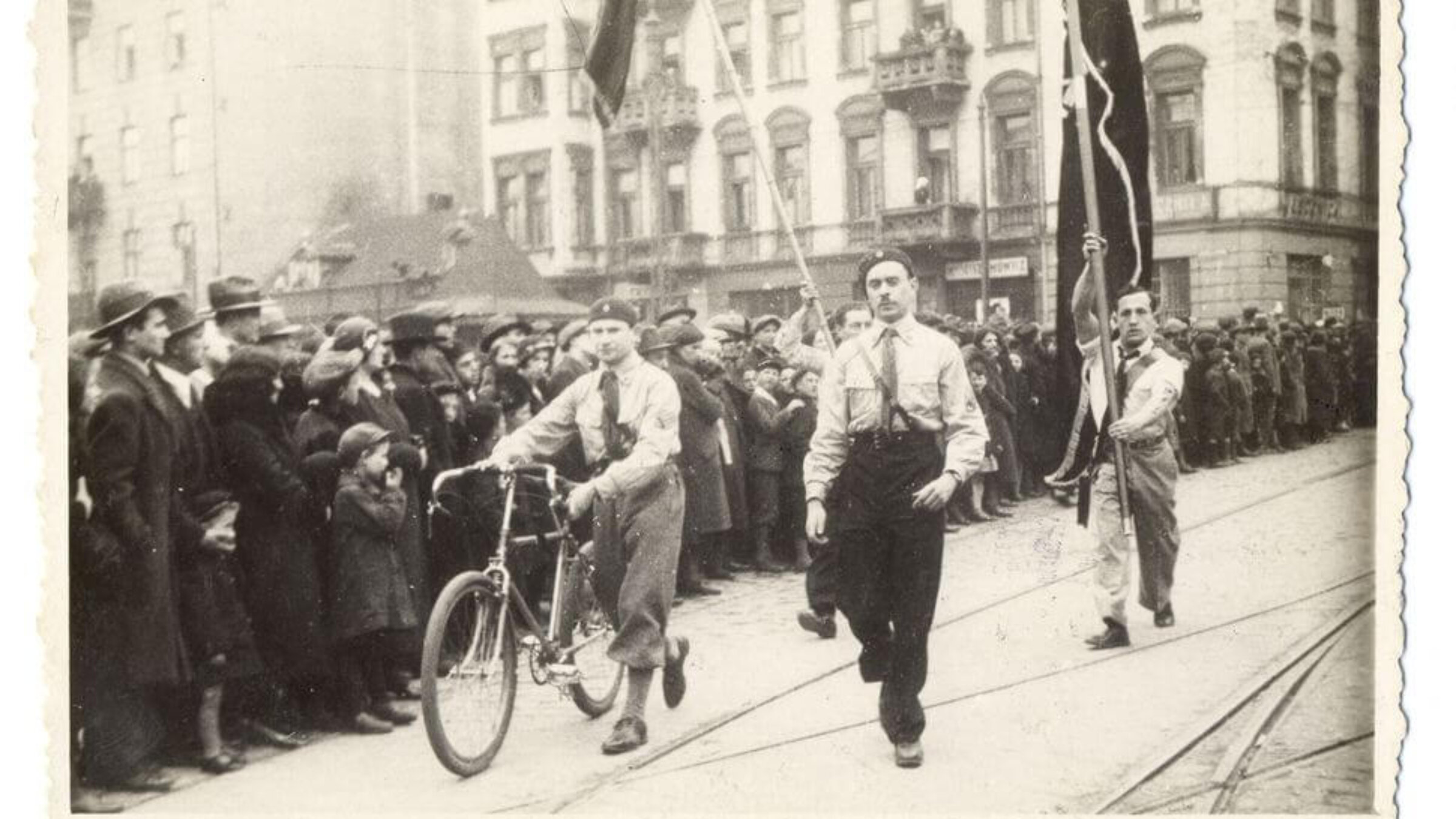
A May Day 1936 Bund demonstration. Courtesy of the Archives of the YIVO Institute for Jewish Research

By Mikhail Krutikov May 17, 2026
Molly Crabapple’s Here Where We Live Is Our Country is a captivating read. Drawing on the biographies of both major and lesser-known activists, Crabapple tells the history of almost 130 years of the Jewish Labor Bund. Her crackling, imaginative prose brings dry, documentary materials to life, and makes long-ago personalities feel contemporary.
Crabapple chooses Sam Rothbord , her great-grandfather, as a guide to the vanished world of Jewish Eastern Europe. Though Crabapple was born many years after his death, her family saved his photos and papers. Crabapple turns to these items to reconstruct a detailed picture of his life.
Born in the town of Volkovysk (now in Belarus), Sam joined the Bund as a young man. He soon immigrated to America, where he became an artist. His first exhibit was held at the former headquarters of the Forward on East Broadway.
Many well-known Bundists make an appearance in the book: Vladimir Medem, Arkady Kremer, Raphael Abramovitch, Mark Lieber, Sophie Dubnova-Erlich, Henryk Erlich, Viktor Alter and others.
Crabapple takes her readers through the cataclysmic events in which the Bund took part: the Russian revolutions of 1905 and 1917, World War I, the establishment of the Polish republic and, finally, the Holocaust. Despite her great reverence for the Bundists’ heroism and sacrifice, Crabapple acknowledges that these heroic figures could also have difficult personalities. She often compares her own experiences as an activist on the left with the struggle of radicals around the world today.
The Bundists left behind a rich legacy of memoirs and documents. Crabapple synthesizes these sources into a lively narrative full of color and emotion.
Crabapple makes liberal use of graphic cliches, and she doesn’t hold back when it comes to representing the “bad guys.” Describing the 1905 pogrom in Odessa, she writes: “Blood-smeared Russian mothers loaded their pushcarts with the spoils from looted Jewish houses, then had their kids torch their homes behind them as they left.”
Crabapple is well-versed in Marxist theory, having learned it from her father who, she writes, is a professor of political economy. She clearly explains the ideological differences between the Bund and other leftist parties. Unfortunately, her relationship to historical facts is occasionally a bit loose.
Czar Nicholas I, for example, did not limit the number of Jewish students in Russian universities; at the time there were nearly no Russian Jews who would have liked to study there. The so-called “percent norm” (quota) was first introduced by his grandson, Alexander III in 1887, over 30 years after Nicholas’ passing in 1855.
Crabapple also writes that “Tsar Nicholas I wrote his policies with the declared aim of forcing a third of Jews to die, a third to emigrate, and a third to convert to Christianity.” But Nicholas I never declared this; in fact, he strictly prohibited emigration from Russia. Many popular books on Russian Jewish history attribute this statement to Alexander III’s official, Konstantin Pobedonostsev, although no documentary source exists for this.
On the whole, Crabapple paints a historical landscape of the time in black and white. The good guys are the Bundists. The bad ones are various governments, the Bolsheviks and, of course, the Zionists. At fault for all the world’s ills is the West, with its capitalist, imperialist regimes.
The book is prominently anti-Zionist in its politics. This ideological direction must have been a motivating factor for Crabapple as she undertook this project — and she’s successfully conveyed it to her readers, reviving the old fighting spirit of Bundist polemics.
For all this, Crabapple isn’t blind to the political weakness of the Bund. “The Bund had accomplished many things in the areas of mutual aid, cultural production, and armed self-defense. But there was one thing that the Bund had neglected: the necessity of taking power.” A question lingers, however: did the Bund ever have that option, besides a handful of times in 1905, in Russian or Polish cities?
Here Where We Live Is Our Country offers a major intellectual resource for today’s generation of radical activists protesting Zionism and the State of Israel. There’s ample historical and theoretical ammo here for their arguments.
Historically, it was Zionism that won out over the Bund, and the State of Israel is an undeniable fact. Indeed, Israel became a new home for many Bundists who survived the Holocaust. For Crabapple, however, that was their bad luck: “The lucky ones got visas for refugee communities in Melbourne and Johannesburg, Paris and Montevideo. Others were not so lucky. In the years after the Holocaust, hundreds of Bundist survivors left for Palestine.” Their party, she adds, meaning the Bund, “had given them fairy tales. Zionists offered a place where they could rebuild their lives.”
There’s a sense of mixed feelings here: Disdain for the Zionists, coupled with the acknowledgement that the Bundist project had come to nothing while Zionism did a better job for the Jews. In keeping with her anti-Zionist attitude, she makes no mention of the Bund’s vibrant afterlife in Israel, which included figures such as Yitshak Luden and Mordechai Tsanin, and the Israeli magazine Lebns-Fragen, which was highly critical of the Israeli government.
But perhaps the book’s greatest weakness is its deeply caricatured portrayal of Zionism. Not a single word is said about the major role of the Zionist program in Europe and America to support Jewish life in the diaspora. Compared to the Bundists, the Zionist activists were often less dogmatic in their perspective on Jewish culture.
Crabapple clearly demonstrates the ideological divide between the Bund and Zionism. However, she doesn’t seem to acknowledge what these two movements shared: a commitment to the future of the Jewish people. Both emerged from the political environment of late 19th-century Eastern and Central Europe, where various ethnic communities were seeking to reinvent themselves as nations.
The Bund and the Zionists offered two different responses to this challenge. One centered on diasporic nationhood, the other on the creation of a nation state. For both, however, Jewish peoplehood remained the primary concern.
Crabapple concludes her book on the Bund by thanking “the people of Palestine.” It’s a provocative and predictable call in today’s radicalized climate. What remains unclear, however, is who exactly these people are: do they include Israeli Jews? A Bundist answer, I suspect, would be “yes.”
I’m personally matching all gifts to the Forward, up to $36,000. Can I match your gift now?

Hello, fellow Forward reader! I’m Joel Brown, a Forward reader and supporter for more than 15 years, and currently the chair of the board of directors.
I’m an avid Forward reader because it ticks so many of my essential boxes: excellent journalism, Jewish focus and diverse viewpoints. In today’s political climate, what I most appreciate is the Forward’s independence — made possible by the generosity of its membership.
The Forward is committed to bringing you unbiased, nuanced Jewish news. From my position as board chair, I see an exciting future as we expand our position as the definitive independent voice of contemporary American Judaism.
— Joel Brown, Forward board chair
Support our mission to tell the Jewish story fully and fairly.