Mamdani’s first statement on antisemitism as mayor-elect got some weird pushback
After someone spraypainted a swastika on a yeshiva, conspiracy theories abounded
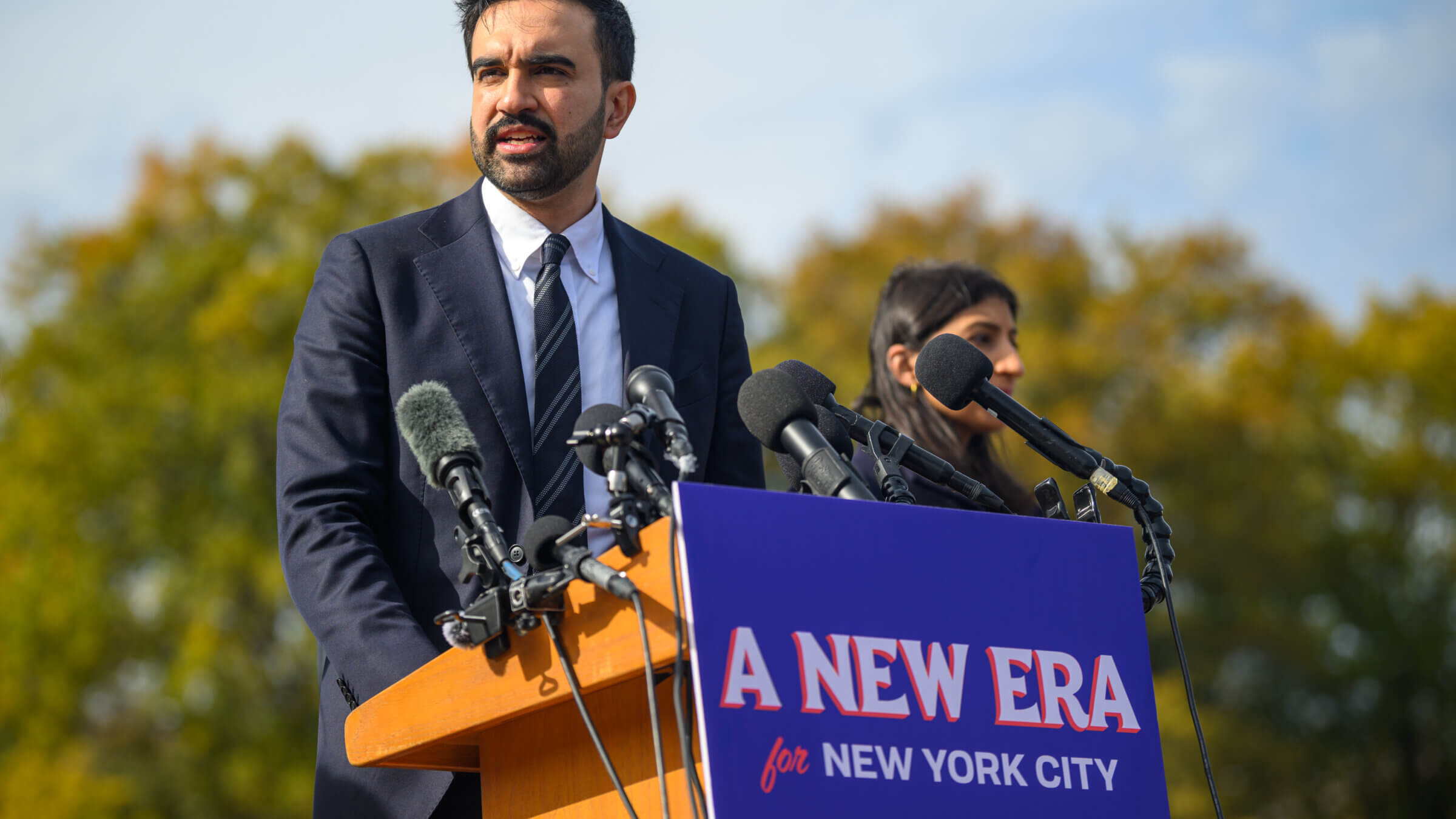
Mayor-elect Zohran Mamdani after his win in the election; one of his first statements after the election was condemning antisemitism after a swastika was painted on a yeshiva. Photo by Alexi J. Rosenfeld/Getty Images

By Mira Fox November 7, 2025
The morning after Zohran Mamdani won New York’s mayoral election, someone spraypainted swastikas on a Syrian Jewish yeshiva’s windows and walls.
“This is a disgusting and heartbreaking act of antisemitism, and it has no place in our beautiful city,” Mamdani wrote on X that morning. “As Mayor, I will always stand steadfast with our Jewish neighbors to root the scourge of antisemitism out of our city.”
It seemed like a perfect moment for Mamdani, whose campaign was dogged by assertions that he would be soft on antisemitism, to reassure the city’s Jewish population that he will have their back — perhaps too perfect.
But immediately after Mamdani made that statement, conspiracy theories began to swirl around the graffiti alleging that it was a “false flag” — an incident that is not, in fact, carried out by the apparently responsible party. In this case, the conspiracy theory implied that the swastikas were painted by pro-Israel supporters trying to prove that Mamdani will encourage violence against Jews.
“Don’t fall for it until you find out who did it. They’re famous for these false flags,” argued one viral reply. “Anything to keep the victim spotlight on them to keep Israel’s stranglehold on the West.”
Others criticized Mamdani’s statement — for overemphasizing the gravity of the incident, and being too friendly to Jews. Some posted that Mamdani had already betrayed his voters. Others urged him to focus instead on Islamophobia.
“There’s no ‘scourge of antisemitism’ in NYC. Acts like these, while reprehensible, are often weaponized to justify Zionist narratives and repression of Palestine solidarity,” wrote Nerdeen Kiswani, the founder of pro-Palestinian activist group Within Our Lifetime. “Mamdani shouldn’t be validating this framing.”
Many people also lauded Mamdani’s statement as reassuring and necessary. But the immediate uproar over what seemed to be a very basic condemnation of Nazi imagery — a condemnation that did not name or blame any particular group for the act, whether pro-Palestinian activists, neo-Nazis or false flag attackers — encapsulates the tricky position the new mayor-elect occupies, particularly when addressing antisemitism.
Part of Mamdani’s new constituency is desperately nervous that he won’t hear them or protect them; the other part is worried he will overcompensate by emphasizing Jewish concerns over their own. And judging by the conspiratorial tenor to the response, some feel emboldened to lean into their own antisemitism, even when he is speaking out against it.
But Mamdani’s statement did not rank antisemitism above — or below — other priorities. The controversy around his words calls to mind a famous post from the old days of Twitter, which is still regularly passed around in meme form. It calls the site “the only place where well-articulated sentences get misinterpreted. You can say ‘I like pancakes’ and someone will say ‘So you hate waffles?’”
It’s our birthday and we’re still celebrating!
We hope you appreciated this article. Before you go, we’d like to ask you to please support the Forward’s independent Jewish news.
This week we celebrate 129 years of the Forward. We’re proud of our origins as a Yiddish print publication serving Jewish immigrants. And we’re just as proud of what we’ve become today: A trusted source of Jewish news and opinion, available digitally to anyone in the world without paywalls or subscriptions.
We’ve helped five generations of American Jews make sense of the news and the world around them — and we aren’t slowing down any time soon.
As a nonprofit newsroom, reader donations make it possible for us to do this work. Support independent, agenda-free Jewish journalism and our board will match your gift in honor of our birthday!
Support our mission to tell the Jewish story fully and fairly.