They escaped the Nazi genocide, but these ‘Wanderers’ still went through hell
In Daniela Gerson’s latest book, a tale of survival and subterfuge that echoes the stories of today’s immigrants
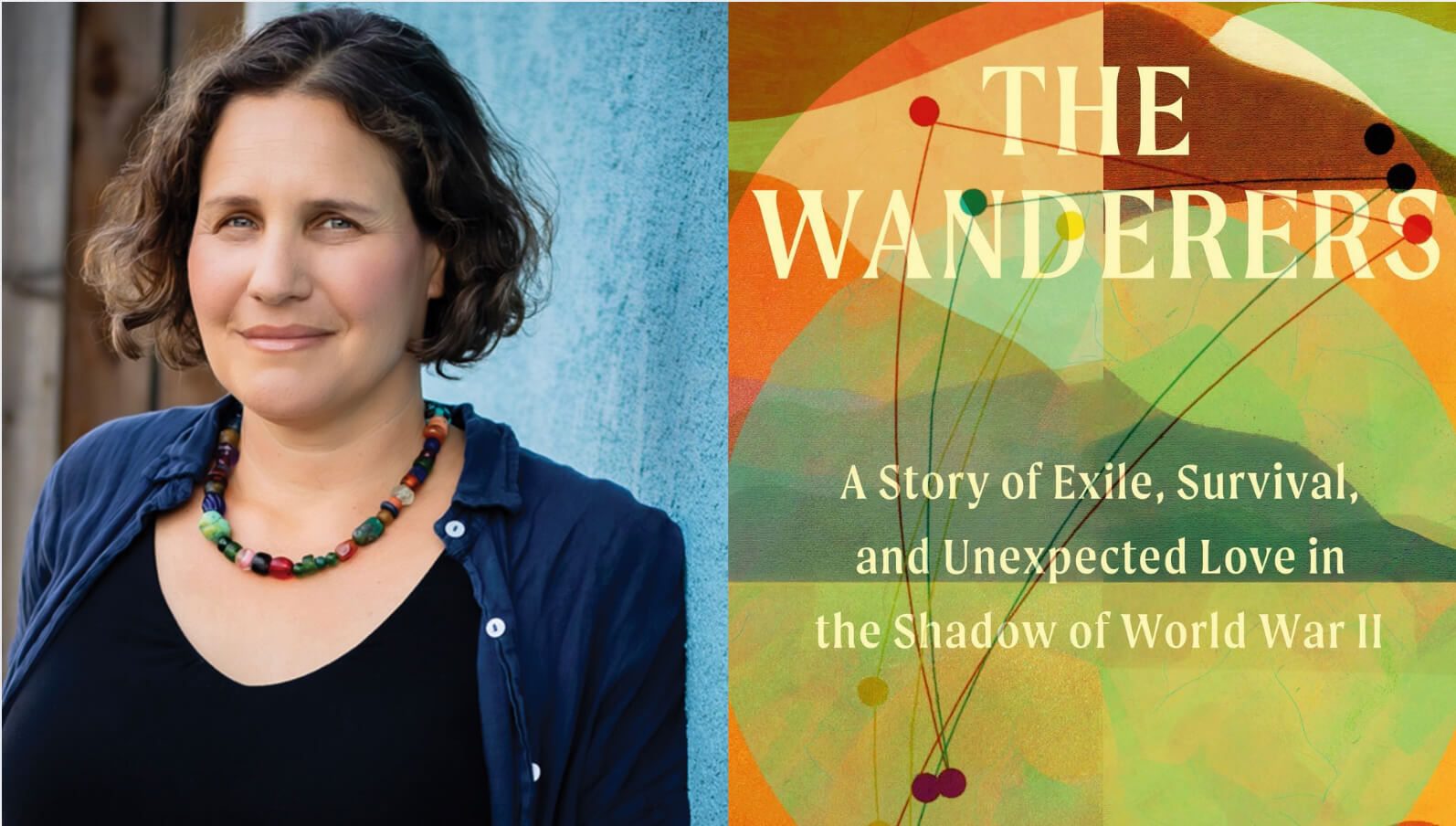
‘The Wanderers,’ by Daniela Gerson, explores a chapter of the Holocaust that is largely unknown in America, even to Jews: about Polish Jews who went not to Auschwitz or to attics, but instead to the Soviet Union. Photo by Kait Lavo/Hachette
The Wanderers
By Daniela Gerson
Grand Central, 336 pages, $30
Daniela Gerson is a journalist with years of experience reporting about immigration, in a time when immigrants are commonly derided as interlopers who will do anything to weasel into America, including by telling untruths. She is also the daughter of a father whose immigrant parents — Gerson’s paternal grandmother and grandfather — lied through their teeth to get here.
The long story leading to why they did this grounds Gerson’s fascinating memoir, which explores a chapter of the Holocaust that is largely unknown in America, even to Jews: about Polish Jews who went not to Auschwitz or to attics, but instead to the Soviet Union. The story defines her family and that of Talia Inlender, a Los Angeles immigration attorney whom Gerson met at a party several years ago. Chatting there, they realized that Inlender’s Jewish paternal grandfather was from the same Polish city as Gerson’s Jewish grandparents. The coincidence drew the two women together, and they ended up marrying, having kids, and digging further into their shared ancestral history. Their excavation has culminated in The Wanderers.
On the eve of World War II, about 3.3 million Jews lived in Poland — more than in any other country in Europe. By 1945, more than 90% of them were dead. About three quarters of the few who survived did so only because they’d spent the war in the Soviet Union. They escaped Nazi genocide but still lived through hell.
For years, Gerson knew this basic history. She knew that in 1939 Poland had been carved in two, west and east, by Germany and the Soviet Union when the two countries signed a non-aggression pact. In the immediate aftermath of the partition, hundreds of thousands of Poles felt more frightened of Hitler than Stalin, and they fled into Soviet territory. But their flight was chaotic. Many lived on the streets or in rooms with no heat, and with little to eat. In Lviv, now in Ukraine but then in the USSR, Gerson’s grandparents experienced their first devastation: Their eight-month-old son fell ill with pneumonia and died.
Inlender’s grandfather’s wife and young son, meanwhile, had opted to remain in Poland. Soon after making that decision, they were shot to death during a Nazi roundup of Jews.
As conditions on the Russian side worsened, almost everyone who’d fled Poland, including Jews, told the Soviets they wanted to go back to the German-run area. The Soviets responded by labeling such people untrustworthy, bourgeois, and traitorous. So, beginning in summer 1940, thousands of Poles, including eight Gersons and several Inlenders, were packed into boxcars and shipped thousands of miles east, to gulags and forced labor camps. There they were consigned to backbreaking work in mines and forests, fed very little, and crowded into vermin infested shacks with little heat in winter. Starving and exhausted, the prisoners were told by their overseers to get used to it, because they were never going home again. At least a quarter of them perished.
Then, after Germany invaded the Soviet Union in summer 1941, the enslaved Poles were freed from the gulags. Waves of them headed south to the USSR’s five Central Asian republics: Uzbekistan, Turkmenistan, Tajikistan, Kazakhstan and Kyrgyzstan. Many wanted to enter Iran and proceed to Palestine. The Gersons tried this but the borders were closed. They backtracked to Uzbekistan. Inlender’s grandfather landed in Kazakhstan.
Again there was hunger and homelessness. Typhoid fever and other deadly epidemics raged. Polish Christians and Jews alike — as well as citizens of the Soviet Union whose homelands were overrun by Nazis — wandered the streets. Everyone suffered.
Some lied to stay alive. Mikhal Dekel, who wrote a book about her Polish-Jewish father’s survival under similar circumstances, noted that, in Central Asia, child refugees, including Jewish children, roamed alone and starving. The parents of others turned them over to Christian orphanages. Historian Gennady Estraikh has written about Jewish children running away from adult relatives, knocking on the doors of those orphanages, and falsely claiming they had no family. Their lies saved their lives.
Gerson doesn’t discuss this specifically, but I imagine the two of us have some common experiences with lying. Like her, I am a longtime journalist focusing on immigration, mainly into the U.S. from Latin America. During the first Trump administration, I met parents who’d fled violence in their home countries, then walked or rode in boxcars to the southern U.S. border, only to be turned back by American immigration authorities and sent to languish in filthy, dangerous encampments on the Mexican side of the line. I saw teenagers in those camps steal away from their mothers and fathers and cross into Texas by claiming they were orphans — they did this because the U.S. was still accepting what immigration law calls “unaccompanied minors.” I saw parents weeping as they kissed their seven year olds goodbye and directed them over the international bridge, with instructions to falsely say they had no mother and father.
And I met adults with carefully planned confabulations. Once I talked with a man who was sifting through Google to study, he told me, how gay men act. He confessed that he wasn’t gay but was learning to walk, dress and behave as though he was, because the U.S. was letting people in who might be attacked in Mexico by homophobes. A woman told me she tried to buy urine from someone who was pregnant, because with a doctor’s certification of pregnancy, she might be let in, too.
What were these people really escaping from? Homicidal gangs? Murderous cartels? Hunger? Hopelessness? Whatever it was, they knew better than to tell truths that mean nothing in U.S. immigration law.
After World War II, most Polish Jewish survivors ended up in displaced persons camps in Europe. The Gersons wanted to get into one that was being run by the United States. But it did not allow new admissions, and the family had not left the Soviet Union until 1946. By then they had a baby boy, born in Uzbekistan. He would grow up to be Daniela’s father. The family wanted to go to America, but McCarthyist immigration restrictions defined Polish Jews, according to one Congress member, as “a gang of well-trained Communists” who would spread through America and plot to overthrow the government.
The Gersons finally made it into America via subterfuge. A couple who were named Blumstein, also with a baby boy, had received permission to enter the displaced persons camp but then abandoned the permission document. The Gersons got a hold of it and started masquerading as the Blumsteins. A few years later, when restrictions against Polish-Jewish immigration loosened, they sailed into New York Harbor under that surname. They spent the next decade in terror of being discovered. An expensive lawyer finally straightened everything out, and by the 1960s they were again the Gersons.
Daniela’s father, Allan Gerson, later became a Nazi-hunter prosecutor for the Department of Justice. His job was deporting Eastern Europeans who had assisted with Nazi atrocities. His method was ironic: He had merely to show that they lied when they applied to live in America — just as his parents had lied. Worried that low-level collaborators would be deported back to Communist countries, judged as criminals without due process, and put before firing squads, he quit the job.
According to his daughter’s memoir, Allan Gerson’s politics were neo-conservative. Nevertheless, he was outspokenly sympathetic toward today’s undocumented young people, the so-called “Dreamers” who came to the United States as children with their undocumented parents. “I was an illegal immigrant,” he wrote in 2017 in the Washington Post. He lamented that Dreamers “stand to be deprived of life as they know it, shipped off to some land they hardly recognize.”
He went to one of those lands in his later years. Did he connect with it spiritually? As a hobbyist art photographer before his death in 2019, he ranged up and down the U.S.-Mexico border, taking photo after photo after photo, almost obsessively, of border walls —those cruel, hard structures meant to exclude our new wandering generations. He shot the walls from the Mexico side, in extreme close up, rendering them almost abstract. But he often included their graffiti. It was giant and brilliantly colored. Likewise, those features in his daughter’s memoir illuminate a history that still shades our place and time.
I’m personally matching all gifts to the Forward, up to $36,000. Can I match your gift now?

Hello, fellow Forward reader! I’m Joel Brown, a Forward reader and supporter for more than 15 years, and currently the chair of the board of directors.
I’m an avid Forward reader because it ticks so many of my essential boxes: excellent journalism, Jewish focus and diverse viewpoints. In today’s political climate, what I most appreciate is the Forward’s independence — made possible by the generosity of its membership.
The Forward is committed to bringing you unbiased, nuanced Jewish news. From my position as board chair, I see an exciting future as we expand our position as the definitive independent voice of contemporary American Judaism.
— Joel Brown, Forward board chair
Support our mission to tell the Jewish story fully and fairly.