The Jewish secret to affordable eyewear that isn’t so secret anymore
Up a flight of stairs in a Brooklyn rowhouse, Minzer’s Optical serves the Orthodox and anyone else looking for a bargain
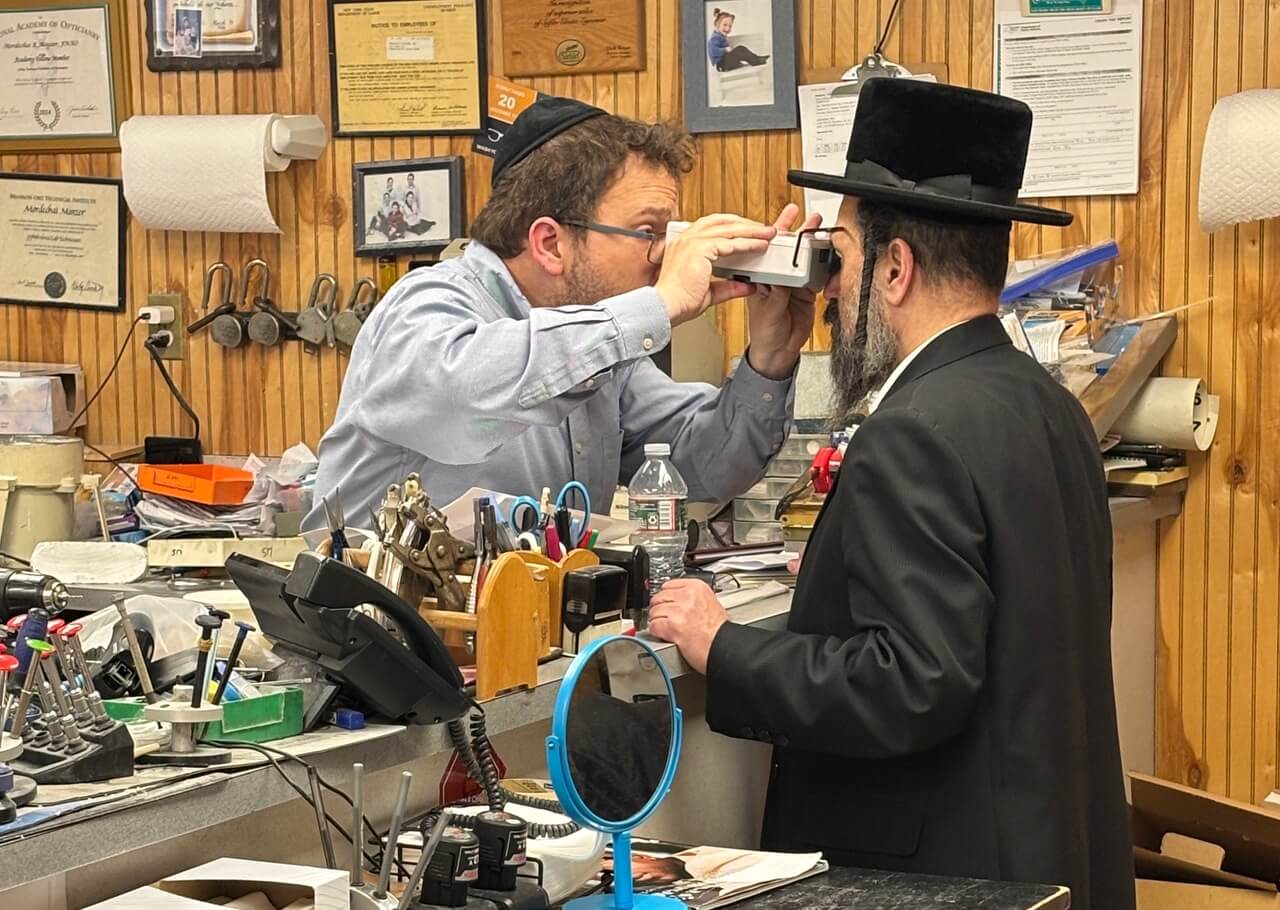
A Minzer employee uses a pupilometer to examine a customer. Photo by Jon Kalish

By Jon Kalish May 15, 2026
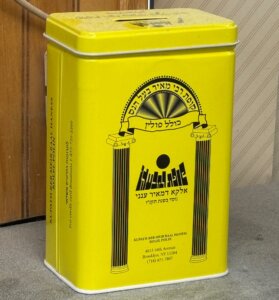
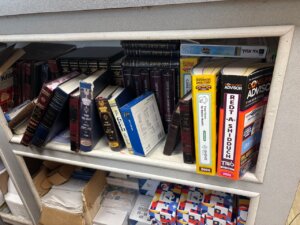
The business cards on the counter at Minzer’s Optical proclaim “45 years of 15-minute service.” If your wait drags on for longer than 15 minutes, you can pick up one of the prayer books that line a shelf beneath the counter. But there’s no need to pray that your eyeglasses won’t cost you an arm and a leg. Minzer’s is known for its low prices, so customers who are feeling charitable might slip a few shekels into one of the pushkes, the tin tzedakah boxes, on the counter.
Once known solely within Brooklyn’s ultra-Orthodox Jewish community, today a majority of Minzer’s customers are not Haredi Jews, let alone members of the tribe. According to Mordechai Minzer, who started the business when he was just 19, this is entirely the result of word of mouth. And Minzer’s has held on in an age where Internet competitors such as Zenni have come close to matching its prices but can’t offer its speedy, in-person customer service.
“There’s an old saying that if you want something fast, good, and cheap, pick any two out of the three. Minzer’s amazingly manages to do all three,” Cheryl Krauss, a Brooklyn jewelry maker who has been a customer for close to 20 years, told me.
Up a flight of stairs in a two-story building on a block of attached homes, customers peruse shelves and carousels displaying frames that run the length of the store, amid the drone of computerized edging machines that grind lenses. Customers stand across the counter from employees who peer through a pupilometer, a device which measures the distance from the center of one pupil to the center of the other, a critical measurement needed to make accurate lenses.
Mordechai Minzer, 64, was trained as an optician in Manhattan at the Bramson ORT Institute of Technology, which began in 1942 as a series of workshops for World War II refugees and is part of a global educational network driven by Jewish values. Early in his career, he worked at a Cohen’s Fashion Optical store in the Bay Ridge section of Brooklyn. Minzner said he stopped working for them because they wanted him to work on Shabbos. In 1981, a few years after the country western hit “Take This Job and Shove It” hit the airwaves, Minzer quit his job. It’s unlikely Minzer, the son of a Bobover Hasid, heard the song on the radio, but he sure did know the words to the chorus.
“I worked very hard there at Cohen’s and they schmatte-ed me,” he said, using the Yiddish word for “rag” as a verb.
So, Minzer started his own business by setting up a lab in the basement of his family home in Borough Park, making eyeglasses for wholesale customers. He also made glasses on the side for friends and students at his yeshiva.
“My customers told other people about it and before I knew it, it exploded. I charged a quarter of the price that Cohen’s charged for the same stuff and I did the glasses on the spot,” he said.
Shulem Deen, author of the memoir All Who Go Do Not Return, remembers going to Minzer’s when he was growing up in Borough Park where his family was part of the Krasna Hasidic community. Deen said he was about 11 when word of the new optician spread.
“Suddenly there’s this new place everybody was talking about and the prices for glasses were ridiculous,” he recalled. “I remember that every time I went there to the basement, the place was packed.”
Deen, a keen observer of the Haredi Jewish world he left behind, said that because Jewish boys focus on the tiny text during Talmud study, it’s no wonder that so many of them need spectacles.
Back then, Minzer’s served frum Jews exclusively. But, over the years, Mordechai Minzer said, many of his observant Jewish customers went elsewhere because they had gotten “spoiled.”
“They want certain very expensive frame styles like Lindberg and I don’t want to carry $500 frames here,” he said. “I don’t want to get involved with that. They still come here, but they’re only 30% of my clientele.”
Nevertheless, Minzer’s ties to Haredi Brooklyn remain strong. He owns two sefer torahs, one of which was written to honor his parents. The scrolls are lent to yeshivas in New Jersey that don’t own sefer torahs. Every year he goes to the yeshivas to inspect them.
“Whenever I go to check up on my sefer torahs, polish the silver a bit, this and that, they always ask me to make them glasses,” Minzer said.
This has been a routine for more than 20 years. He goes a few weeks before Purim, and brings a box of inexpensive frames and optical instruments. He then proceeds to make more than a hundred pairs of free glasses for the boys.
“I like to see the kids smiling,” he told me.
Zenni and other online eyewear retailers have taken a toll on his business in recent years, Minzer said, adding that one of the big advantages he has is that customers who come to the store can try on the frames and see how they look before deciding whether to buy them. And in an era when fewer and fewer opticians still have a lab on the premises, Minzer’s can often make customers new glasses while they wait, and even dip them into sunglass tints on the spot.
One Jewish customer told me she felt uncomfortable as a non-Orthodox single woman walking into Minzer’s wearing pants but added, “that may be me projecting.” Another Jewish woman, whose husband advised her to dress modestly before her first visit, scoffed at the advice after seeing other customers wearing tank tops and shorts.
A Manhattan painter who had never been to Minzer’s recently paid less than $300 to have lenses made for her complex progressives prescription. The previous pair she had purchased at another store cost between $700 and $800. Pamela Hecht was reluctant to make the 40-minute subway ride from her loft in Manhattan to Borough Park but decided to make the schlep after learning what her new lenses would cost.
“It’s a long trip out there on the train but I will do it again because my lenses cost so much less than what I have been paying,” she told me. “I was very dubious that the quality was going to be sufficient. How could the price be so low without cutting corners? But the quality is very good. I’m very satisfied.”
Did you know that only 2% of Forward readers donate to support our nonprofit newsroom? That 2% make it possible for millions to read the Forward without a paywall or subscription — removing any barriers to the full and fair Jewish story.
But while the Forward is free to read, it isn’t free to produce. Big stories — like deep dives into the antisemitism data, political scoops or reporting trips to college campuses — take months of research and fact-checking. All while we keep you informed of what you need to know each day.
— Rachel Fishman Feddersen, Forward Publisher & CEO
Support our mission to tell the Jewish story fully and fairly.