Would Judaism have an issue with ‘Disclosure Day?’
Steven Spielberg stated that first contact would make the faithful question God
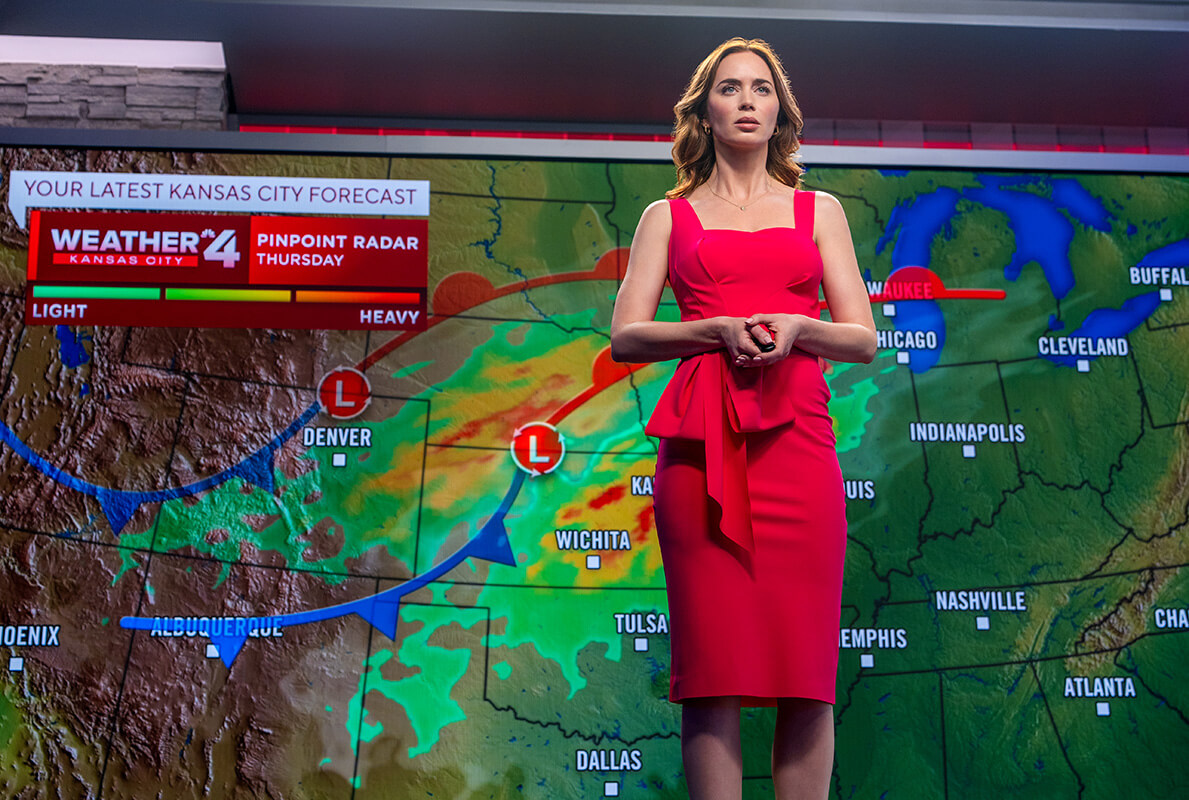
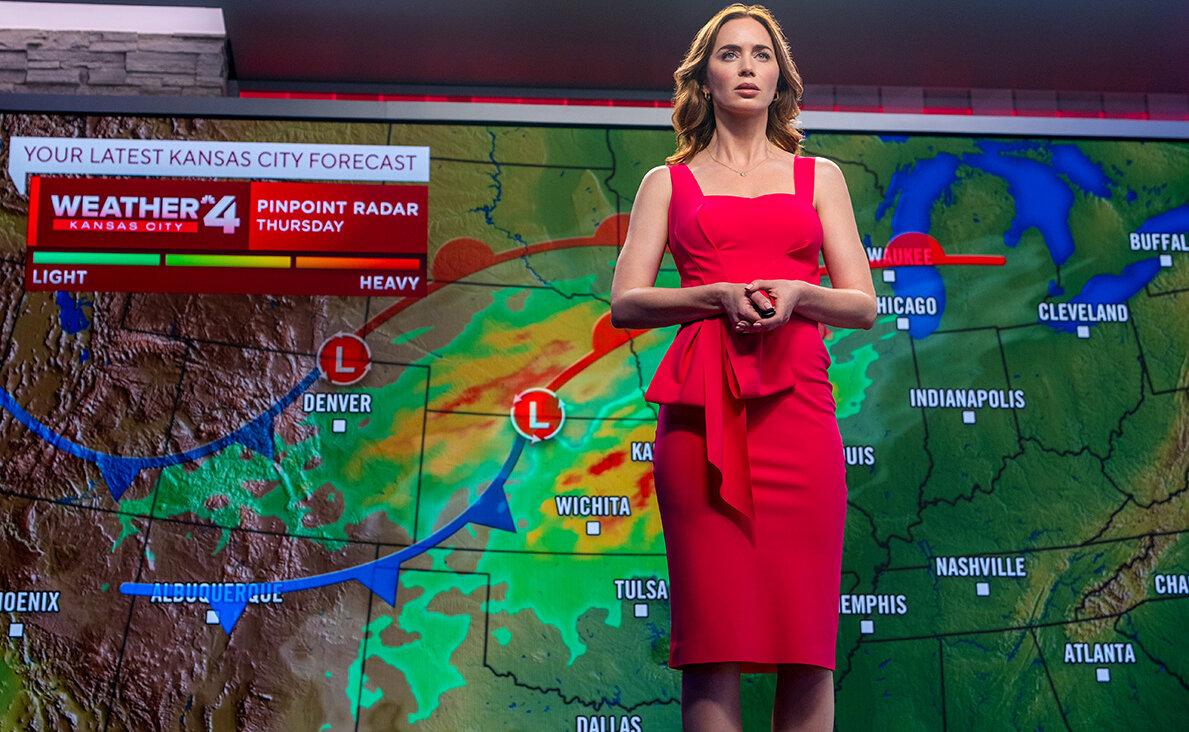
Emily Blunt in Disclosure Day. Courtesy of Universal Pictures

By PJ Grisar June 15, 2026
Steven Spielberg is in his aliens exist era — but in truth, he’s been there since at least 1977. That’s when the director said NASA sent him a 20-page letter objecting to the release of Close Encounters of the Third Kind, fearful the public might take to watching the stars the way they did beaches after Jaws. Did this indicate there was something to hide?
“I really found my faith when I heard that the Government was opposed to the film,” he said.
Spielberg’s fascination with UFOs goes back even further. In 1964, five years before the moon landing, he made the 8 millimeter alien invasion flick Firelight, a 17-year-old’s dry run at the topics he’d later handle with Roy Neary and his mesa-like mound of mashed potatoes and the world’s loudest game of Simon.
He’d return to aliens again, with E.T., War of the Worlds and the critically reviled Indiana Jones and the Kingdom of the Crystal Skull. But the 79-year-old director has never been so forthcoming with his views on alien life as he has been on this current press tour for Disclosure Day, where he made the controversial claim that first contact might pose a problem for the faithful.
“Is God, our God only on this planet, or is God a God for every system where there’s civilization, intelligent life, and even developing life?” Spielberg asked on CBS Sunday Morning. This is one of the questions posed by Disclosure Day, which is about the tug of war between a group dedicated to broadcasting the truth about intelligent extraterrestrial beings, and the shady agency determined to keep it under wraps.
Many in the church — meaning Christians, who are represented in the film by ex-novitiate Jane (Eve Hewson) — have said such a disclosure would be a nonissue for their belief. But what of Spielberg’s own coreligionists?
“Within the classic Jewish perspective is the idea that to embrace reality is to embrace our creator,” Rabbi Josh Breindel, whose teachings on speculative fiction earned him the moniker “sci-fi rabbi,” said in an interview. “So, if we were to have irrefutable proof of alien life, then that’s an opportunity for us to celebrate our creator in whose image we were made, and then maybe to probe and say, ‘Where do we see echoes or resonances of that image in this other life form in their sentient discourse?’”
We need not only take Rabbi Breindel’s word for it. The question pops up as early as the Middle Ages.
Writing in the 14th Century, the Spanish philosopher Hasdai Crescas claimed life on other planets wouldn’t be an issue for Jewish faith. Our texts feature many apparent allusions to other worlds in which God has dominion.
A place called Meroz, mentioned in the Book of Judges, has been interpreted as being another planet. The school of Merkabah mysticism, inspired by Ezekiel’s vision of the wheel, is a sort of Judaism-forward UFO watcher group. If we’re talking biblically accurate angels, or even the revelation at Sinai, there’s plenty in the Hebrew Bible that appears otherworldly.
Disclosure Day, written by David Koepp from a story by Spielberg, is a chase film about Danny Kelner (Josh O’Connor), a whistleblower for a U.S. government-aligned group called Wardex, intent on studying alien life and technology and keeping their findings suppressed. Danny is a math genius, and in a relationship with Jane, the ex-nun played by Hewson. He’s carrying sacred cargo: a backpack full of flash drives with evidence of spacecrafts and a weird rod made by the alien life forms whose precise capabilities include, but are not limited to, letting you turn invisible or allowing you to control someone else’s body and swap eye colors with them in the process.
In an effort to explain why men in black SUVs are chasing them, Danny shows Jane footage of an alien interrogation. Her response to seeing a small creature tortured by humans is an odd one: She thinks people will worship them as deities.
Here the film stumbles. Jane’s concern about a breakdown in belief may be justified in the realization that we’re not alone, but her leap to calling extraterrestrials “supreme beings” feels unwarranted. Yes, they have impressive technology. Also yes, a human can wield their magic baton MacGuffins, provided they’re wearing surgical gloves.
The faith subplot takes a backseat in the end to a familiar Spielbergian preoccupation: his parents and what he’s inherited from them. We learn the aliens taught Danny math, “the language of the book of the universe,” and made Emily Blunt’s character, Margaret, a Kansas City weatherperson, into a supreme empath, like Star Trek’s Deanna Troi cranked up to 11. As established in The Fabelmans, Spielberg, a product of his engineer father and musician mother, is naturally both. (Gilding the lily of the parental metaphor, there’s a sequence with a train that’s hauling pianos.)
On their phones and on TV, the world will bear witness to “disclosure,” including scenes of emaciated and disemboweled little green men, recalling both images from the Holocaust and current conflicts including Gaza. (Spielberg made it so the coverup for these cruel experiments began in 1947, probably just to align with the year of the Roswell incident, but before that was explained, I was thinking of the UN partition plan.)
Sometime before, Jane makes a call to the abbess at her old nunnery.
Paraphrasing Genesis, she says God made humans his supreme creation, to which the Abbess (Elizabeth Marvel), applies a close reading: “his supreme creation on Earth.”
This view is consistent with rabbinic thought, and the Abbess’ subsequent line, “why would He make such a vast universe, yet save it only for us,” is essentially what the Lubavitcher Rebbe told microbiologist Velvl Greene: “for you to sit here and say there is no life outside of planet Earth is to put limitations on the Creator, and that is not something any of His creatures can do!”
A better question for Jews, perhaps, is if these aliens have a separate covenant with the creator.
If one is interested in the Catholic view, know that Pope Francis said he’d baptize aliens. As for how other sci-fi writers have treated on Jews in Space, Dune scribe Frank Herbert seems to believe the faith was uniquely durable, having made it the only religion from an Earthbound society to survive in an intergalactic reality.
One thing that’s striking about Spielberg’s latest foray into the galaxy is its implications for geo-politics.
The backdrop of Disclosure Day is one of military escalation said to rival the Cuban Missile Crisis. Colin Firth’s foppish Brit bad guy warns that the truth would “tip the balance in an already destabilized world.” This runs counter to works like Watchmen and Independence Day, which posit a great common cause when people are confronted with life forms from outer space.
The difference is that these aliens are no invaders. They come in peace to teach us a lesson in empathy. That, the film seems to say, is the true threat to the world order: that humans behave with humanity.
In the final minutes of the film, the truth comes out and we are given a simple message, conveyed first through click consonants, then a math equation, and finally a single English word: “Listen.”
“I saw that, and I was like, ‘Oh, that’s Shema,’” Breindel said. “If you get it you get it.”

Hello, fellow Forward reader! I’m Joel Brown, a Forward reader and supporter for more than 15 years, and currently the chair of the board of directors.
I’m an avid Forward reader because it ticks so many of my essential boxes: excellent journalism, Jewish focus and diverse viewpoints. In today’s political climate, what I most appreciate is the Forward’s independence — made possible by the generosity of its membership.
The Forward is committed to bringing you unbiased, nuanced Jewish news. From my position as board chair, I see an exciting future as we expand our position as the definitive independent voice of contemporary American Judaism.
That’s why I’m paying it Forward, by matching $36,000 of reader gifts. It’s an investment in the Forward’s newsroom, to continue telling the American Jewish story with truth and independence.
— Joel Brown, Forward board chair
Support our mission to tell the Jewish story fully and fairly.