A lackluster exhibit gives short shrift to Claude Lanzmann’s legacy — and to the Shoah’s victims
‘Voices from the Shoah Tapes’ at The New York Historical is a pale shadow of a proper tribute in Berlin
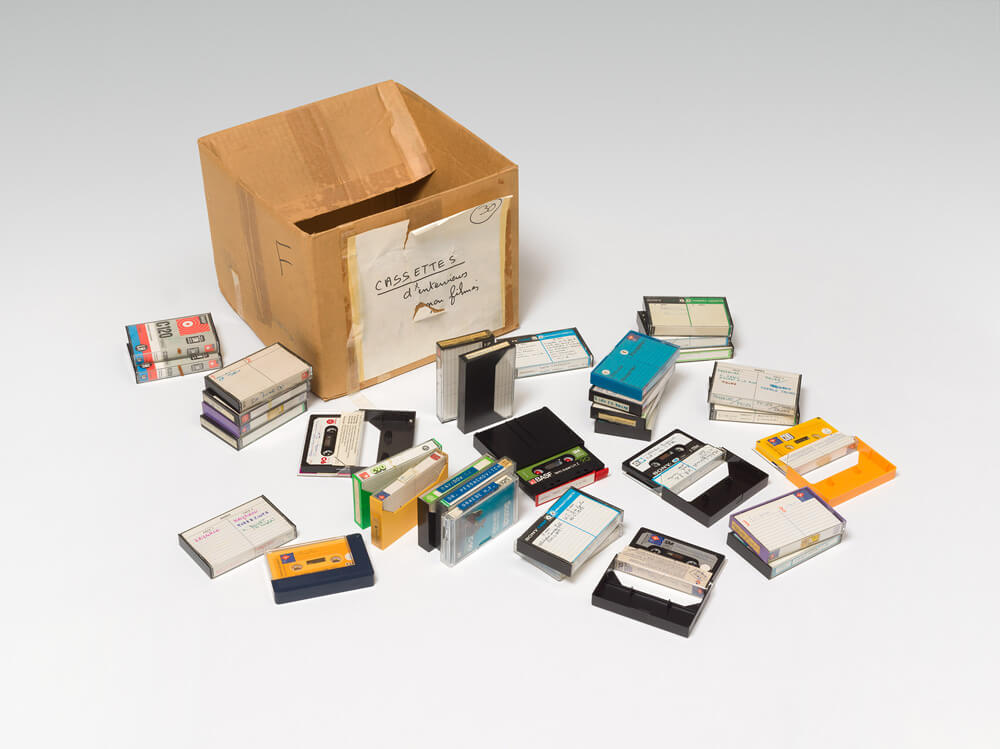
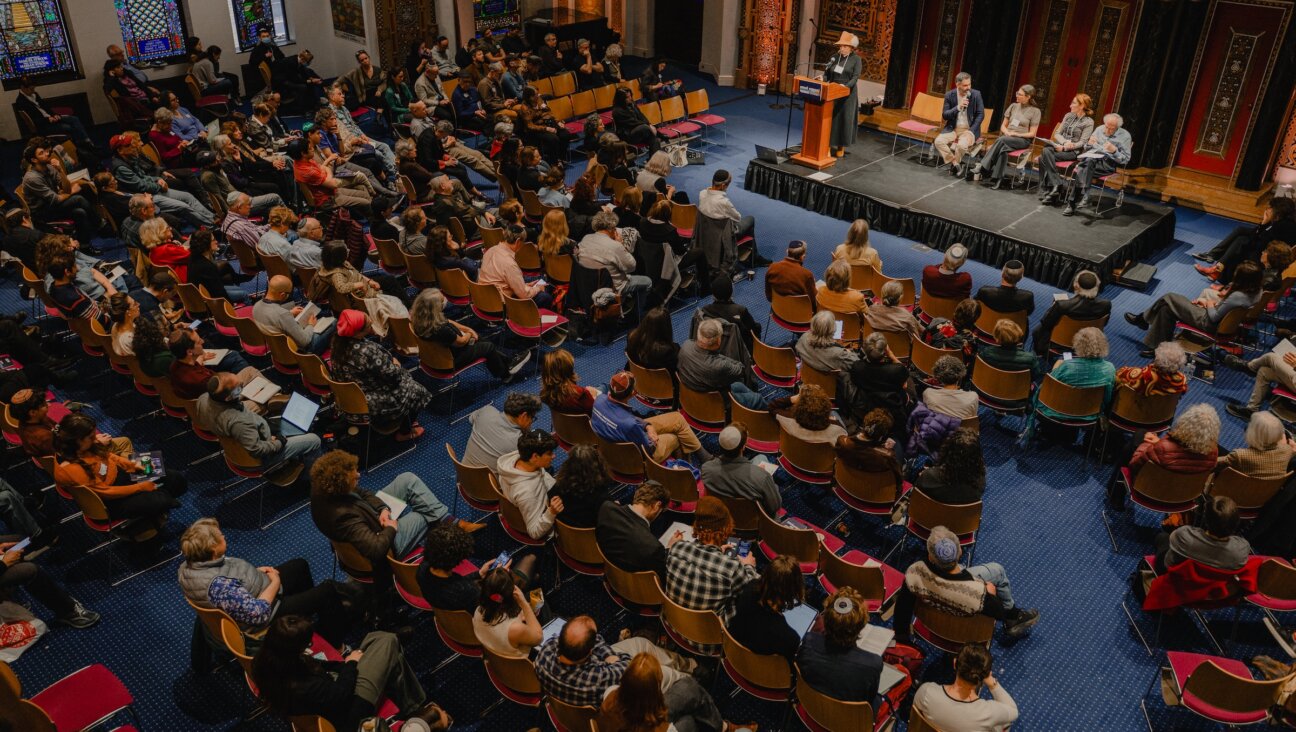
An exhibit shows a sampling of the recordings Claude Lanzmann collected for his monumental Shoah. Courtesy of The New York Historical

By Dan Friedman December 5, 2025
For reasons both political and cultural, it’s a worrying moment in history when New York City dedicates valuable gallery space to pale echoes of exhibits from German-speaking museums. That is currently the case, though, for The Recordings: Voices from the Shoah Tapes — the new exhibition at The New York Historical (formerly The New York Historical Society) and Documents of Injustice: The Case of Freud at the Austrian Cultural Forum NYC.
The Austrian Cultural Forum is a tiny vertical glass and aluminum skyscraper a block away from MoMA in New York’s Midtown East. Built in 2002 on a plot of a townhouse and with that aesthetic in mind, it is a hidden gem. On the ninth floor overlooking St. Patrick’s Cathedral, a single room represents the Freud Museum’s current exhibit of the trove of documents testifying to the legal appropriation of the Freud families’ assets and the murder of Sigmund Freud’s sisters (Freud, his wife and his daughter Anna escaped from Austria to London, where he died 22 days after Hitler invaded Poland). The minimal exhibition comprises six wall banners, a single display case of documents, and a TV screen with four intercut testimonies from Yale’s Fortunoff Video Archive for Holocaust Testimonies. In the videos, Jewish women who grew up in the same district as Freud’s famous Berggasse 19 address bear witness to the sudden absence of legal and social protection after the Nazi Anschluss in March 1938.
Barely a mile north at the Historical, a bewildering series of absences dog the small but potentially important Shoah exhibit — itself a splinter of the concurrent display at the Jewish Museum of Berlin — Claude Lanzmann: The Recordings.
The most striking absence in a show dedicated to highlighting the audio tapes Claude Lanzmann recorded during the research for his documentary film is the lack of the film Shoah itself in all its 9-hour sobering majesty: not an excerpt cycling on a wall monitor, not a related screening or two in the auditorium while the show is up — nada. The several stations all have screens showing transcripts and translations next to headphones where two visitors at a time can listen and one larger screen has video testimony that Lanzmann chose not to use.
As Lanzmann told me when I interviewed him for the Forward, at the heart of Shoah are some crucial silences. The Fortunoff video at ACF spells that out a little more in the dedication at the end of the testimonies: “You cannot interview the dead.”
The Recordings, for their part, bear witness to some of the sounds and testimonies that were available to Lanzmann as he embarked upon his filming but chose not to use. The film itself is so arresting, and so epic in scale, that, for example, he could exclude all of his research on the atrocities in Lithuania without significantly affecting the final 9-hour-long monument. As the descendant of Lithuanians and after historian Simon Schama’s trip there for PBS, the newly public testimony from witnesses Lanzmann interviewed in Lithuania at NYH is deeply arresting.
According to Louise Mirror, CEO of NYH, the institution chose to host this shadow show as the United States heads to its 250th birthday to promote democracy “by showing what democracy isn’t.” But that’s at least one step too far into negative space — promoting democracy by showing one instance of fascism, an exhibition for audio tapes that are not on display, tapes that were research for the documentary Shoah that were not used for the documentary. So, yes, the film shows the indifference of the populations of Europe to the (murderous) removal of Jews, but the NYH’s show’s deferrals and absences do not serve that same idea.
Unlike the modest but appropriate setting of the Freud room which, sharing the same name as the Viennese show, is explicitly a satellite show, The Recordings has its own name and is jammed into the first third of a single long exhibition hall with Stirring the Melting Pot. That latter is a putatively companion exhibition of NYH archive photos showing the multicultural history of New York City. The logic is clear, explicit even, but not good — New York has always been a place of refuge: where Jews, Hungarians (Jews and not), Ukrainians, Ethiopians (Jews and not), Italians and many others can make a new home.
It’s scant solace for the ethnic cleansing of Europe and this unfortunate juxtaposition shows an almost obscene disproportionality.
Any significant exhibition about the Shoah must center loss in some way or other. The multiyear catastrophe we call by that name was the unthinkably vast systematic destruction of a European civilization and murder of its people by a modern, developed, mechanized European nation state. The extent of the civilization is essentially unrepresentable, its annihilation is unfathomable, and the bureaucratized slaughter of millions incomprehensible. So not only do we feel grief and horror at the inhumanity of it, but we also feel loss at our own inability to grasp the enormity of the events.
To put up a few neighborhood photos of the New York “Melting Pot” after listening to the negative space defining the yawning abyss at the moral heart of modern culture feels a little like bringing a box of chocolates to the Tree of Life shivas. It’s inadequate and inappropriate. If you want to do a Holocaust exhibition, do it properly; if you want to promote democracy, do it properly.
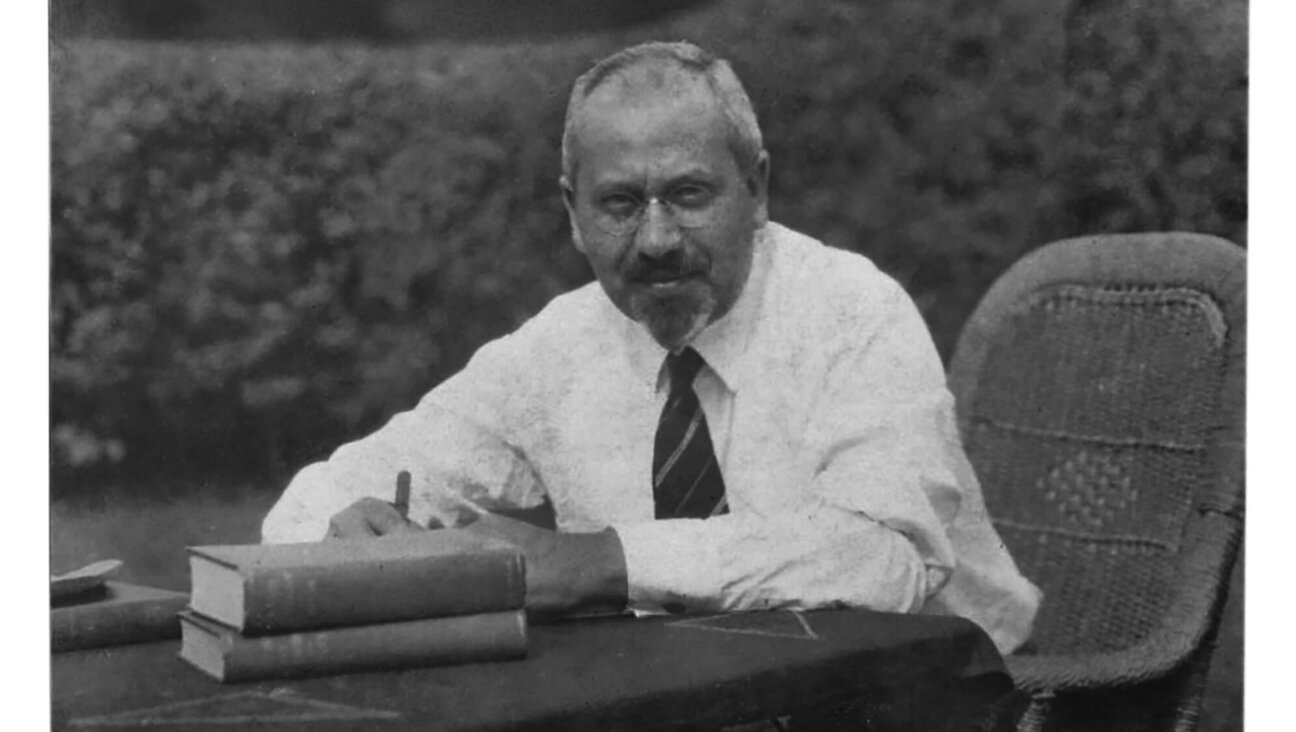
The occasion for the exhibit, apart from America’s birthday, is the 100th anniversary of Lanzmann’s birth, 80 years since Auschwitz was liberated and 40 years since Shoah was released. Lanzmann left all his archive to the Jewish Museum of Berlin, where the main show is, but little or none of that material has either physically or spiritually come to New York. Sadly, though there are significant moments of horror and enlightenment, this show is a poor commemoration of a great man, a catastrophic historical loss and an immense cultural achievement.