AJC, USC Shoah Foundation announce partnership to document antisemitism since World War II
Once completed, the collection will be the largest archive of first-hand testimonies of postwar antisemitism
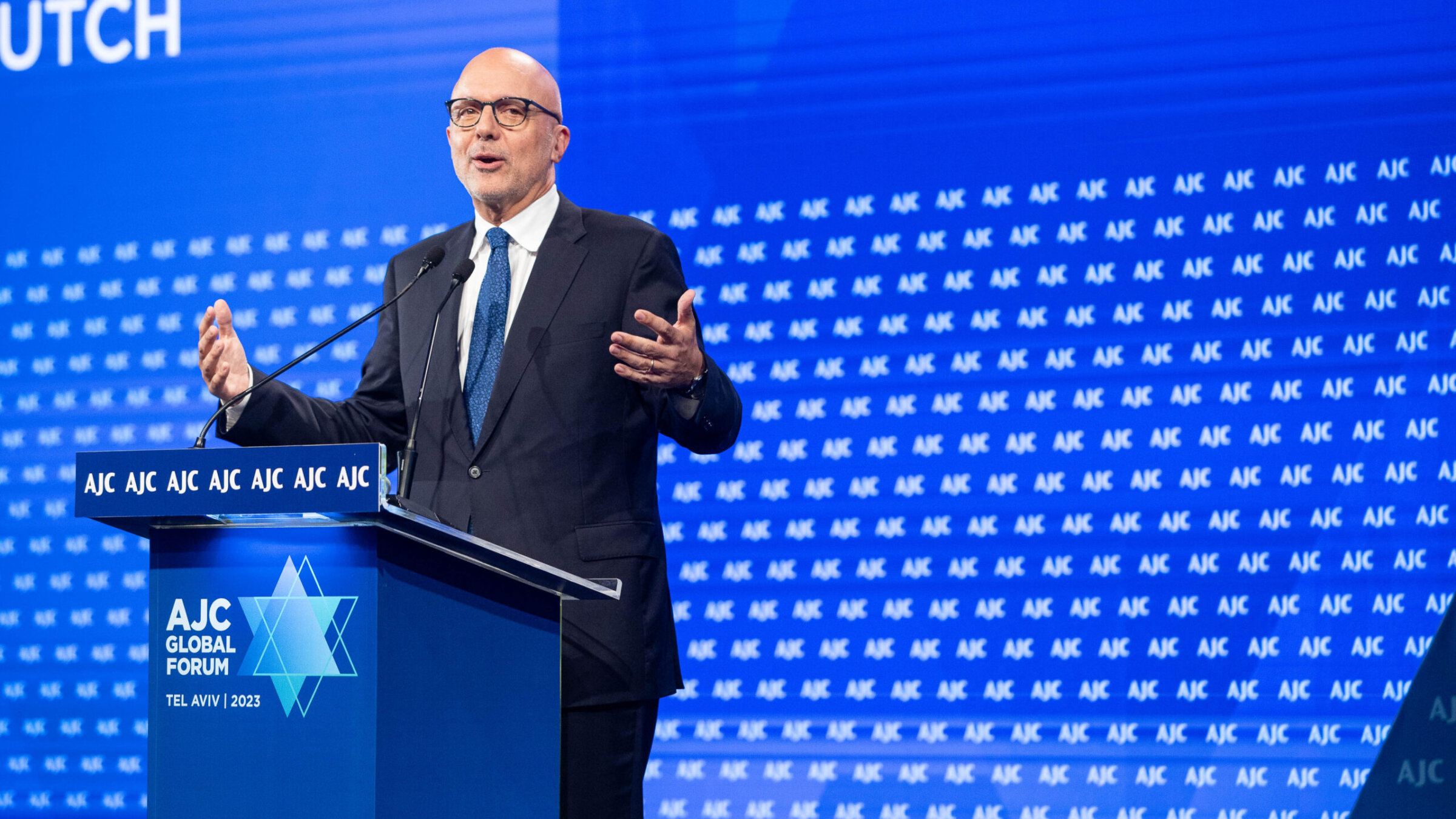
American Jewish Committee CEO Ted Deutch speaks at the organization’s Global Forum 2023 in Tel Aviv, Israel, June 14, 2023. (American Jewish Committee)
(JTA) — The American Jewish Committee and the USC Shoah Foundation announced that they will partner to collect 10,000 testimonies from Jews about global antisemitism since World War II.
The collaboration will be part of the foundation’s Contemporary Antisemitism Collection, and seeks to showcase the various ways antisemitism has manifested since the Holocaust.
“We must clearly show to the world – and preserve for the future – what antisemitism is, what it looks like, and the personal toll it takes on Jews around the world. AJC has seen, firsthand, the way antisemitism has morphed and manifested itself in different ways since the end of the Holocaust,” said AJC CEO Ted Deutch in a press release.
The USC Shoah Foundation, a Holocaust research center founded by Steven Spielberg in the wake of the success of his Holocaust drama, “Schindler’s List,” is home to the largest collection of testimonies of victims of genocide, including the Holocaust, in the world. It houses over 61,000 testimonies.
“Our partnership with AJC will enable us to reach survivors of antisemitic violence from all over the globe. In turn, this is a powerful statement that bringing the world’s attention to antisemitism requires partnerships built on a shared commitment to giving voice to the personal histories of those who have and continue to experience one of humanity’s oldest and most enduring forms of hatred,” said Robert Williams, CEO of the USC Shoah Foundation.
One testimony that will be included in the new collection is that of Daniel Pomerantz, a survivor of the 1994 bombing of the AMIA Jewish center in Buenos Aires that killed 85 people and has been attributed to the Lebanese terror group Hezbollah.
“The [Hezbollah] terrorists killed 85 and injured 300. These were my friends and colleagues. They were Argentinian Jews and Argentinians of all backgrounds. Thirty-one years later, those responsible for orchestrating that horrible day – for attacking my place of work, my community’s gathering place, and for murdering and maiming dozens – have still not been brought to justice or held accountable for their crimes,” said Pomerantz, who is now the executive director of AMIA, in a press release.
Another testimony will come from Antoine Haguenauer, who was attacked in Paris in February while attending a memorial for the Bibas family, who were killed in Hamas captivity.
“I was berated, told I supported genocide. I was threatened – they told me they would follow me home, leak my address, kill me and my family. I was assaulted – punched in the head from behind. When I reported the attack to a police officer, he told me: ‘You could press charges, but what would be the point?’” said Haguenauer in a press release.
Once completed, the collection will be the largest archive of first-hand testimonies of postwar antisemitism.
Antisemitism, and discourse surrounding it, has remained a central part of the Jewish experience. Last week, the ADL released a report that found that antisemitic incidents in the United States had set a new record for the fourth year in a row. Part of the trend was spurred by an over 80% increase in antisemitism on college campuses.
I’m personally matching all gifts to the Forward, up to $36,000. Can I match your gift now?

Hello, fellow Forward reader! I’m Joel Brown, a Forward reader and supporter for more than 15 years, and currently the chair of the board of directors.
I’m an avid Forward reader because it ticks so many of my essential boxes: excellent journalism, Jewish focus and diverse viewpoints. In today’s political climate, what I most appreciate is the Forward’s independence — made possible by the generosity of its membership.
The Forward is committed to bringing you unbiased, nuanced Jewish news. From my position as board chair, I see an exciting future as we expand our position as the definitive independent voice of contemporary American Judaism.
— Joel Brown, Forward board chair
Support our mission to tell the Jewish story fully and fairly.