He may have been the world’s most famous mime, but in this play, he won’t shut up
Ethan Slater misses the mark with ‘Marcel on the Train,’ an uneven play about Marcel Marceau’s Holocaust rescues
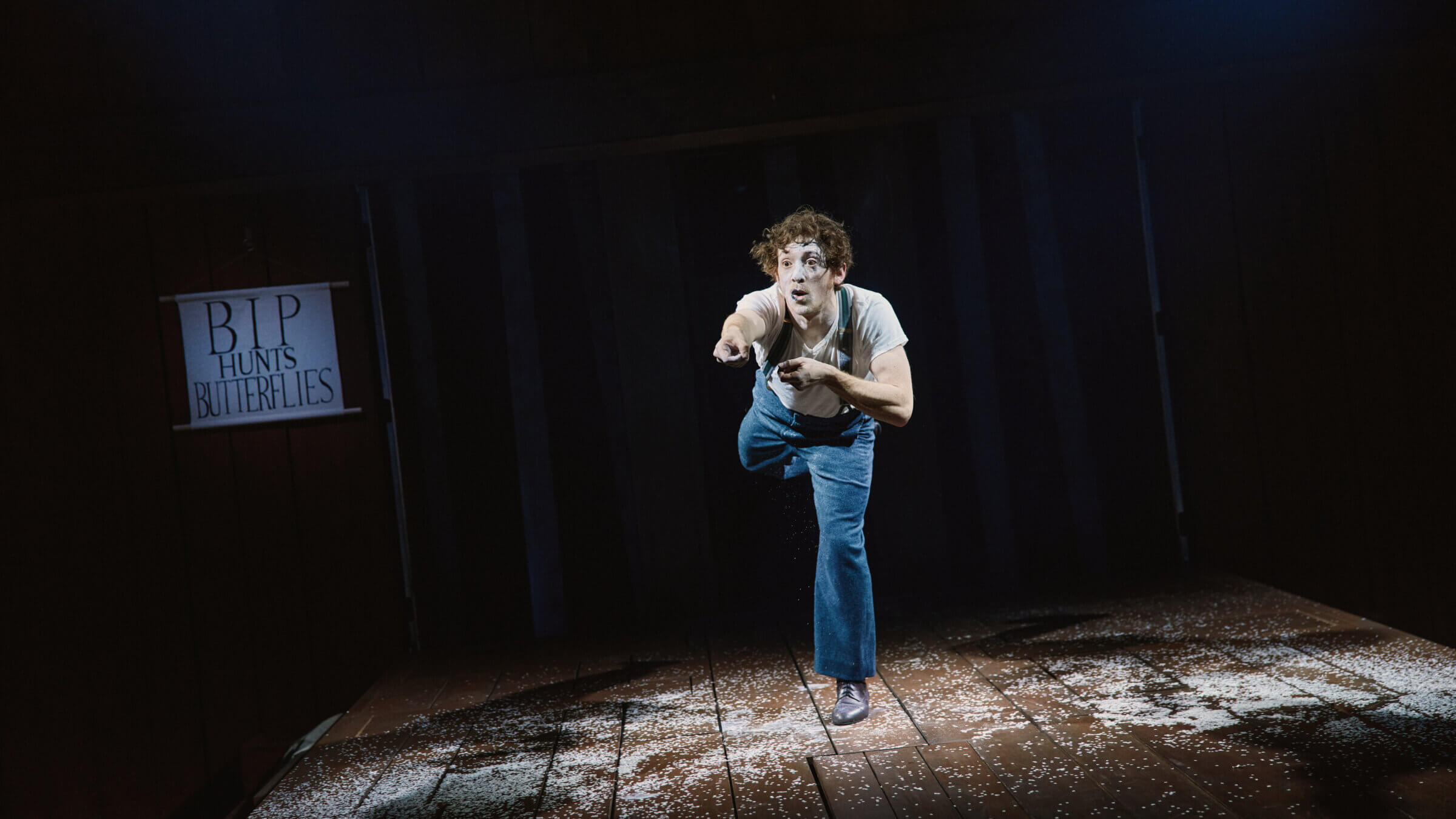
Ethan Slater as Marcel Marceau’s Bip in Marcel on the Train. Photo by Emilio Madrid

By PJ Grisar February 22, 2026
There is a kind of sublime poetry in Marcel Marceau’s first act.
As a young man in occupied France, Marceau (then Mangel) forged identity papers and shepherded dozens of Jewish children across the Alps to Switzerland. In scenarios where staying quiet was essential for survival, Marceau soothed his charges into silence with his own.
In Marcel on the Train, Ethan Slater and Marshall Pailet’s play of Marceau’s pre-Bip life, the world’s most famous mime is anything but silent.
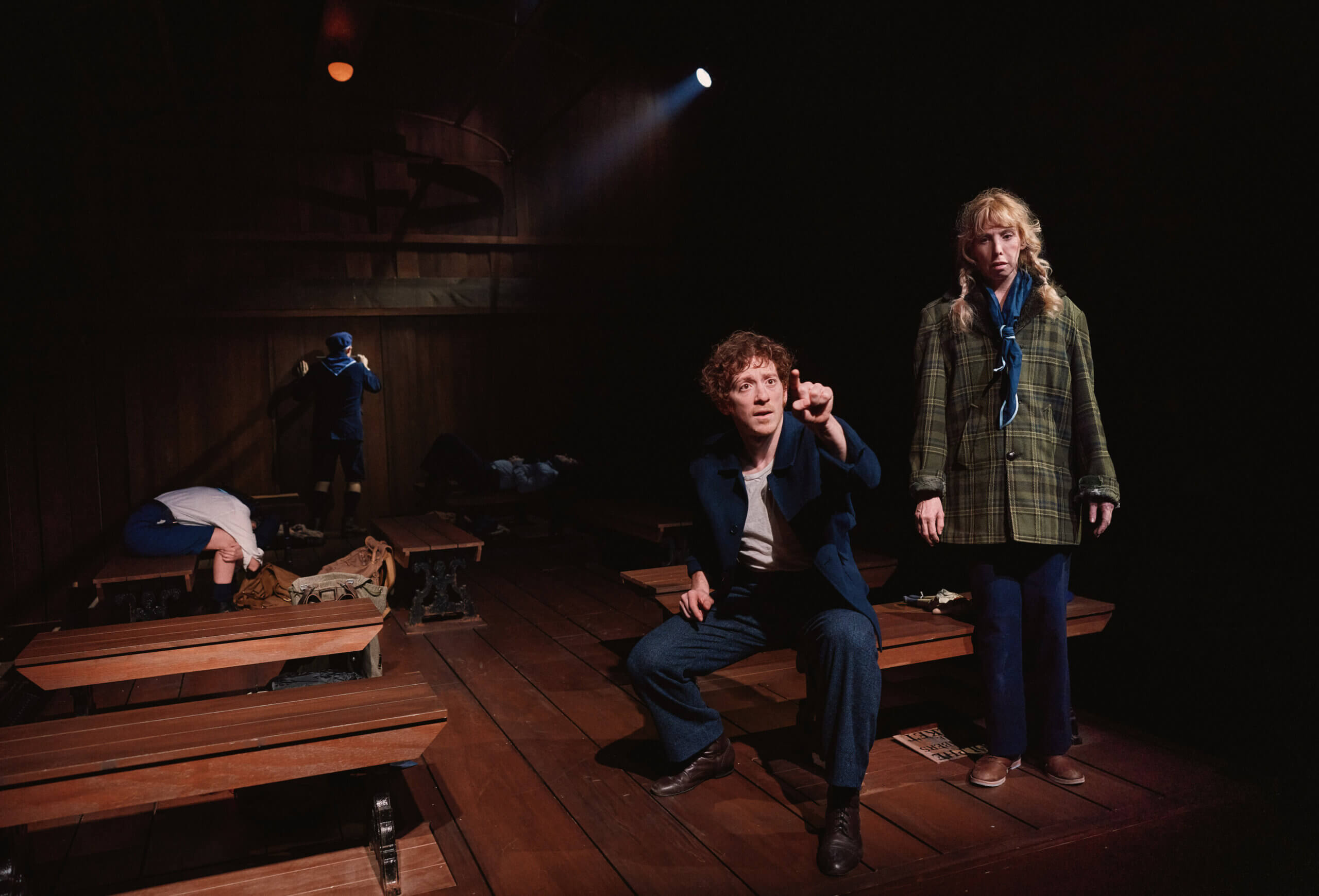
The action of the play, which bounces through time back to Marcel’s father’s butcher shop and forward to a P.O.W. camp in Vietnam (don’t ask), unfolds over the course of a train ride. Slater’s Marceau is chaperoning four 12-year-old orphans, posing as boy scouts going on a hike.
The kids — played by adults — are a rambunctious lot. Marceau tries to put them at ease juggling invisible swords, performing Buster Keaton-esque pratfalls and exhausting his arsenal of Jewish jokes that circle stereotypes of Jewish mothers or, in one case, a certain mercenary business sense.
Pailet and Slater’s script toggles uncomfortably between poignancy and one-liners with a trickle of bathroom humor (the phrase “pee bucket” recurs more often than you would think.)
The terror of Marceau’s most melancholy escortee, Berthe (Tedra Millan) is undercut somewhat by her early, anachronistic-feeling declaration, “Wow, we’re so fucked.” The bumptious Henri (Alex Wyse) would seem to be probing a troubled relationship with Jewishness and passing, but does that discussion a disservice when he mentions how it wouldn’t be the biggest deal if he “sieged a little heil.” Adolphe (Max Gordon Moore) is described as “an exercise in righteousness” in the script’s character breakdown. Sure, let’s go with that.
The presence of a mute child, Etiennette (Maddie Corman), is tropey and obvious. It doesn’t suggest that she inspired him to abandon speaking in his performances, but it doesn’t dismiss that possibility either.
But the chattiness and contrived functions of the fictive children are made more disappointing by the imaginative staging maneuvering around the shtick. Slater, best known for his role in the Wicked films and as Spongebob in the titular Broadway musical, is a gifted physical performer.
When things quiet down, Pailet’s direction, and the spare set by scenic designer Scott Davis, create meadows of butterflies. Chalk allows Marceau to achieve a kind of practical magic when he writes on the fourth wall. One of the greatest tricks up the show’s sleeve is Aaron Serotsky who plays everyone from Marceau’s father and his cousin Georges to that familiar form of Nazi who takes his torturous time in sniffing out Jews.
Surely the play means to contrast silence and sound (sound design is by Jill BC Du Boff), but I couldn’t help but wonder what this might have looked like as a pantomime.
While the story has been told before, perhaps most notably in the 2020 film Resistance with Jesse Eisenberg, Slater and Pailet were right to realize its inherent stage potential. It’s realized to a point, though their approach at times leans into broad comedy that misunderstands the sensibilities of its subject.
Like Slater, who learned of the mime’s story just a few years ago, Marceau was an early acolyte of Keaton and Chaplin. But by most accounts he cut a more controlled figure — that of a budding artist, not a kid workshopping Borscht Belt bits on preteens.
The show ends with a bittersweet montage of Bip capturing butterflies (not jellyfish — you will probably not be reminded of Mr. Squarepants). It means to frame Marceau’s established style as a maturation that nonetheless retains a kind of innocence, stamped by the kids he rescued.
“You’ll live,” Berthe tells him in a moment of uncertainty. “But I don’t think you’ll grow up.”
In Marceau there was, of course, a kind of Peter Pan. But there’s a difference between being childlike and being sophomoric.
The play Marcel on the Train is playing through March 26 at Classic Stage Company in New York.
This is a moment of great uncertainty. Here’s what you can do about it.
We hope you appreciated this article. Before you go, we’d like to ask you to please support the Forward’s independent Jewish news this Passover. All donations are being matched by the Forward Board - up to $100,000.
This is a moment of great uncertainty for the news media, for the Jewish people, and for our sacred democracy. It is a time of confusion and declining trust in public institutions. An era in which we need humans to report facts, conduct investigations that hold power to account, tell stories that matter and share honest discourse on all that divides us.
With no paywall or subscriptions, the Forward is entirely supported by readers like you. Every dollar you give this Passover is invested in the future of the Forward — and telling the American Jewish story fully and fairly.
The Forward doesn’t rely on funding from institutions like governments or your local Jewish federation. There are thousands of readers like you who give us $18 or $36 or $100 each month or year.
Support our mission to tell the Jewish story fully and fairly.