It’s not just a myth that Jews head to Chinese restaurants on Christmas. It’s science.
A completely unscientific poll suggests that Jews do indeed spend Christmas chowing down on Buddha’s Delight
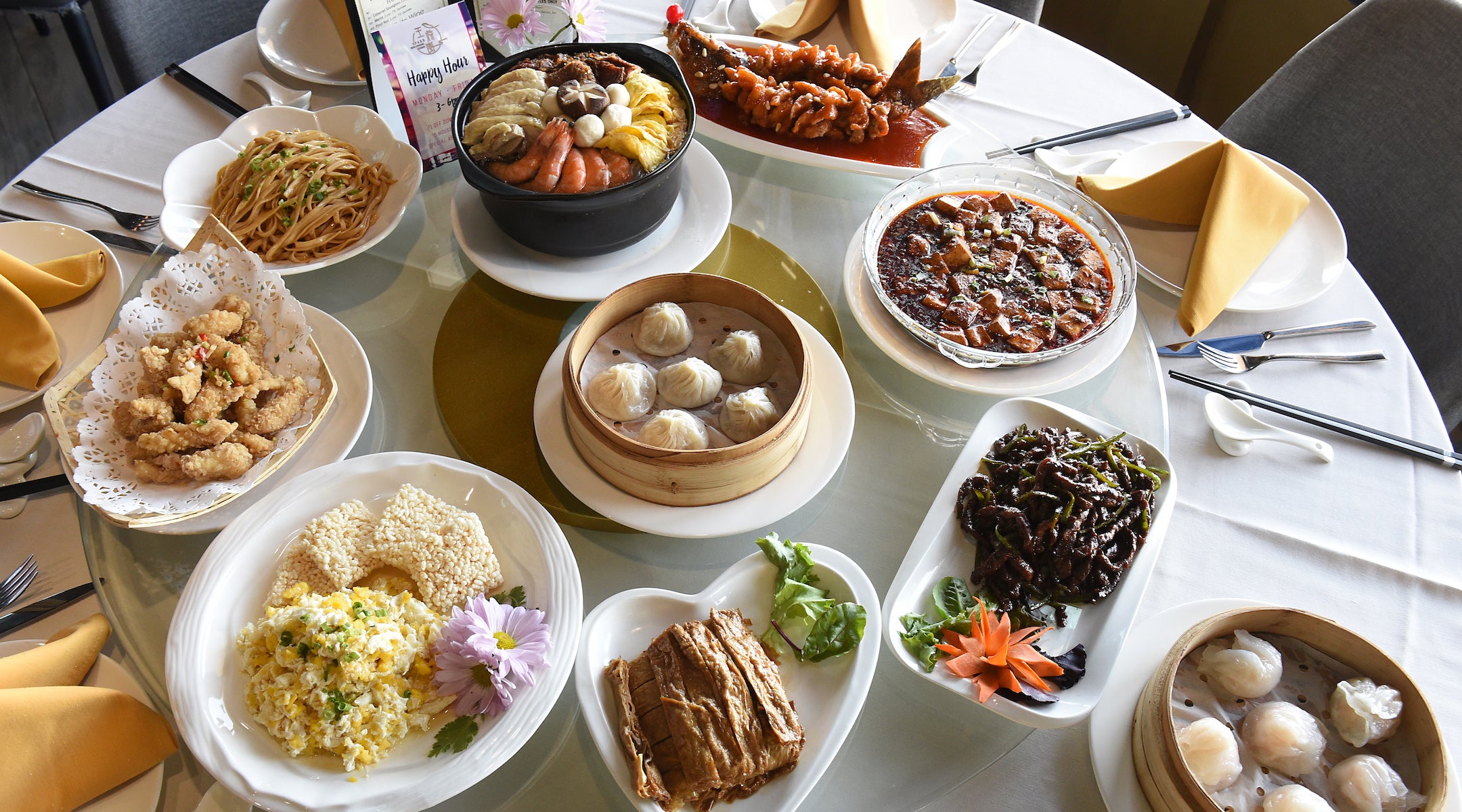
Table with dishes served family style on a rotating centerpiece at SparX Fine Chinese Cuisine in Halfmoon, New York. Photo by Lori Van Buren/Albany Times Union via Getty Images
It’s not just a myth that Jews head to Chinese restaurants on Christmas. It’s science!
Sort of. A new report from the financial services company Coventry Direct claims to have quantified the trend. The report analyzed search data for “Chinese food near me” during the week of Christmas from 2020 to 2024, and found that the Northeast dominated the results.
The top five states included Delaware, Rhode Island, Connecticut, New Jersey and New Hampshire, while New York, which is home to the largest Jewish population in the country, came in seventh place. Under the assumption that Jews are overrepresented in the Northeast, the study confirms that Coventry Direct is not peer-reviewed.
The study also analyzed Google search trends over the past year to find the top-searched Chinese food dish in each state. While Szechuan chicken was the most popular dish, taking first place in eight states, New York’s most searched item was Buddha’s Delight, a — IYKYK — vegetarian stew.
The Jewish Christmas tradition was famously referenced during Elena Kagan’s United States Supreme Court confirmation hearings in 2010 when she was asked where she was on Christmas day:
“You know, like all Jews, I was probably at a Chinese restaurant,” replied Kagan.
In recent years around Christmas, social media has also been flooded with images of a sign where the seemingly fictional “Chinese Restaurant Association” of America thanks its Jewish diners for their patronage.
“The Chinese Restaurant Association of the United States would like to extend our thanks to the Jewish people,” the sign reads. “We do not completely understand your dietary customs … but we are proud and grateful that your GOD insist you eat our food on Christmas.”

Two men enjoy Chinese cuisine prepared by Chinese chefs within the guidelines of kosher food preparation at a restaurant. (Getty Images)
But the now-ubiquitous tradition of Jews eating Chinese food on Christmas traces back to the early 20th century, when Jewish immigrants began carving out distinctly American rituals of their own. If for no other reasons, Chinese restaurants were more likely to be open on Christmas.
A classic 1993 study on the tradition, “New York Jews and Chinese Food: The Social Construction of an Ethnic Pattern,” by Gaye Tuchman and Harry Levine, traced the Jewish affinity for Chinese food to a few factors: Chinese restaurants at the time “welcomed everyone,” offered flavors familiar to an Eastern European Jewish palate and were considered a “sophisticated” dining experience for new-ish, Jewish Americans stepping outside their comfort zones.
While Chinese restaurants do not typically offer kosher fare, Tuchman and Levine also argued that Chinese restaurants were viewed as “safe treyf” because Chinese cuisine rarely mixes milk and meat and ingredients like pork and shrimp are chopped into hard-to-identify pieces.
To celebrate the longstanding tradition, a comedy club in New York’s East Village is set to host “Kosher Chinese: The Comedy Show,” with patrons enjoying kosher dumplings and an “unapologetically alternative holiday spirit we all secretly love.” In San Francisco, the 33rd Annual Kung Pao Kosher Comedy show kicks off tonight, and runs through Friday, Dec. 26.
From Massachusetts to Ohio, Jewish delis have also planned their own Chinese-inspired menus to mark the tradition.
This article originally appeared on JTA.org.
Did you know that only 2% of Forward readers donate to support our nonprofit newsroom? That 2% make it possible for millions to read the Forward without a paywall or subscription — removing any barriers to the full and fair Jewish story.
But while the Forward is free to read, it isn’t free to produce. Big stories — like deep dives into the antisemitism data, political scoops or reporting trips to college campuses — take months of research and fact-checking. All while we keep you informed of what you need to know each day.
— Rachel Fishman Feddersen, Forward Publisher & CEO
Support our mission to tell the Jewish story fully and fairly.