Venice Biennale jury won’t consider countries whose leaders face ICC charges, putting Israel out of contention
Russia is also ineligible for prizes under the new rule, which Israel criticized
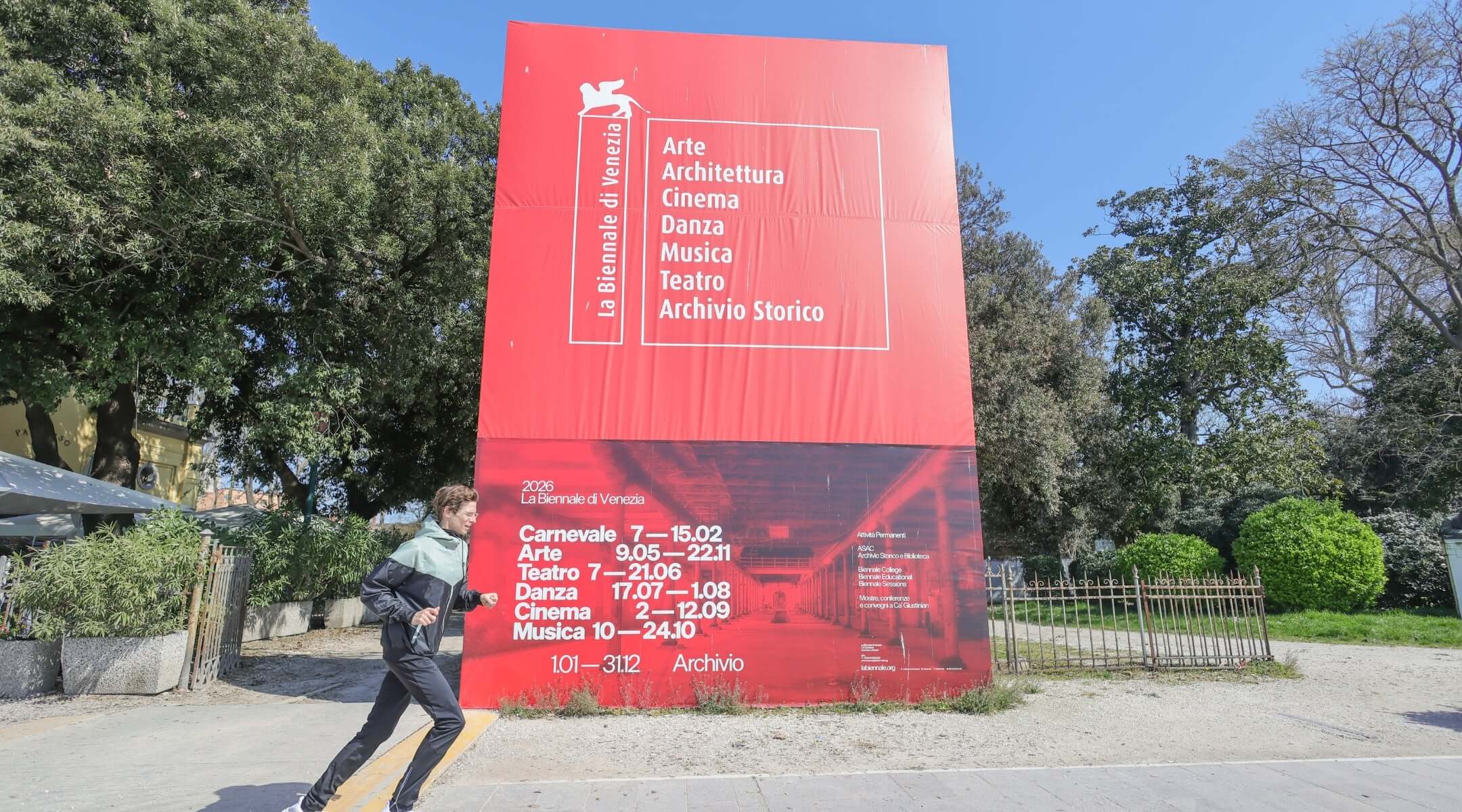
The Venice Biennale jury has banned Israel and Russia from awards deliberation, citing International Criminal Court charges against leaders of both countries. (Stefano Mazzola via Getty Images)
(JTA) — A five-person international jury at the Venice Biennale says it will no longer consider entries from Israel or Russia in its award deliberations — though it didn’t name either country in its announcement.
The jury announced its decision in the online arts publishing platform e-flux last week. In a statement, the jury explained that it “will refrain from the consideration of those countries whose leaders are currently charged with crimes against humanity by the International Criminal Court.”
The ICC, located in the Hague, Netherlands, is an intergovernmental body that prosecutes international crimes. In 2024, the ICC put out arrest warrants for Israeli Prime Minister Benjamin Netanyahu and his former defense minister on charges of war crimes and crimes against humanity — charges they both deny. The year before, the ICC issued a warrant for President Vladimir Putin on charges related to the unlawful deportation of children in Ukraine.
By excluding countries whose leaders have warrants out for their arrest, the judges could rule out Israel, which has faced widespread exclusion in the arts world, without explicitly doing so.
The judges tied their decision to the theme of the festival, “In Minor Keys,” which was chosen by the artistic director Koyo Kuouh, who died last year.
“As members of the jury, we also have a responsibility towards the historical role of the Biennale as a platform that connects art to the urgencies of its time,” their statement said, even as they said they accepted that there is a “complex relationship between artist practice and nation-state representation.”
They added, “We stand in solidarity to embrace Koyo Kouoh’s own curatorial statement: ‘In refusing the spectacle of horror, the time has come to listen to the minor keys, to tune in sotto voce to the whispers, to the lower frequencies; to find the oases, the islands, where the dignity of all living beings is safeguarded.’”
Other countries whose leaders are facing ICC charges include Sudan and Afghanistan, but neither has a presence at the Biennale this year.
During the last Venice Biennale, in 2024, the Israeli artist shut down her exhibit to call for a ceasefire and hostage deal in the Gaza war. Still, her inclusion drew criticism from across the art world.
This time, the Romanian-born Israeli artist and sculptor Belu-Simion Fainaru is representing Israel at the Biennale, with a reflective pool installation titled “Rose of Nothingness.”
Fainaru has fended off calls for his exclusion by saying that he opposes cultural boycotts and believes that “art thrives on openness.” Responding to the jury’s decision to the Israeli newspaper Haaretz, Fainaru shared a letter from president of the International Association of Art Critics in Israel, Michael Levin, which advanced the same ideas.
“We believe that art should remain an open opportunity for the expression of ideas and meaningful discourse,” the letter says. “It is a universal language that provides opportunities for the exchange of ideas and critical thinking through multilayered artistic meanings.”
Israel’s Foreign Ministry condemned the decision to exclude the Israeli submission from judging.
“The boycott of Israeli artist Belu-Simion Faiinaru by the International Jury of the Venice Biennale is a contamination of the art world,” the ministry said in a statement. “The political jury has transformed the Biennale from an open artistic space of free, boundless ideas into a spectacle of false, anti-Israeli political indoctrination.”
Members of the jury include its president Solange Oliveira Farkas, a Brazilian curator; Vietnamese-Australian curator and writer Zoe Butt; Spanish curator and artistic director of Public Art Abu Dhabi Biennial Elvira Dyangani Ose; American curator Marta Kuzma; and Italian art historian Giovanna Zapperi.
“The judges wrote to us that they cannot award prizes because the governments are under investigation by the International Criminal Court,” Venice mayor Luigi Brugnaro told Italian media Thursday. “This is an independent choice which we respect, just as the Biennale is independent in choosing to have these pavilions.”
Though they won’t be permitted to vie for awards, both Israel and Russia will have pavilions during the festival, which opens on May 9.
Russia officially had pavilions during the last two festivals, held during the war that Putin initiated against Ukraine, but it did not send artists. This year, it is sending artists — along with a signal that Russia is unwilling to continue to accept its exclusion from global festivals.
The European Union has also announced it would cut 2 million euros from the Biennale budget if Russia’s participates and gave the Biennale 30 days to reverse its decision allowing Russia to continue operating its pavilion.
The Biennale opens days after the Eurovision Song Contest, another international arts competition being staged in Europe. There, multiple countries have sworn off participation because the European Broadcasting Union rejected calls to bar Israel.
I’m personally matching all gifts to the Forward, up to $36,000. Can I match your gift now?

Hello, fellow Forward reader! I’m Joel Brown, a Forward reader and supporter for more than 15 years, and currently the chair of the board of directors.
I’m an avid Forward reader because it ticks so many of my essential boxes: excellent journalism, Jewish focus and diverse viewpoints. In today’s political climate, what I most appreciate is the Forward’s independence — made possible by the generosity of its membership.
The Forward is committed to bringing you unbiased, nuanced Jewish news. From my position as board chair, I see an exciting future as we expand our position as the definitive independent voice of contemporary American Judaism.
— Joel Brown, Forward board chair
Support our mission to tell the Jewish story fully and fairly.