Hampshire College closure reverberates for alumni who treasured a Yiddishist hub
The Yiddish Book Center says it’s unaffected by the planned shutdown of the campus next door

A student in a sukkah at Hampshire College. Courtesy of Aleks Ritter

By Hannah Feuer April 14, 2026
Hampshire College, once a hub for Yiddish scholarship thanks to its proximity to the Yiddish Book Center, will close by the end of the year amid financial challenges.
The Yiddish Book Center will not be affected by the closure, said spokesperson Rebecka McDougall, noting that the Yiddish Book Center owns its land and building, located adjacent to campus.
Even so, the closure signals the end of an era for Yiddishists who found their footing at Hampshire. Among its alumni are Yiddish singer Miryem-Khaye Seigel, the Yiddish Book Center’s academic director Madeleine (Mindl) Cohen, and the Forward’s archivist, Chana Pollack.
“It connected me to other people that were very instrumental to my broader Yiddish interests,” said Lana Adler, a 2013 Hampshire graduate who went on to work at the YIVO Institute for Jewish Research, which houses the largest collection of Yiddish-language works in the world. “It was an incredibly important space for Yiddish.”
Hampshire and Yiddish
Founded in 1970 in Amherst, Massachusetts, Hampshire College was conceived as an experiment in alternative education, offering self-designed concentrations instead of traditional majors and “narrative evaluations” rather than grades.
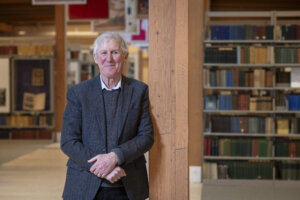
A decade later, it became home to a major Yiddish revival effort when alum Aaron Lansky returned to found the Yiddish Book Center. Alarmed that American Jews were discarding irreplaceable Yiddish books, Lansky set out to save them.
New York City seemed the obvious base. But mentors warned he might “get swallowed up” among the city’s many Jewish institutions, recalled Penina Migdal Glazer, a former Hampshire professor, in a 2024 interview.
Instead, Lansky chose Amherst — a place he knew from his college years, with faculty mentors who could support the project, and more affordable land. He purchased 10 acres on an apple orchard next to the Hampshire campus and, in 1997, built the Harry and Jeanette Weinberg Building, designed to evoke an Eastern European shtetl.
In the years that followed, the Yiddish Book Center and Hampshire College became a magnet for students interested in Yiddish. The two hosted Yiddish language classes and programs like the Yiddish Book Center’s Steiner Summer Yiddish Program, where participants immerse themselves in seven weeks of Yiddish language and culture while staying in Hampshire College dorms.
The closure’s impact
Facing declining enrollment and mounting debt, Hampshire College’s Board of Trustees voted to permanently close the school following the fall 2026 semester, president Jennifer Chrisler announced Tuesday.
McDougall told the Forward that the Yiddish Book Center’s summer residential programs are independent of Hampshire College and will continue, adding, “There is currently no programmatic partnership with Hampshire College.”
“We are saddened by Hampshire College’s announcement,” Susan Bronson, president of the Yiddish Book Center, said in a statement. “Hampshire has been a valued neighbor for many years, and we recognize the significance of this moment for its community.”
For Aleks Ritter, co-founder of the student group Hampshire Jewish Life, the campus’ proximity to the Yiddish Book Center was a large part of the school’s appeal when Ritter first applied. Ritter had studied Yiddish through YIVO in high school and hoped to continue in college.
Ritter would often go to the Yiddish Book Center with friends to study and hang out, and several of Ritter’s friends worked part-time jobs there.
“The school has been really wonderful for Jewish students,” Ritter said.
Now, Ritter will have to transfer to another college in the area.
For alumni like Adler, the loss also feels personal. Hampshire was the first time she had formally studied Yiddish — an experience that shaped her career.
“There was something special happening at Hampshire,” Adler said. “It was very important to me and to a lot of other people. I’m just so sad. I can’t believe it’s closing.”
Correction: A previous version of this article misspelled Susan Bronson’s name. She is Susan Bronson, not Bronsin.

Hello, fellow Forward reader! I’m Joel Brown, a Forward reader and supporter for more than 15 years, and currently the chair of the board of directors.
I’m an avid Forward reader because it ticks so many of my essential boxes: excellent journalism, Jewish focus and diverse viewpoints. In today’s political climate, what I most appreciate is the Forward’s independence — made possible by the generosity of its membership.
The Forward is committed to bringing you unbiased, nuanced Jewish news. From my position as board chair, I see an exciting future as we expand our position as the definitive independent voice of contemporary American Judaism.
That’s why I’m paying it Forward, by matching $36,000 of reader gifts. It’s an investment in the Forward’s newsroom, to continue telling the American Jewish story with truth and independence.
— Joel Brown, Forward board chair
Support our mission to tell the Jewish story fully and fairly.