New York shouldn’t divest from Israel Bonds — and voters should be wary of politicizing pensions
Calling to divest New York state’s pension fund from Israel bonds misinterprets Jewish tradition
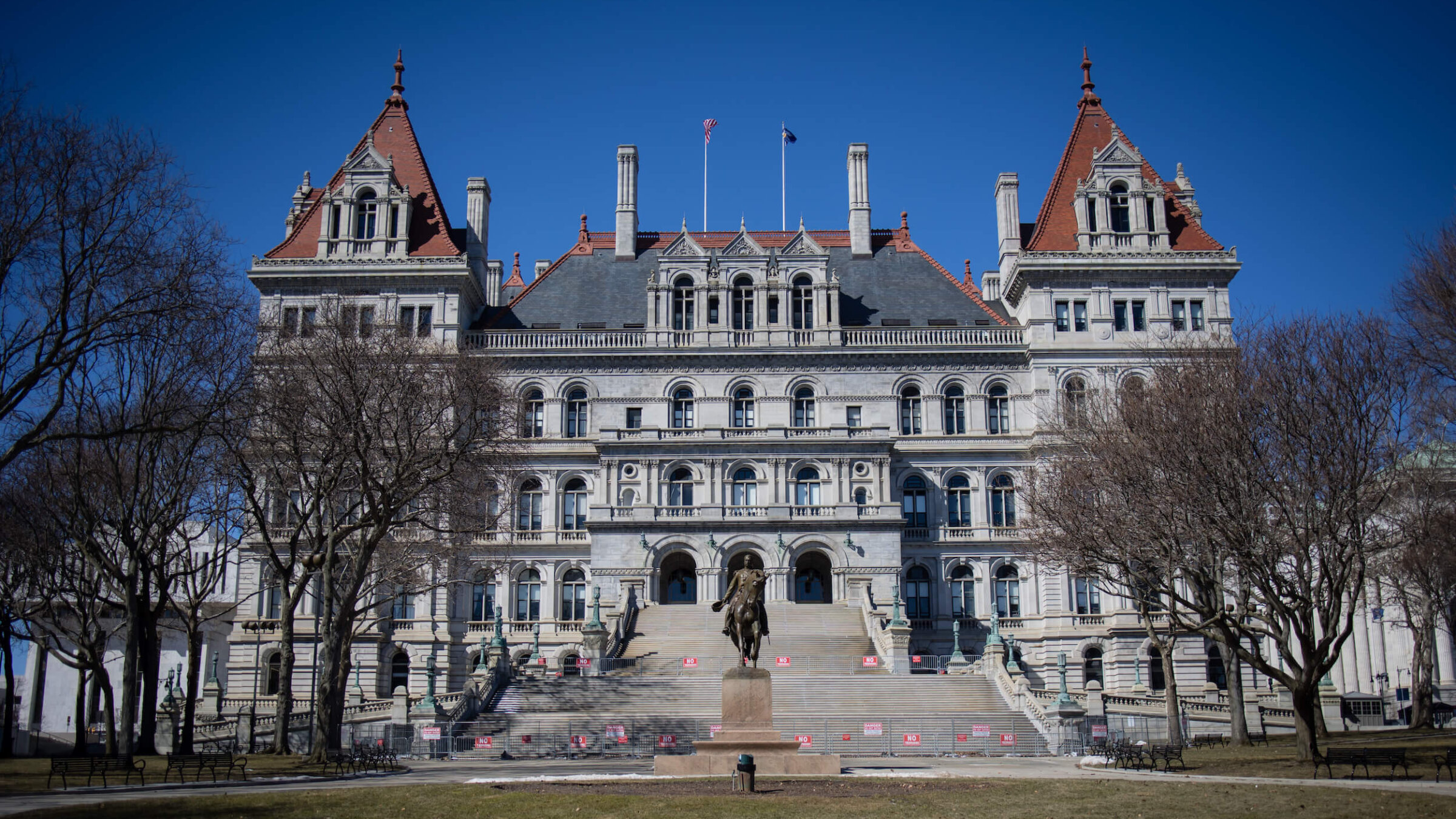
The New York State Capitol building in Albany, New York. Photo by Matthew Cavanaugh/Getty Images
In response to “I’m a Jewish candidate for New York comptroller. Our state must divest from Israel bonds“
At the Passover Seder, we sing dayenu — “it would have been enough.” Each verse names a gift given by God to the Jewish people: the exodus, the parting of the sea, manna in the desert, the Torah. We sing the song to cultivate gratitude, and to remind ourselves that while just one of these miracles would have been sufficient, together, they are overwhelming. The point is to recognize that we have been blessed and that we carry an obligation — to remember, to protect and to stand with those who are still in danger.
Drew Warshaw, a candidate who is challenging Tom DiNapoli in the Democratic primary for New York state comptroller, recently published an op-ed in these pages calling on New York to divest its pension fund from Israel Bonds. He reinterpreted the Seder’s recitation of dayenu not as a prayer of gratitude but rather as a reminder of a personal reckoning — “enough is enough!” he wrote — suggesting it is time to withdraw the United States’ support from Israel.
This beautiful tradition deserves better than to be weaponized against a financial instrument, Israel bonds, that has served New York State pensioners — including school administrators, sanitation workers, court officers, and first responders — well for many years.
So, as a member of the Israel Bonds national board of directors, let me offer my own dayenu:
- If Israel bonds had simply never defaulted or had never been late on a single payment since 1951 — through wars, recessions, and regional upheaval — dayenu. It would have been enough.
- If Israel bonds had only delivered consistent, strong investment returns to the police officers and firefighters who rely on New York State’s pension fund — dayenu.
- If Israel bonds had only helped build a democratic nation from the ground up, the only stable democracy in a deeply unstable region — dayenu.
- If Israel bonds had done all of this while the state of Israel endured wars, fought terrorism and weathered the Hamas attack of Oct. 7, 2023 — dayenu.
These facts present strong reasons to maintain or expand the investment. In contrast, the case for divestment is weak. That’s especially true given that Israel bonds represent far less than one percent of the nearly $300 billion held by the New York state common retirement fund. This is not a portfolio-defining position. It is a rounding error being treated as a moral crisis.
Warshaw is right that our tradition demands moral courage. But the story of the exodus is not only a story about the courage to leave; it is also a story about the courage required to build.
For Israel, sovereign bonds are part of that building. The proceeds from Israel bonds have been used to build every part of Israel’s economy. To treat an Israel bond as nothing more than a political statement is to collapse a complex financial instrument into a bumper sticker.
The New York State comptroller has one overriding obligation: to make investment decisions based on financial evidence guided by economics, not a personal political agenda.
State-level divestment from Israel would set a troubling precedent, telling voters that New York’s pension fund can be redirected not by financial best practice but by ideological pressure, its investment decisions subject to the political winds of any given election cycle. That is a slippery slope to travel.
The New Yorkers whose savings are at stake deserve better, and so does the tradition Warshaw has invoked. It teaches us that the hardest work is not, in fact, leaving. It is, instead, building something worth staying for.