They tried to steal our language, too
Catalogues of Yiddish books kept by the Nazi-controlled Hungarian regime are being translated into English
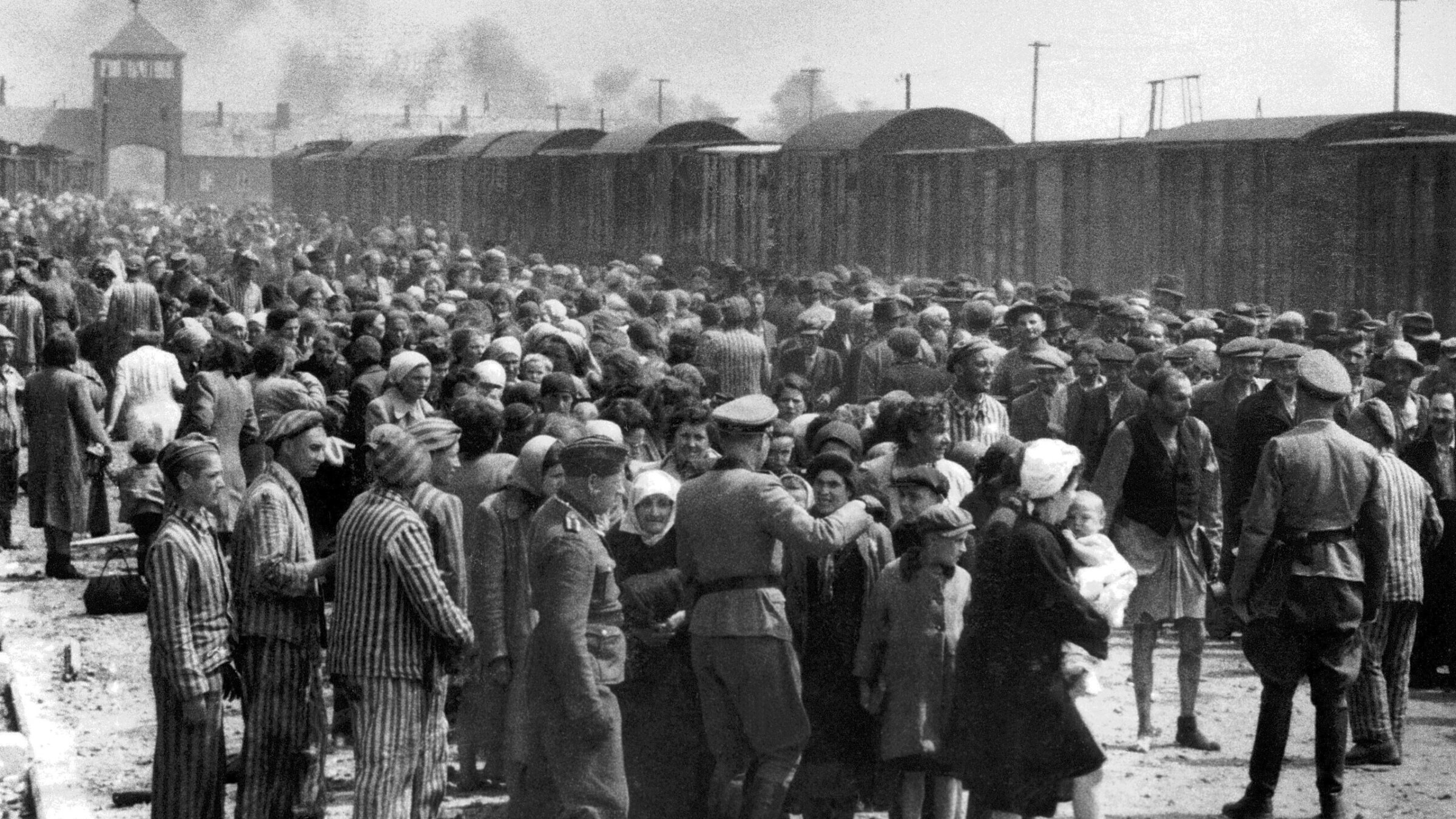
“Selection” of Hungarian Jews on the ramp at Auschwitz-II-Birkenau in German-occupied Poland, May/June 1944. Jews were sent either to work or to the gas chamber. Photo by Auschwitz Album / Wikimedia Commons
In 1944, as the Nazi-backed Hungarian regime swept through Jewish homes in Budapest and beyond, the looting was not limited to silverware, paintings or jewelry. They also stole our language.
Among the thousands of personal items cataloged by Hungarian officials were books titled Jiddische Sprachlehre (Yiddish Grammar) and Jiddische Geschichten (Yiddish Stories) — quiet but powerful traces of a living language on the brink of annihilation. These weren’t just books. They were survival manuals, cultural lifelines and bedtime stories whispered across generations.
Holocaust survivor and researcher Clara Garbon-Radnoti, who co-founded the Holocaust Art Recovery Initiative, and I discovered these titles not in some distant archive, but in Hungarian government documents that we were translating with AI’s help earlier this month. The list, which was written in Hungarian and some German, is part of a cache of 180 Holocaust-era microfilm reels long overlooked by historians. Garbon-Radnoti, who’s also a former librarian at the Zekelman Holocaust Center in Michigan, and I have spent a lot of time analyzing and tracing the meaning of the words, often line by line, slide by slide.
To see the word Jiddisch in the middle of an official wartime Hungarian inventory is haunting. These books were registered by functionaries working under the Arrow Cross regime — Hungary’s homegrown fascists. We thought about the Yiddish grammar textbook stripped from its owner; one can imagine it left open on a desk in a ransacked apartment. We imagined the collection of Yiddish stories whose pages might have still smelled of childhood or candlewax. No author was listed. No publisher. Just a note that it was Jewish.
The theft of Yiddish books was no accident. As with art, Torah scrolls and personal diaries, the regime sought to dismantle not only Jewish life but Jewish memory. The language of exile, resistance, lullabies and prayer was boxed up and sent for storage — or destruction.
During the Holocaust and for a short time afterwards, many of the seized items were funneled to Hungarian institutions, including national libraries and museums. Some may still remain in private collections, as is made clear in the Hungarian documents. Others are lost forever. But the record of their existence endures, and with it, a duty to tell the stories behind the titles.
These aren’t just dusty documents. They’re living evidence. They show that Hungary’s Holocaust looting extended beyond what could be carried away in bags. They reached into the very soul of a people, and tried to erase its voice.
Thanks to Clara Garbon-Radnoti’s discovery, and AI-assisted translation, we are finally recovering some of that voice. One line at a time.

Hello, fellow Forward reader! I’m Joel Brown, a Forward reader and supporter for more than 15 years, and currently the chair of the board of directors.
I’m an avid Forward reader because it ticks so many of my essential boxes: excellent journalism, Jewish focus and diverse viewpoints. In today’s political climate, what I most appreciate is the Forward’s independence — made possible by the generosity of its membership.
The Forward is committed to bringing you unbiased, nuanced Jewish news. From my position as board chair, I see an exciting future as we expand our position as the definitive independent voice of contemporary American Judaism.
That’s why I’m paying it Forward, by matching $36,000 of reader gifts. It’s an investment in the Forward’s newsroom, to continue telling the American Jewish story with truth and independence.
— Joel Brown, Forward board chair
Support our mission to tell the Jewish story fully and fairly.