Trump taps Abraham Accords negotiator as ambassador-level hostage envoy amid Gaza crisis
Adam Boehler shares Trump’s view of U.S. negotiations backed by the threat of military action
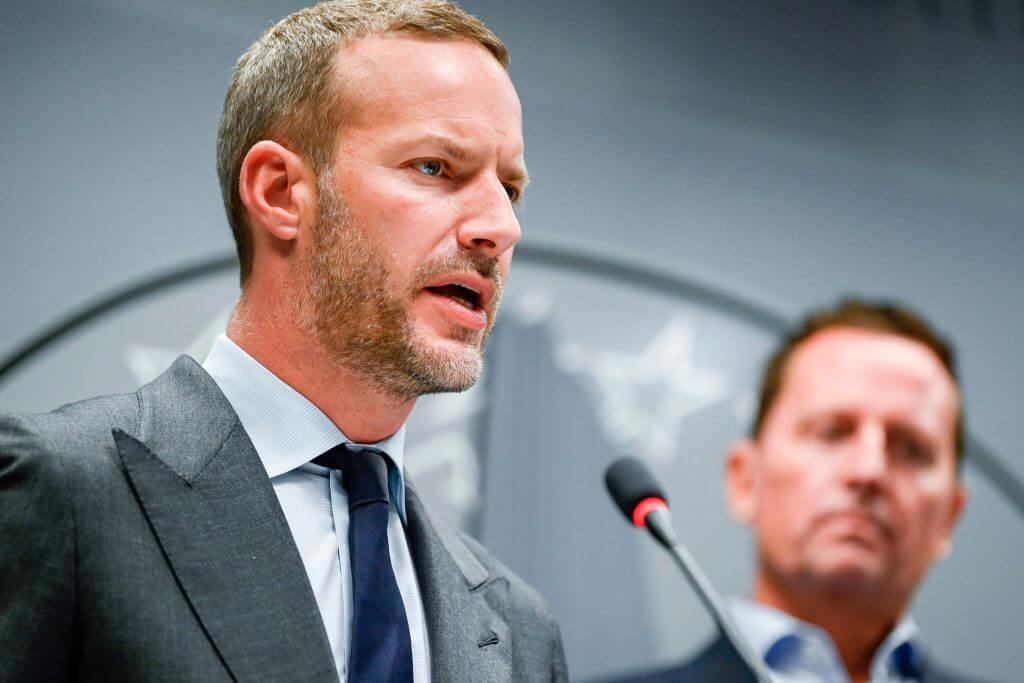
Adam Boehler on Sept. 21, 2020. Photo by ARMEND NIMANI/AFP via Getty Images

By Jacob Kornbluh December 4, 2024
President-elect Donald Trump on Wednesday nominated the man who helped him negotiate Israel’s deals with Gulf states during his first term to serve as his special envoy for hostages, a post he aims to elevate to the rank of ambassador. The nominee, Adam Boehler, said he’d be focused on the seven Americans among some 100 hostages who were kidnapped during the Oct. 7 Hamas terror attack on Israel and still captive in Gaza.
“There is nothing more important than bringing Americans home,” Boehler, 45, said in a social media post. “Under Donald Trump’s leadership, there will finally be action and consequences.”
Boehler, who is Jewish, was CEO of the U.S. International Development Finance Corporation during the first Trump administration. He served with Jared Kushner, Trump’s son-in-law, on the negotiating team for the Abraham Accords and was the lead negotiator in normalization talks between Israel and Morocco. Bohler and Kushner were summer college roommates and also worked together on a national coronavirus testing plan.
What it means for American Jews and Israel
The Biden administration has been attempting a final push to get a hostage and ceasefire deal sealed before departing office on Jan. 20. Trump himself issued an ultimatum on Monday to Hamas, saying all hostages must be released before he returns to the White House or “there will be ALL HELL TO PAY in the Middle East, and for those in charge who perpetrated these atrocities against Humanity.”
But experts believe any agreement would likely involve waves of releases over perhaps 45 to 60 days.
Three American hostages — Keith Siegel, Sagui Dekel-Chen and Edan Alexander – are believed to still be alive. The bodies of four more — Itay Chen, Omer Neutra, Gadi and Judi Haggai — are also believed to be in Gaza.
In past writings and interviews, Boehler said that U.S. negotiations to secure the release of Americans should be backed by the threat of military action. Earlier this year, Boehler said that the Abraham Accords happened because Trump took a hard stance on Iran.
“That is how real peace is achieved in the Middle East, through strength,” he wrote on LinkedIn. “Now is the time to get tough on Iran and their proxies, especially Hamas.”
The position Boehler was tapped for, special presidential envoy for hostage affairs, was created in 2015 by former President Barack Obama – following pressure from the families of hostages who were held abroad by terror organizations – and has been continuous since then. The current envoy, Roger Carsten, was appointed by Trump in 2020 and continued under President Joe Biden.
Trump elevated it to ambassador level, presumably given the gravity of the situation, as Biden did with the special envoy to combat and monitor antisemitism. That means the post will require Senate confirmation, which is not expected to be an issue for Boehler.
"Why I became the Forward’s Editor-in-Chief"
You are surely a friend of the Forward if you’re reading this. And so it’s with excitement and awe — of all that the Forward is, was, and will be — that I introduce myself to you as the Forward’s newest editor-in-chief.
And what a time to step into the leadership of this storied Jewish institution! For 129 years, the Forward has shaped and told the American Jewish story. I’m stepping in at an intense time for Jews the world over. We urgently need the Forward’s courageous, unflinching journalism — not only as a source of reliable information, but to provide inspiration, healing and hope.
Support our mission to tell the Jewish story fully and fairly.