The handwriting analysis that convicted Alfred Dreyfus is for sale
The dossier of Etienne Charavay shows a confused argument that the handwriting expert ultimately recanted
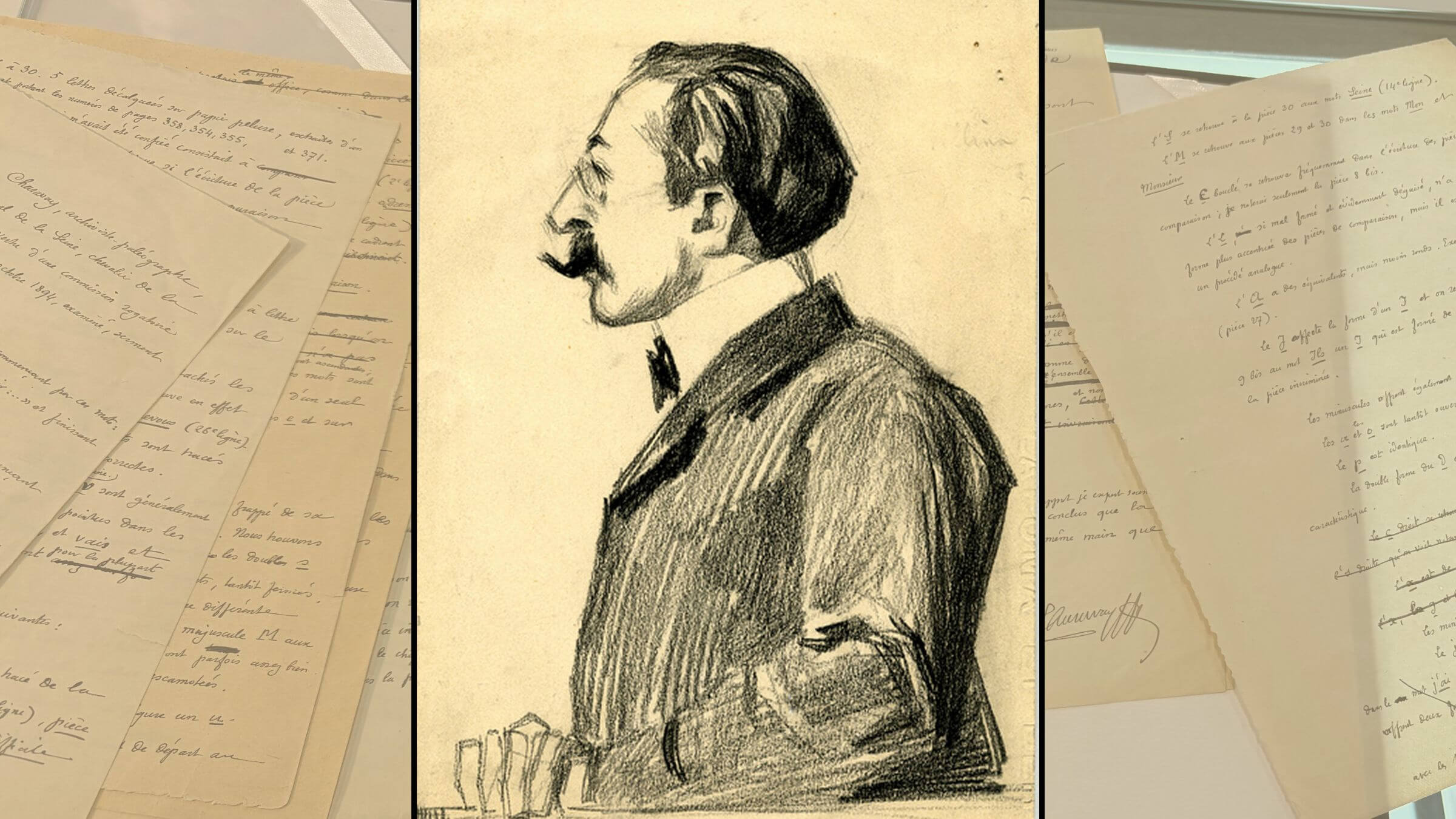
Alfred Dreyfus and the report that falsely argued his handwriting was behind a traitorous document. Screenshot of Getty Images / Manhattan Rare Book Company

By Mira Fox May 1, 2026
The false conviction of Alfred Dreyfus, a captain in the French military, for treason against France in 1894 is remembered by historians as a flashpoint of antisemitism in modern history. It spread a renewed hatred and suspicion of Jews throughout French society, birthed Emile Zola’s famous J’accuse and spurred early Zionists like Theodore Herzl, who referenced the Dreyfus affair as proof that Jews could never be safe in Europe.
The case turned on a document known as the bordereau, a handwritten memo offering French military secrets to the Germans. But the handwriting didn’t resemble Dreyfus’ script. So, key to the case was the testimony of a celebrated handwriting expert, Etienne Charavay, whose analysis confirmed a theory that the bordereau was an example of “autoforgery,” a convoluted theory that Dreyfus was purposefully disguising his handwriting, yet it could still be identified as his — in short, that the lack of resemblance between the handwriting somehow was further proof of Dreyfus’ guilt.
However far-fetched, the theory that Charavay’s report advanced convicted Dreyfus in the public eye as well as in court. Now, those papers — tracings of Dreyfus’ writing alongside the script from the bordereau, an analysis of letter shapes and the expert report — are for sale by the Manhattan Rare Book Company at the Antiquarian Book Fair this week for the low price of $175,000. They are all the more interesting for the fact that Charavay emotionally recanted his testimony against Dreyfus several years after the trial, in 1899.
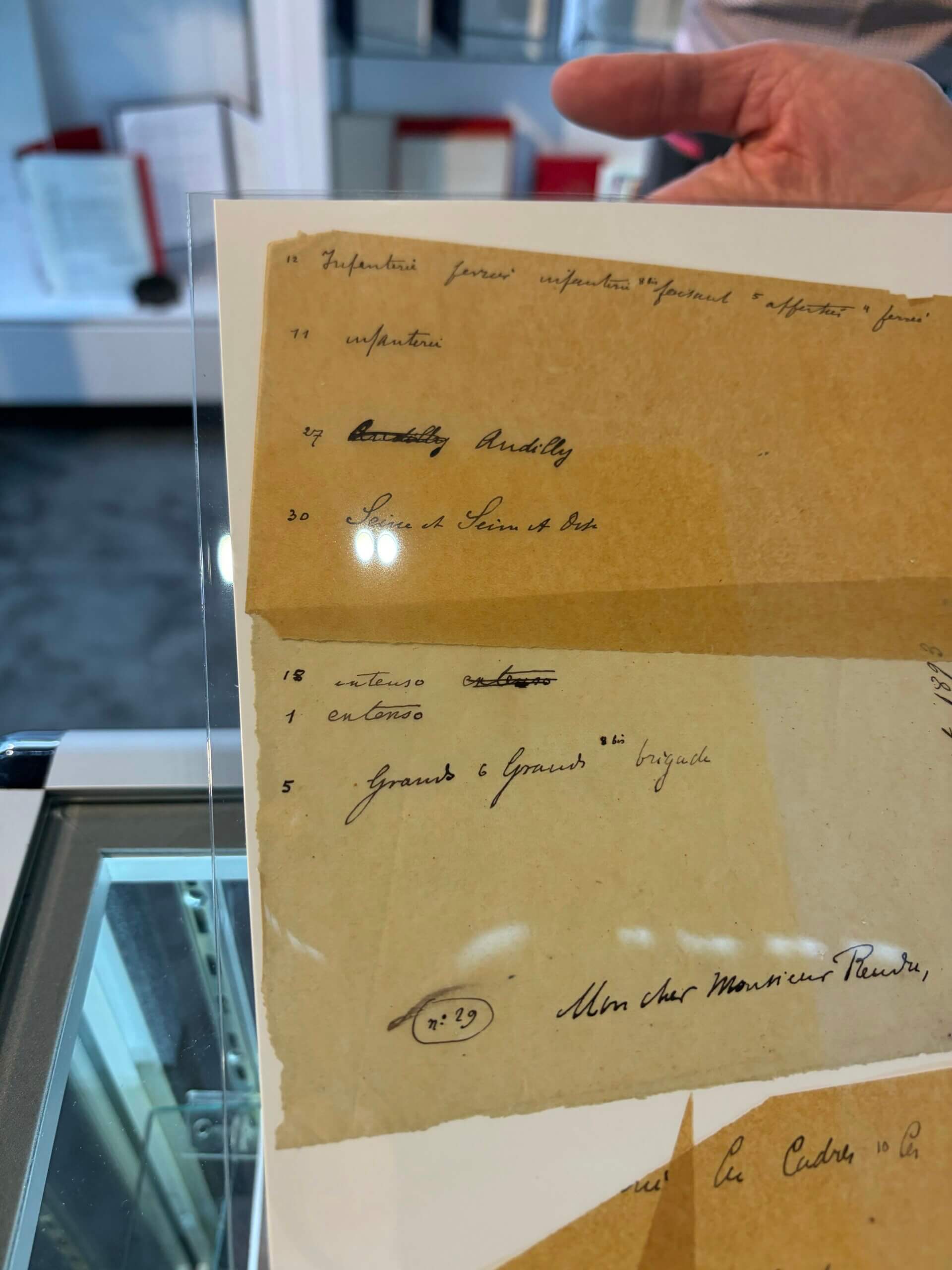
When I went to see the documents for myself at the fair, I found myself applying my own — admittedly amateur — handwriting analysis to the letters. In the first few pages of the dossier, composed of intact only slightly yellowed paper, Charavay outlines the differences between Dreyfus’ hand and the bordereau document, not similarities. There, his writing seems assured; it is unfailingly neat without corrections or ink marks.
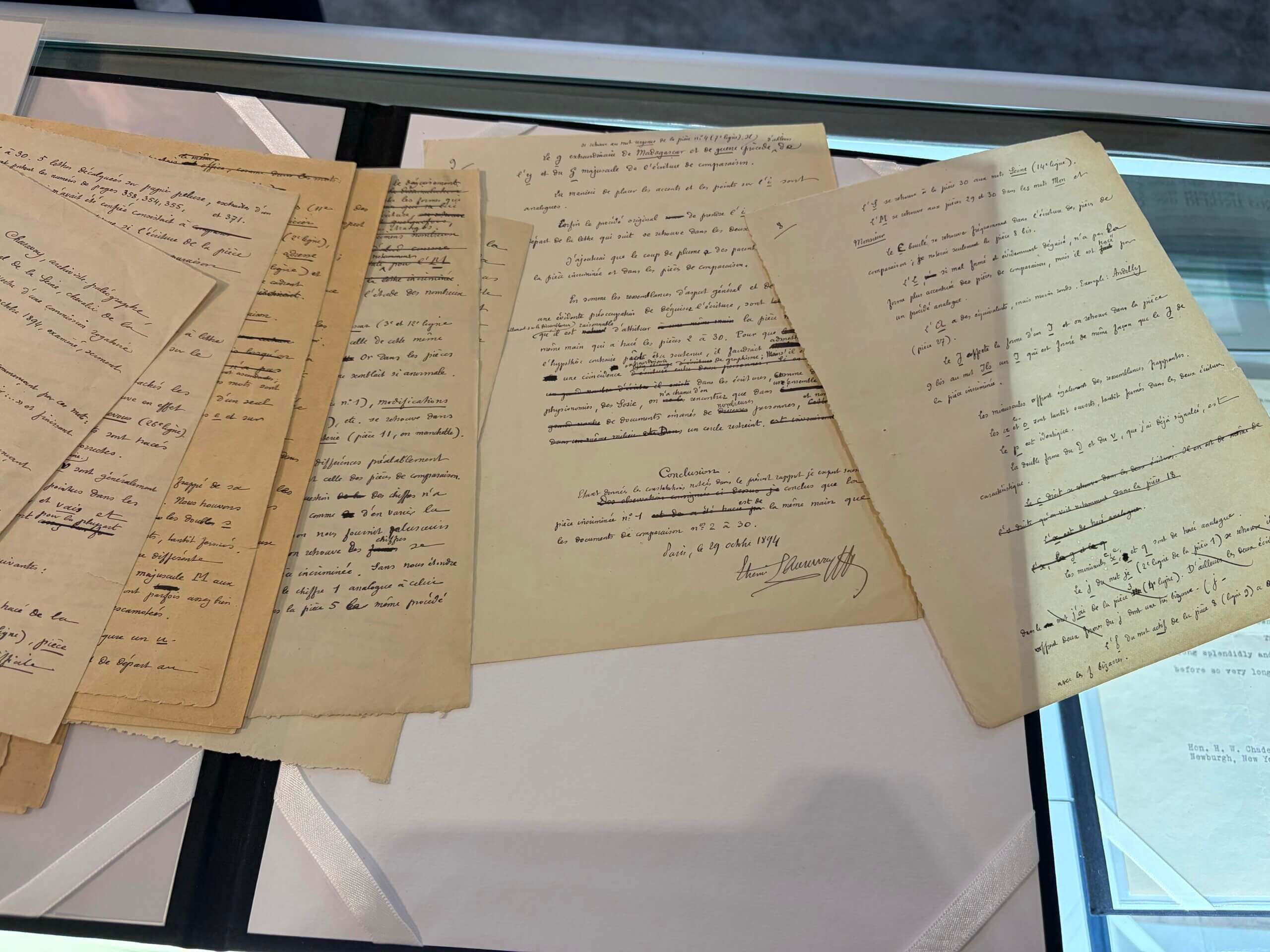
But as Charavay turns to the similarities between the letters, arguing that there are, in fact, particular letters that bear a resemblance to those in the bordereau, he begins to repeatedly cross out lines and make cramped corrections. There are lines of analysis that look almost mathematical, comparing individual letters in quasi-equations. The conclusion of the report has almost as many lines crossed out as there are cleanly written.
When I spoke with Michael DiRuggiero, the owner of Manhattan Rare Books, and his colleague Jeremy O’Connor, both marveled repeatedly at the upside-down logic, which violates a cardinal sin of identifying writing. “As professionals who deal with manuscripts, you can’t argue from differences back to validating manuscripts,” O’Connor said. “He’s working his way back from a conclusion that the handwriting is not Dreyfus’.”
It’s hard to know for sure why exactly the French government was so set on convicting Dreyfus, or what pressures were operating on Charavay when he wrote his much-edited report.
“I don’t know if he believed it or if he’s trying to make an argument that he doesn’t believe,” DiRuggiero said. “I don’t know if that can ever be known, what’s in his head, but the French government wanted a scapegoat.”
Handwritten drama
Dreyfus’ handwriting and that in the bordereau were so obviously different that, before Charavay entered the case, there were many attempts to get Dreyfus to produce the same script. Another officer in the army, Major Mercier du Paty de Clam, tasked with the case, attempted to trick Dreyfus into writing out many of the same sentences as in the bordereau in hopes of reproducing the letters, without luck.
Initially, an expert in signatures at a bank was consulted on the handwriting in the bordereau; he said it appeared “spontaneous,” which is to say written fluidly and freely, an idea that would seem to contradict the later autoforgery theory. (Charavay initially concurred with the analysis of a spontaneous hand.) He pointed out many differences and concluded Dreyfus did not write the traitorous note.
But then a French police officer, Alphonse Bertillon — a forensic expert but not in handwriting — originated the “self forgery” theory, putting forth a report concluding that the writing was Dreyfus’. His testimony was not enough, but it influenced the three people consulted next, including Charavay.
Charavay had risen to a sort of celebrity in France a few years before the Dreyfus trial, when he proved that thousands of letters a collector had bought — including supposed writings from Julius Caesar and Mary Magdalene — were all forgeries. He used a newly scientific form of analysis, comparing individual letter shapes and fluidity with unprecedented precision.
At the time, DiRuggiero told me, science was increasingly being brought to bear in prosecutions. Forensics, including fingerprinting, was a new and buzzy frontier. Charavay’s advances in analysis brought him fame and credibility, as did his titles: the highest form of academic paleographic credential and an appointment as the premier forensic document specialist in the country.
“Without Charavay’s credential, the auto forgery theory is just a nutty theory,” said DiRuggiero. With it, however, papers ran with the story, including a piece in the antisemitic paper La Libre Parole, which had long campaigned against Jews in the French army due to their supposedly treasonous nature. With this, the case became a national controversy.
“If you’re told that’s probably Dreyfus’s hand and you pick up a newspaper and that’s what you’re told,” said DiRuggiero, “the public will just believe that.”
As time after the conviction continued, the public — which had divided into Dreyfusard and anti-Dreyfusard camps — continued to debate the case, with prominent intellectuals including Zola and the novelist Anatole France defending Dreyfus’ innocence. Knowledge of the thin evidence began to disseminate, with Zola specifically castigating several of the handwriting experts by name.
Zola noted their reports were “deceitful and fraudulent, unless a medical examination finds them to be suffering from a condition that impairs their eyesight and judgement.” Charavay, however, was not named, a fact O’Connor hypothesized may have been because he was friends with France and may have expressed his doubts in private, doubts France may have relayed to Zola.
In any case, Charavay emotionally recanted his testimony at Dreyfus’ retrial in 1899, just a year after J’accuse…! Dreyfus himself noted the speech in his memoirs. But it wasn’t enough. Though the real perpetrator, Ferdinand Esterhazy, had fled to England and confessed to journalist Rachel Sassoon Beer, Dreyfus was reconvicted. Eventually, he pled guilty in exchange for a pardon; it took several more years for him to be legally exonerated and reinstated in the army.
We will never be sure why Charavay testified against Dreyfus in the first place. Zola wrote in J’accuse…! that one of the handwriting experts “faced military pressure because he dared to come to a conclusion other than the desired one.” Perhaps Charavay bowed to the same. Based on the overwriting, he struggled to make the pivotal argument to himself.
What we know for sure, however, is that the papers are legitimate — DiRuggiero and O’Connor would never make the same mistakes Charavay did. When I asked them how they validated the dossier, they laughed. “There’s no question that it’s his handwriting,” DiRuggiero said.
I’m personally matching all gifts to the Forward, up to $36,000. Can I match your gift now?

Hello, fellow Forward reader! I’m Joel Brown, a Forward reader and supporter for more than 15 years, and currently the chair of the board of directors.
I’m an avid Forward reader because it ticks so many of my essential boxes: excellent journalism, Jewish focus and diverse viewpoints. In today’s political climate, what I most appreciate is the Forward’s independence — made possible by the generosity of its membership.
The Forward is committed to bringing you unbiased, nuanced Jewish news. From my position as board chair, I see an exciting future as we expand our position as the definitive independent voice of contemporary American Judaism.
— Joel Brown, Forward board chair
Support our mission to tell the Jewish story fully and fairly.