In celebration of David Attenborough’s 100th birthday, a very Jewish song
‘What a Wonderful World,’ immortalized by Louis Armstrong and heard at Attenborough’s centenary, has a particularly Jewish history
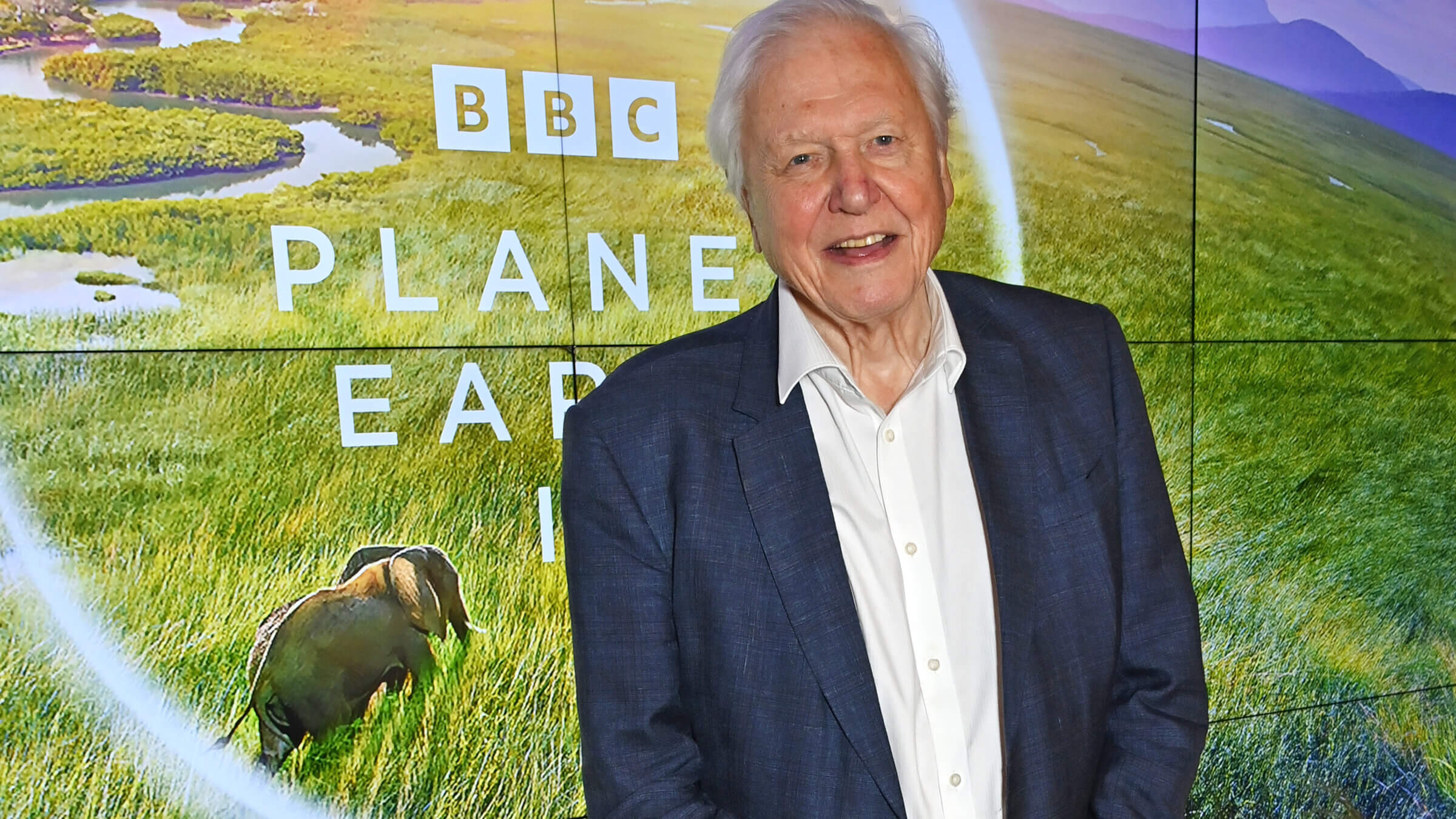
Sir David Attenborough attends the Global Launch of BBC Studios’ “Planet Earth III,” 2023. Photo by at Frameless on October 12, 2023 in London, EnglDave Benett/Getty Images

By Benjamin Ivry May 20, 2026
When the much-beloved English broadcaster David Attenborough was celebrated at London’s Royal Albert Hall with the tribute 100 Years On Planet Earth, a spoken word recording was played of Attenborough reciting the song “What a Wonderful World.”
Co-written by the Jewish songwriter George David Weiss, a Juilliard-trained musician, the song was originally intended for Louis Armstrong as a reflective follow-up to Armstrong’s peppy smash hit “Hello, Dolly!” by the Broadway composer Jerry Herman. “What a Wonderful World” was not universally acclaimed at first. Armstrong’s clarinetist Joe Muranyi later described Satchmo’s first reaction to the tune in a way that may be politely paraphrased as “What is this drek?”
The unabashed sentimentality, funereal tempo, and absence of any jazziness may have put off musicians initially, and indeed discouraged record company president Larry Newton (born Louis Nutinsky). Newton so loathed the very concept of the melody that he tried to stop the recording session and had to be physically removed and locked out of the studio. Later, Newton refused to promote the song, which had almost no immediate impact in America, although it became a #1 hit in the U.K.
“What a Wonderful World” expressed a Great Society optimism of the 1960s, which was overwhelmingly supported by American Jews, believing that successive generations would be better educated and the federal government would resolve systemic poverty and racial inequality. “I hear babies cry, I watch them grow/ They’ll learn much more than I’ll ever know,” Armstrong sang.
Meanwhile, the song acquired newfound popularity in 1999 when the saxophonist Kenneth Bruce Gorelick, known as Kenny G, added his own accompaniment to Armstrong’s vocals and other elements of the original recording. Jazz mavens were outraged, led by the guitarist Pat Metheny, who called Kenny G’s effort “musical necrophilia.” No such excoriations were heard in 2001, when punk rockstar Joey Ramone (born Jeffrey Ross Hyman), produced an exceedingly loud cover version with its own gritty integrity and authenticity. And in 2018, Barbra Streisand was generally praised for blending the song with John Lennon’s “Imagine” on her album Walls. As The Hollywood Reporter commented, Streisand’s purpose was likely to inspire hope during a crisis in American sociopolitical history, to offer a reason to “persevere during a period of cascading nightmares.”
The Attenborough event at the Royal Albert Hall also featured a performance of “Nature Boy” by the Jewish U.K. singer Sienna Spiro, whose full-throated singing recalls the precedent of the 1960’s Jewish U.K. singer Alma Cogan. The song Spiro chose to sing was written by George Alexander Aberle, who spent his early childhood at the Brooklyn Hebrew Orphan Asylum and adopted the pen name of eden ahbez, spelled with lower-case letters because, he asserted, only the words God and Infinity merited capitalization.
As was the case with “What a Wonderful World,” some controversy surrounded “Nature Boy,” originally popularized by Nat King Cole. The Belarusian Jewish-born composer and singer Herman Yablokoff claimed in a memoir that the melody of “Nature Boy” was plagiarized from his song “Shvayg mayn harts” (“Be Still, My Heart”), which he wrote for the play Papirosn (Cigarettes) in 1935.
At first, ahbez denied the charge, claiming to Yablokoff that he had first heard the tune in the California mountains, as if sung by angels. To which Yablokoff, with the brass-tacks realism of a Yiddish theater veteran, replied that the song was geganvet (stolen) and if any angels had been singing it, they must have purchased the sheet music of his song. Eventually ahbez’s lawyers offered an out-of-court settlement, which was accepted.
As far as the Attenborough concert is concerned, the tribute at the Royal Albert Hall brought to mind the case of Miriam Rothschild, a Jewish naturalist who preceded Attenborough in creating compelling nature documentaries. Rothschild was also a celebrated zoologist, entomologist and conservationist of lasting original achievements.
Nicknamed the queen of fleas due to her understanding of that life form, Rothschild was also an activist who saved lives of Jewish refugees during wartime, personally housing 49 children at her family estate and urging that laws be liberalized to allow more escapees from Fascist Europe to find safety in Britain. Perhaps tellingly, Rothschild also marveled at tiny mites that found refuge in the ears of moths. Her films did not dwell on the predatory violence of nature, which most other documentaries, even Attenborough’s, sometimes did to inspire thrills and chills among viewers.
With comparable compassion, Rothschild supported social causes including animal welfare, free milk for children at school, and gay rights by contributing to the 1957 Wolfenden Report which resulted in decriminalizing homosexual behavior in the U.K. By contrast, Attenborough, as a senior manager at the BBC, controller of BBC Two, and director of programming for BBC Television in the 1960s and 1970s, eschewed making public statements about societal issues until very recently, even those relating to climate change, as Nature Magazine observed in its centenary salute.
Yet by focusing on the world and latterly on damage from careless abuse of natural resources, Attenborough promoted biodiversity, renewable energy, and natural preservation areas, among other initiatives. And all Jewish TV spectators can only be grateful that as controller of BBC Two, Attenborough commissioned The Ascent of Man, the 1973 series in which Jacob Bronowski, the Polish Jewish mathematician and humanist, expressed his personal philosophy. In its own way a sometimes rueful homage to a wonderful world, Bronowski’s conclusions about nature and humanity were so powerful that they overshadow the occasional executive decision for which Attenborough later expressed regret, such as the budget-motivated 1960s destruction of archived BBC programs. As a result, much Jewish media history was lost, including The Madhouse on Castle Street, a 1963 teleplay with the then- little-known Bob Dylan among the performers.
Nonetheless, Attenborough’s series, which include Life on Earth, The Living Planet, The Trials of Life, The Life of Mammals, Life in the Undergrowth and many others underscore the fact that appreciating nature is a L’chaim to all of creation, the ultimate message of his long life’s work, much deserving of the praise it has received.
I’m personally matching all gifts to the Forward, up to $36,000. Can I match your gift now?

Hello, fellow Forward reader! I’m Joel Brown, a Forward reader and supporter for more than 15 years, and currently the chair of the board of directors.
I’m an avid Forward reader because it ticks so many of my essential boxes: excellent journalism, Jewish focus and diverse viewpoints. In today’s political climate, what I most appreciate is the Forward’s independence — made possible by the generosity of its membership.
The Forward is committed to bringing you unbiased, nuanced Jewish news. From my position as board chair, I see an exciting future as we expand our position as the definitive independent voice of contemporary American Judaism.
— Joel Brown, Forward board chair
Support our mission to tell the Jewish story fully and fairly.