Despite what (Ashkenazi) tradition says, not everyone eats dairy on Shavuot
From beer to berbere-spiced bread, culinary traditions from across the diaspora harken back to ancient foodways.
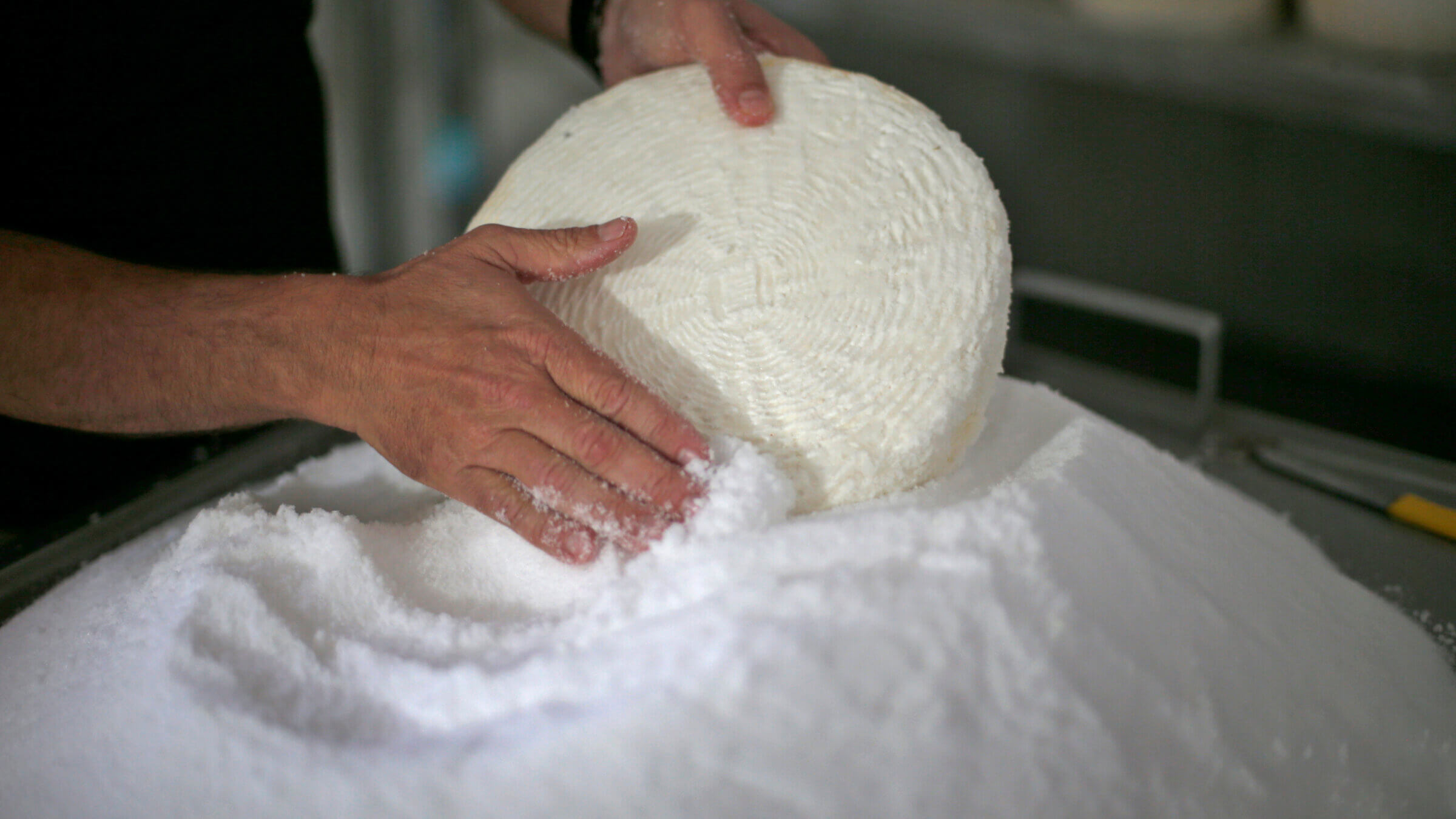
Cheese is prepared for Shavuot, a holiday often associated with dairy. Photo by JALAA MAREY/AFP via Getty Images)
This week, synagogues and community centers around the country will abound with opportunities for a festive scoop of ice cream. To heck with the lactose intolerant among us; it’s Shavuot, a festival that for many is as synonymous with all things dairy as Passover is with all things matzot. In my childhood Ashkenazi home, Shavuot meant my bubbe’s cheese blintzes freshly pan fried and golden brown on the kitchen table, ready for me to drench in syrup. Each year, the holiday, with its invitation to indulge in specially prepared creamy desserts, won me back to my Jewish culinary birthright after I spent Passover explaining my unleavened lunches to narrow-minded classmates. This year, however, I’ve been the one getting the education.
“Not all Jewish communities explicitly connect Shavuot with dairy foods,” Leah Koenig, whose cookbooks include the encyclopedic The Jewish Cookbook and the forthcoming The Dessert Table: 100 Joyful Jewish Sweets, told me. “It is a reminder that Jewish cuisine is anything but a monolith.”
Indeed, at Shavuot tables across the diaspora, you’ll find a parade of sweet, milky delicacies, and sometimes none at all, revealing a diversity ripe for this season when we recite the story of Ruth.
Born in Europe, Shavuot foods grew up around the world
Torah scholars and rabbis tend to agree that eating dairy on Shavuot first emerged as a tradition (minhag) during the High Middle Ages, at first among Ashkenazi Jews in France and Germany. Agreement ends there. A 2009 study offered nearly 150 reasons for the tradition. Lesser known theories posit that dairy pays homage to our nomadic ancestors. Teachings that endure today evoke the Torah and Israel’s symbolic associations with milk and honey.
Since its first appearance in Western Europe, dairy at Shavuot tables has gone global. “Sephardim, Ashkenazim, Mizrahim celebrate Shavuot eating dairy foods,” said Hélène Jawhara Piñer, author of Food, Jews, and Spain, which studies medieval Spanish Jews through their cuisine. During the Middle Ages, she noted, a culinary dialogue ran between Ashkenazi and Sephardic communities. “Rabbis, merchants, physicians, refugees and manuscripts circulated between Iberia, Provence, Italy, North Africa, France, and the German lands,” she said. In her latest cookbook, Matzah and Flour, she offers a Shavuot recipe for a sweet version of barkoukch, a Moroccan milk-and-semolina soup she calls one of the oldest Sephardi Shavuot foods still eaten today. It shares a heritage with other Sephardi and Mizrahi desserts like arroz con leche, a cinnamon-scented rice pudding, and its rose-flavored cousin, shir berenj.
For the modern-day Bene Israel, a small community of Indian Jews whose roots in the coastal region south of Mumbai date back to 175 BCE, it took 1,500 years and the arrival of Sephardic Jews before they associated eating dairy treats with Shavuot, according to Zilka Joseph, an Ann Arbor-based poet and editor who explores her Bene Israel heritage through her writing. Isolated from the diaspora, the Bene Israel sustained a handful of rituals (Shabbat, reciting the Shema). When Sephardic families arrived in present-day Kerala after their expulsion from Spain, these practices helped them identify the Bene Israel as Jewish. They went on to introduce the Bene Israel to a host of other traditions, which could have included dairy on Shavuot, Joseph told me.
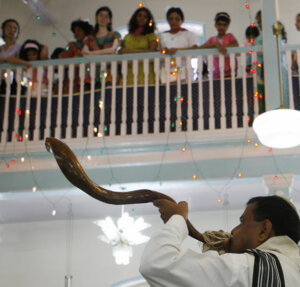
Today, most of the Bene Israel live in Israel, but even the roughly 5,000 who remain in India celebrate Shavuot with dairy specialties, according to Nissim Pingle, program director at the Joint Distribution Committee (JDC) in India. These include custards and mousses — like basundi, a creamy slowly simmered milk dessert bursting with cardamom seasoning and chopped nuts, and shrikhand, a tangy strained yogurt often infused with fresh fruit like in-season mango — that are also common at birthdays and other special family occasions.
“When people ask about Bene Israel food, and they say, ‘So, is it really Maharashtrian food?’” said Joseph, referring to the Indian state where the Bene Israel’s ancestral home is located today. “It is,” she said, “but we adapted it to our kosher laws.”
The Bene Israel are not alone. Jews around the world ate the foods influenced by the places they settled and adapted them to dietary law.
“Food culture was shaped at least as much by geography, commerce and shared local taste as by rabbinic prescription,” said Jawhara Piñer.
“The cheesecake Ashkenazi Jews eat on Shavuot is a descendant of the curd cheese-based cakes that Jews and their neighbors ate in Germany,” Koenig told me.
Trading dairy for ancient harvest customs in the Horn of Africa
For communities from the Horn of Africa, near historical Judea, it’s no wonder that their Shavuot menu — which does not always contain dairy — hews closer to the foodways of our biblical ancestors, for whom the holiday was in part an agricultural festival.
To escape persecution in Ethiopia in the early 1980s, Beejhy Barhany, Ethiopian-born founder and executive chef of the Harlem cultural hub and event-space Tsion Café, immigrated to a kibbutz in Israel, where she immersed herself in the tradition of bikkurim, or festival of the first fruits.
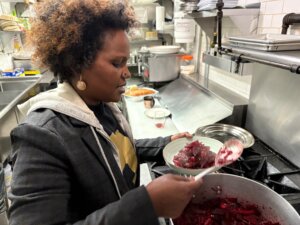
“It was lovely to learn about other traditions and customs,” Barhany said, “but we always have to make sure that we know our traditions and teach others that there are different forms to celebrate the holidays.”
Since Ethiopian first fruits often meant wheat, barley or millet, Barhany told me that Ethiopian Jews like her (also known as Beta Israel) would make baked bread for Shavuot, such as a barley, honey-infused version of the celebratory dabo. But in Ethiopia barley wouldn’t stop there: brewing beer can help celebrate the harvest, as can roasting and consuming coffee, a ceremony called buna, an appropriate conclusion for Ethiopian spiritual occasions. (On Shavuot, coffee might be extra important, given its suspected role in popularizing the holiday’s tradition of all-night Torah study.)
Likewise, Yemenite Jews take pride in never having lost touch with their ancient traditions. They still recite prayers in Hebrew and Aramaic, as instructed by the Mishnah. Since the Mishnah doesn’t dictate eating milky foods for Shavuot, they stick to savory, classical regional holiday fare. This can include traditional Shabbat breads (thin jachnun, flaky malawach, and yeasty, pull-apart kubaneh), according to Dr. Ephraim Isaac, a Harvard scholar and former president of the Yemenite Jewish Federation of America. The Brooklyn-based Association of Jewish Yemenites told me that Shavuot celebrations would include zalabyeh, a fried pita.
Eating diversely while embracing the meaning of Ruth
No matter which foods they’re eating for Shavuot this year, everyone I spoke to said they would be reading the Book of Ruth, the story traditionally recited for the holiday. Ruth is from the Moab people, considered bitter enemies of the Israelites. Nevertheless, she stays loyal to her Israelite mother-in-law Naomi after her husband’s death. She follows Naomi to Bethlehem and gleans the fields at harvest to feed them. Rabbis note this as an instructive story to tell on Shavuot as a complement to our focus on receiving the Torah at Mount Sinai. Ruth, who wasn’t born a Jew, helps Naomi out of pure lovingkindness (hesed), not legal obligation, and Boaz marries and has a child with her that starts the lineage of Kings David and Solomon. Lovingkindness, not law alone, is what made us a people; and why we should keep widening our table. So, this Shavuot, go ahead and eat a blintz, barkoukch, loaf of dabo or cool, creamy basundi. Or grab a beer. It’s all in the family.
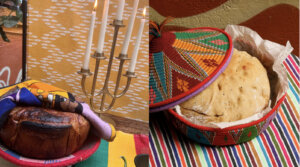
Nay Kedam Dabo / Meswait, or Pot-Baked Shabbat Bread*
*Holiday Festival Variant
From Gursha: Timeless Recipes for Modern Kitchens, from Ethiopia, Israel, Harlem, and Beyond by Beejhy Barhany
Makes 1 large loaf (serves 10 to 12)
INGREDIENTS
2 pounds (907 grams) spelt flour*
*For the holiday, Barhany encourages substituting some barley flour in place of spelt (around 450 grams barley flour, with 457 grams spelt)
2 tablespoons granulated sugar or brown sugar*
*For the holiday, Barhany encourages substituting honey
2¼ teaspoons (1 envelope) instant yeast
1 teaspoon fine sea salt
½ teaspoon ground fenugreek
½ teaspoon ground coriander
½ teaspoon ground cardamom
2½ cups (600 grams) warm water, plus more if necessary
1 tablespoon vegetable oil, plus more for drizzling
INSTRUCTIONS
In a large bowl, mix the flour, sugar, yeast, salt, fenugreek, coriander, and cardamom. Add the warm water, ½ cup at a time, working the water into the flour until a dough forms. Knead the oil into the dough until it is wet and elastic. If it seems too dry, add more water, a tablespoon at a time.
Cover with a damp towel and place in a warm place until doubled in size and light and bubbly on top, 1 to 2 hours.
Line a medium cast-iron pot or Dutch oven with two layers of parchment paper and drizzle the paper with oil. Transfer the dough to the pot and use wet hands to spread it into an even layer and smooth out the surface. Cover with the lid and let rise for about 15 minutes. With the pot still covered, set it over low heat and cook for 25 minutes.
Use the top layer of parchment paper to lift the bread out of the pot. Place on a plate. Drizzle the uncooked top with oil, then return the bread oiled-side down to the pot on top of the second layer of parchment paper, and drizzle the other (cooked) side with oil.
Cook until the bread is golden brown and puffed and the center reaches about 190°F on an instant-read thermometer, about 25 minutes.
I’m personally matching all gifts to the Forward, up to $36,000. Can I match your gift now?

Hello, fellow Forward reader! I’m Joel Brown, a Forward reader and supporter for more than 15 years, and currently the chair of the board of directors.
I’m an avid Forward reader because it ticks so many of my essential boxes: excellent journalism, Jewish focus and diverse viewpoints. In today’s political climate, what I most appreciate is the Forward’s independence — made possible by the generosity of its membership.
The Forward is committed to bringing you unbiased, nuanced Jewish news. From my position as board chair, I see an exciting future as we expand our position as the definitive independent voice of contemporary American Judaism.
— Joel Brown, Forward board chair
Support our mission to tell the Jewish story fully and fairly.