Yiddish street signs: Commemoration or marginalization?
A “memory landscape” in Berlin’s former Yiddish-speaking neighborhood revives the dream of Yiddish as an official minority language of Germany
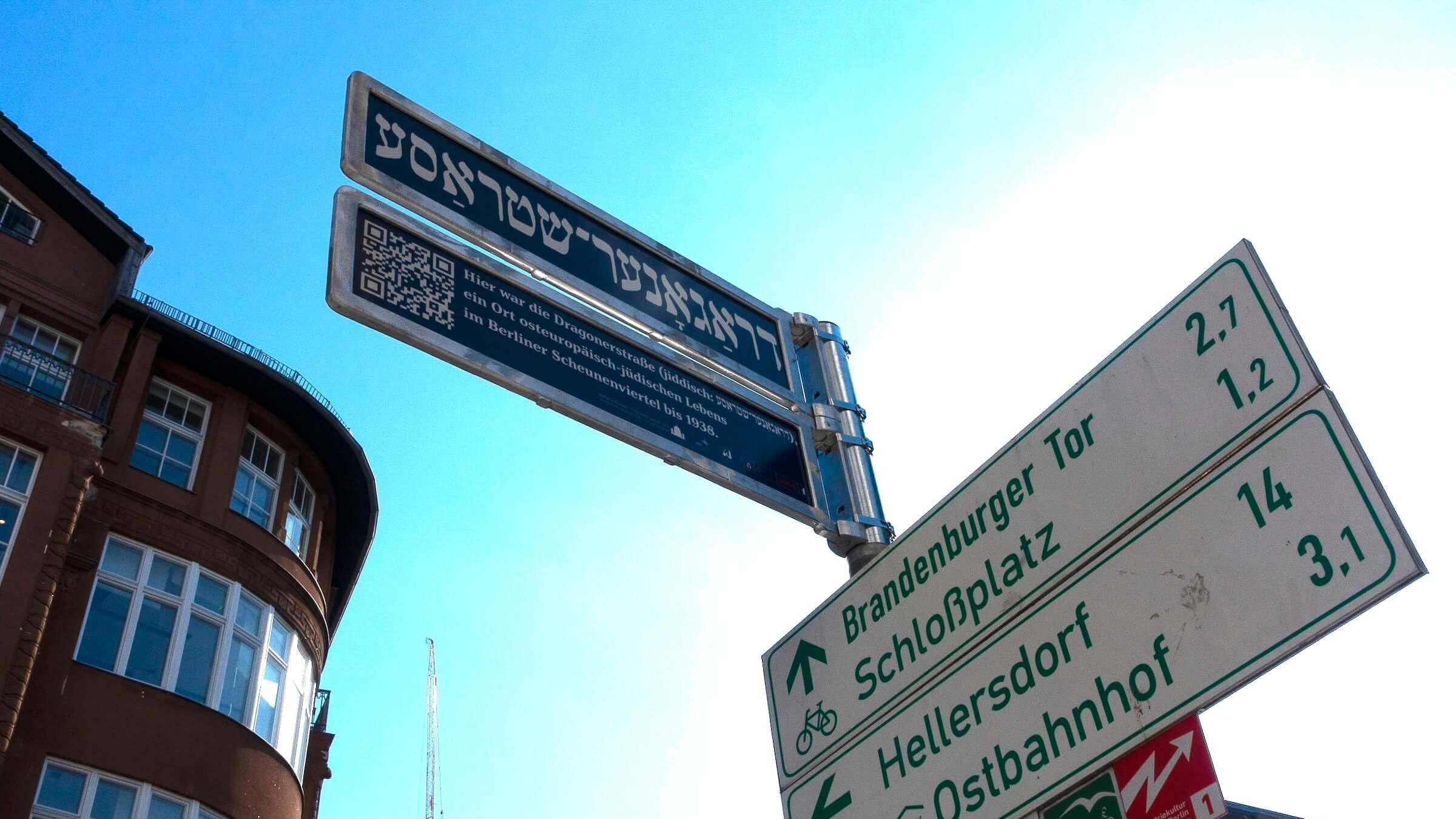
A new Yiddish sign for a street that was called Dragonerstrasse when Eastern European Yiddish speakers lived there, roughly from the 1880s to the 1930s Photo by Arndt Beck
By Jake Schneider May 1, 2026
This is a revised translated version of the original article in Yiddish which you can read here.
One sunny day in spring 2021, without asking permission, artist Sebestyén Fiumei climbed a ladder in central Berlin and attached a white sign to a pole. It was inscribed with an antiquated Yiddish spelling of the street’s former name, “Grenadierstrasse.” Apart from the name change and the Yiddish alphabet, Fiumei’s illicit artwork was identical to the official German street sign on the same pole.
Until 1938, Grenadierstrasse was the most visibly Jewish street in Berlin. Its Jewish residents were predominantly Yiddish speakers born in Eastern Europe. In a sense, they’d brought the language home. After all, the Yiddish language originated in Germany, or “Ashkenaz,” and most German Jews had shifted to German just a few generations earlier, hoping conformity might bring them equality.
The Holocaust catastrophically exposed the false promises of German assimilation, while nearly obliterating Yiddish, the language of 85% of the murdered Jews.
Fiumei’s rogue street sign was quickly seized by a street patrol. But a Jewish district official, Nathan Friedenberg, was moved by its message: that German memorials and museums should commemorate not only affluent German speakers, but working-class Yiddish speakers as well — and reflect how Jews lived, not only how they died.
Together with historian Jess Earle, Friedenberg sought funding and approval for 10 official Yiddish signs around the old Jewish quarter, modeled on Fiumei’s.
The project quickly got snarled in red tape. Even the white background and the words “sign” and “art” were verboten. To make matters worse, regulations nearly prohibited the official use of Yiddish at all, due to the fact that it isn’t one of Germany’s recognized minority languages.
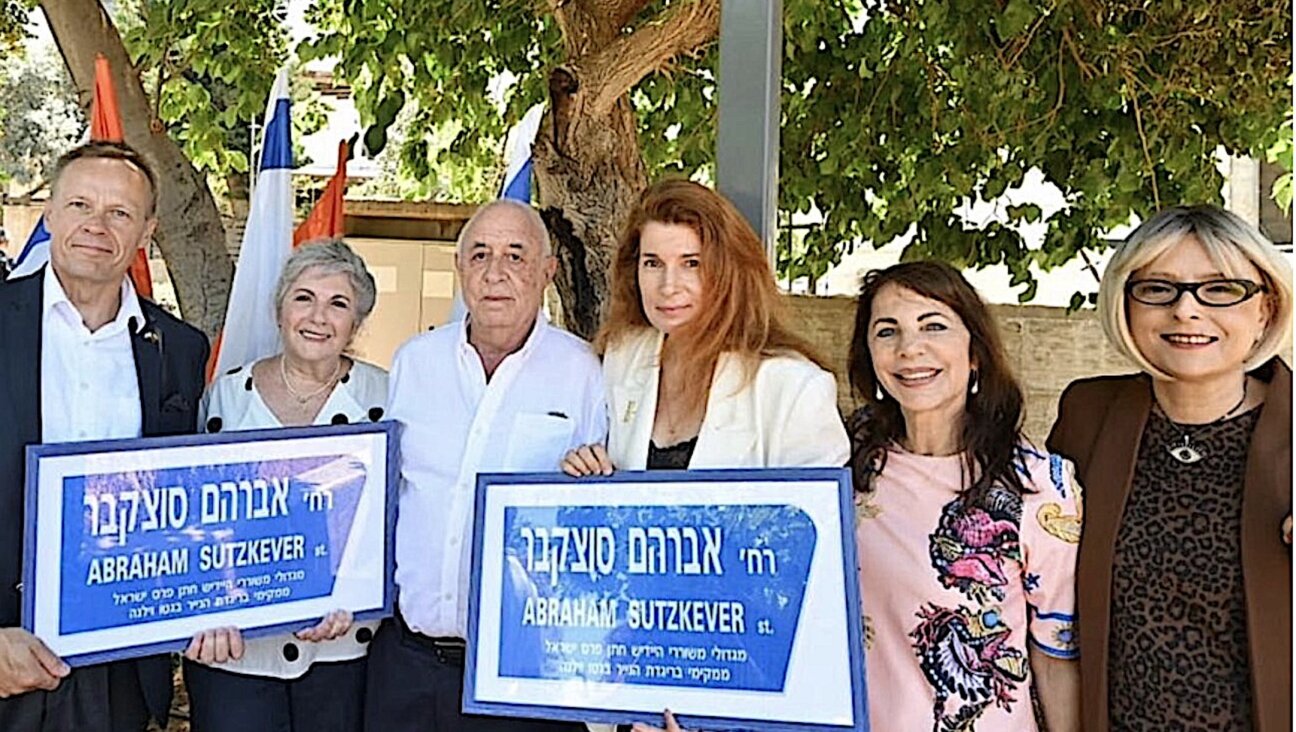
Five years later, on March 11, Earle, Friedenberg, and the institutions they work for, held an unveiling on the corner. The new “marker” retains Fiumei’s Yiddish spelling, above a contextualizing plaque in German and English. A QR code links to a new local history website headlined “Without a trace?”
The roughly 30 people who attended the unveiling included at least four Yiddish professionals, all thrilled to see our language in a public space. But the ceremony didn’t include a word of Yiddish.
“Of course not,” Earle told me unapologetically. “Yiddish isn’t the focus. It’s only mentioned when completely necessary.” Indeed, the website barely invokes it. Friedenberg, for his part, acknowledged the omission and promised to involve Yiddish speakers in future events.
But what exactly has vanished “without a trace”? Most Jews living in Germany today are from Eastern Europe, especially the former Soviet Union — another wave of Ashkenazis returning to Ashkenaz. Latvian-born Yiddish singer Sasha Lurje, for example, settled in Neukölln — an immigrant neighborhood like the old Jewish quarter — where she spearheaded a vibrant Yiddish music scene with her friends.
“I deeply connect to the people who once lived in the Jewish quarter,” says Lurje. “They remind me of my relatives.”
That Neukölln scene spawned the cultural organization Shtetl Berlin, with its regular events and an annual Yiddish music and culture festival, which is gradually coalescing with the literature and arts scene around a second group, Yiddish.Berlin. (I work with both groups.) In March alone, the combined community hosted a jam session, a potluck, poetry events, concerts, a Yiddish-speaking bar meetup, and assorted reading and writing groups.
Not all “real” street signs in Germany are monolingual. In late March, I drove 110 km (70 miles) to Lusatia, home to two recognized Slavic minority languages: Lower Sorbian (Wendish) and Upper Sorbian. There, Sorbian place names are legally mandated on village signs, street signs, even canal signs. But all weekend, I didn’t hear a word of the language.
For centuries, German governments suppressed Lower and Upper Sorbian: imposing German names, banning Sorbian-language newspapers, expelling pastors, resettling outsiders, collectivizing farms and destroying more than 130 villages to make way for coal mines.
Eventually, parents stopped speaking Lower Sorbian to their children, and Upper Sorbian survived in just a few Catholic enclaves. But serious revitalization efforts are now underway for both languages, with a goal of 100,000 Sorbian speakers by 2100.
The Sorbian languages are now protected under the European Charter for Regional or Minority Languages, a status that brings funding and institutions: a Sorbian research institute; wide-ranging arts programs; language immersion programs for children and adults; a publishing house; several museums; two high schools; and, crucially, salaried jobs.
The Sorbian Institute even hired two linguists, Šyman Blum and Evan Bleakly, to visit 70 villages by bicycle and photograph every sign in the “linguistic landscape,” even ones that illegally exclude Sorbian.
For some people, seeing the revitalization of “definitely endangered” Lower Sorbian elicited an emotional reaction. “When I first heard children speaking the language, I almost cried,” Bleakly said.
Sorbian artist Bernhard Schipper called the bilingual signs “very important,” and the language activist Měto Nowak is proof. The signs inspired Nowak to learn Lower Sorbian; he later chaired the body representing Germany’s minority languages.
In a message to me, Nowak wrote: “I’ve often wondered why Yiddish is not a minority language in Germany, as it is in eight European countries.” Its significant support in Sweden, for example, was recently highlighted in the comic documentary Swedishkayt.
At a café on former Grenadierstrasse overlooking the Yiddish sign, Nowak told me behind-the-scenes stories about the politics of minority languages and how they attain this status. A week later, he published his own article about the Yiddish signs — written in Lower Sorbian.
As it happens, Fiumei was working on more than one public-facing Yiddish project in spring 2021. He also launched a campaign with his then-roommate Eliana Jacobs for Yiddish to become Germany’s eighth minority language. Their Facebook page has been silent for years — but the new signs have revitalized the discussion.
“Let’s relaunch the campaign!” Jacobs told me.
“It’s very realistic,” Lurje agreed.
One can only hope. Yiddish has certainly not vanished from Berlin — but without official recognition, it remains nearly invisible.
I’m personally matching all gifts to the Forward, up to $36,000. Can I match your gift now?

Hello, fellow Forward reader! I’m Joel Brown, a Forward reader and supporter for more than 15 years, and currently the chair of the board of directors.
I’m an avid Forward reader because it ticks so many of my essential boxes: excellent journalism, Jewish focus and diverse viewpoints. In today’s political climate, what I most appreciate is the Forward’s independence — made possible by the generosity of its membership.
The Forward is committed to bringing you unbiased, nuanced Jewish news. From my position as board chair, I see an exciting future as we expand our position as the definitive independent voice of contemporary American Judaism.
— Joel Brown, Forward board chair
Support our mission to tell the Jewish story fully and fairly.