1912 Yiddish operetta tackles class conflict and women’s rights
‘Khantshe in Amerike’ was produced by, and starred Bessie Thomashevsky, grandmother of the late Michael Tilson Thomas
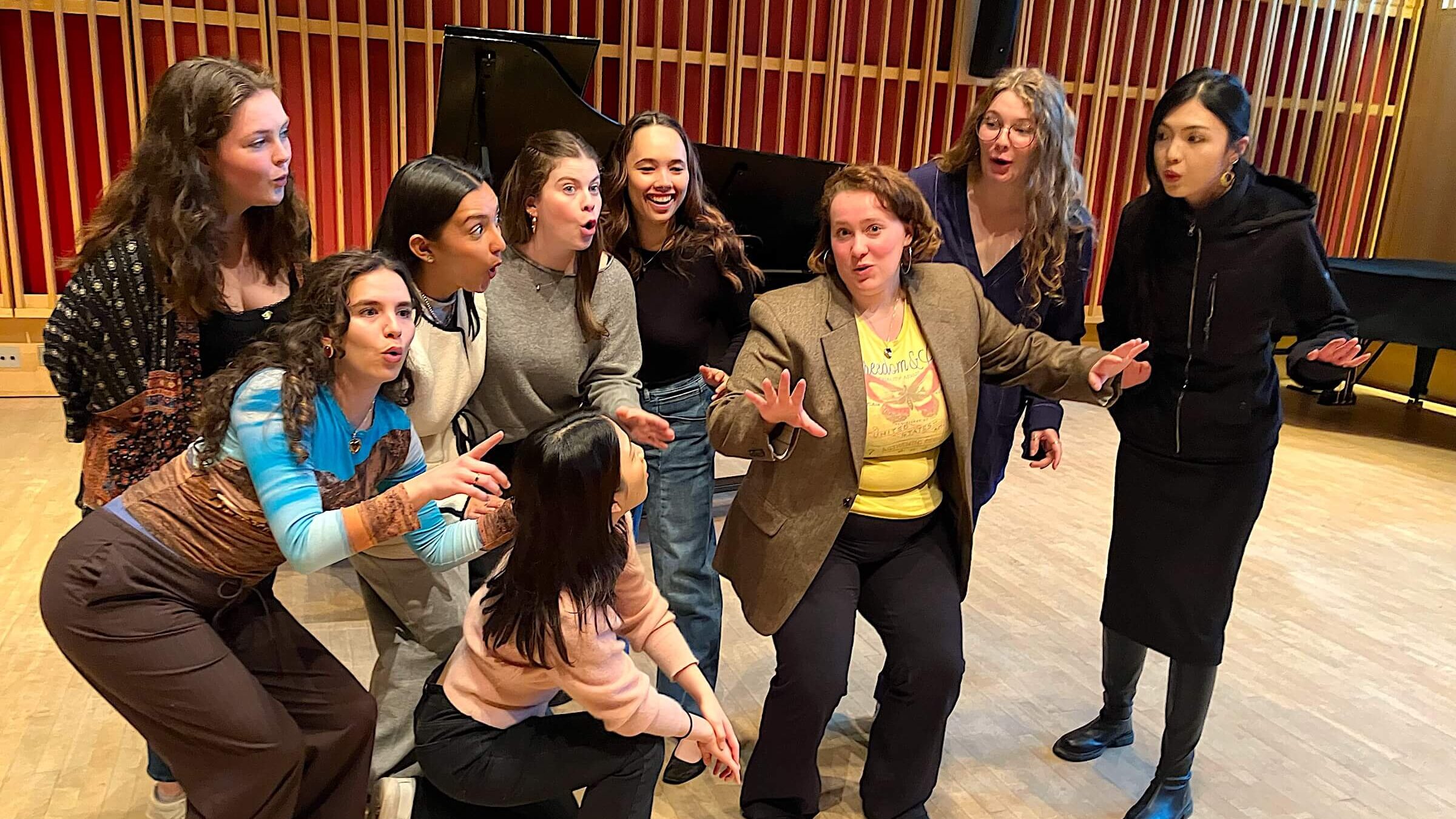
Part of the cast of ‘Khantshe in Amerike’ rehearsing the operetta, May 13, at Bard College Photo by Ronald Robboy

By Jon Kalish May 13, 2026
One of the smash hits of New York’s thriving Yiddish theater scene in the early 20th century grappled with socio-political issues that still resonate 100-plus years later. It’s coming back for a very limited run and you don’t have to speak Yiddish to enjoy it.
The production — a concert of songs from the 1912 Yiddish operetta Khantshe in Amerike — will be performed twice this month, first at Bard College in Annandale-on-Hudson, New York and then at the YIVO Institute for Jewish Research in Manhattan.
The protagonist, Khantshe, is a young working-class woman who dresses as a man, working as a chauffeur for a nouveau-riche immigrant family. Khantshe flirts with and romances the women she works for — mother and daughter alike. The operetta grapples with class conflict, women’s rights, gender fluidity and cars.
The performances, made possible by material reconstructed from archival documents, will feature students from Bard accompanied by piano. There will be no dialogue; instead the singers will deliver brief plot summaries in English before each song. A translation of the lyrics will be included in a booklet for the audience, who will also be able to follow along watching English supertitles.
The operetta first opened on Dec. 31, 1912 at Sarah Adler’s Novelty Theatre in Williamsburg, Brooklyn and was a runaway hit. It was mounted in Warsaw just six months after the New York premiere.
“This is one of the shows that were in dialogue with all of the political and social issues that people were talking about,” said Alex Weiser, director of public programs at YIVO and a member of the trio that reconstructed the performance materials. “They were made because the masses needed the cultural material in their language that spoke to the specificity of their milieu.”
Khantshe in Amerike was also a turning point in the career of both its composer, Joseph Rumshinsky, and its star, Bessie Thomashefsky. The previous year she had left her renowned husband Boris Thomashefsky, the titan of the Yiddish stage, known as a compulsive philanderer.
At the height of their influence, the Thomashefskys owned theaters in and out of New York, published their own magazine, The Yiddish Stage and wrote columns in the popular Yiddish newspapers of the day. When Boris Thomashefsky died in 1939, some 30,000 people lined the streets of the Lower East Side for his funeral.
“This show was a star vehicle for Bessie when she first left Boris,” notes Weiser. “They were a power couple and this was a really important turning point in her career. She left him, she went out on her own and there was a big question: ‘Is this it for her?’”
The angry, wily, rebellious and militantly feminist character that Bessie Thomashefsky portrayed became the prototype for a series of heroines she played going forward. They were tough, brassy, usually working-class fighters, endowed with chutzpah.
Bessie Thomashefsky also produced the operetta.
The musical was a watershed moment for Rumshinsky, as well. He went on to dominate the American Yiddish musical for the rest of the decade. It marked the first time that “American rhythm” had been incorporated in Yiddish music, a euphemism for acknowledging the influence of African-American music on the genre.
“Nothing had ever happened like that in Yiddish theater before,” said Ronald Robboy, who was part of the team that reconstructed the performance material. “Yiddish theater then quickly started incorporating elements of Tin Pan Alley. It also became interestingly more self-consciously Jewish, as smarter and better educated composers learned how to manipulate Jewish modal material, the scales that came from liturgical music and klezmer music. So the music was at once more American and at the same time more skillfully Jewish in its self-identity.”
Robboy’s connection to the material is a lengthy one. For five years he served as researcher for the Thomashefsky Project, an homage to the legacy of Boris and Bessie Thomashefsky instigated by their grandson, the late conductor Michael Tilson Thomas. The culmination of the project occurred in April 2005 with the premiere of The Thomashefskys: Music and Memories of a Life in the Yiddish Theater at Carnegie Hall. A recording of a subsequent performance in Miami Beach aired on the PBS series Great Performances in 2012.
Robboy worked with Weiser and Max Friedman, a law student in Memphis, to turn a number of archival documents into the printed matter needed to do the Khantshe performance. In 2023 the team reconstructed Rumshinsky’s Shir-hashirim operetta.
The documents for Khantshe came from YIVO and the American Jewish Historical Society, among other sources. They included a copy of the libretto that had been published as a bootleg in Warsaw.
Friedman got obsessed with Yiddish while studying for a master’s degree in music composition at Brandeis. For his master’s thesis he set to music sound recordings of Yiddish poets H. Leivick, Yankev Glatshteyn, Kadia Molodovsky, and Rokhl H. Korn reading their own work.
The last musical number in Khantshe in Amerike has the protagonist singing about herself. Soon the song Khantshe was played whenever Bessie Thomashefsky walked into restaurants and social gatherings. Tilson Thomas often played it as she made her triumphant entrance into the family living room.
Khantshe in Amerike will be performed on Thursday, May 14, in the Bitó Conservatory Building at Bard College from 7 – 8:30 p.m.
It will also be performed at YIVO on Monday May 18, at 7 p.m., as part of Carnegie Hall’s United in Sound: America at 250 festival. Admission is $15, $10 for YIVO members and students. Registration is required for the free livestream on Zoom.
Did you know that only 2% of Forward readers donate to support our nonprofit newsroom? That 2% make it possible for millions to read the Forward without a paywall or subscription — removing any barriers to the full and fair Jewish story.
But while the Forward is free to read, it isn’t free to produce. Big stories — like deep dives into the antisemitism data, political scoops or reporting trips to college campuses — take months of research and fact-checking. All while we keep you informed of what you need to know each day.
— Rachel Fishman Feddersen, Forward Publisher & CEO
Support our mission to tell the Jewish story fully and fairly.