Interviews with Holocaust survivors reveal the richness of Yiddish
Thanks to a new online resource, the Corpus of Spoken Yiddish in Europe, anyone can now hear or view these recordings
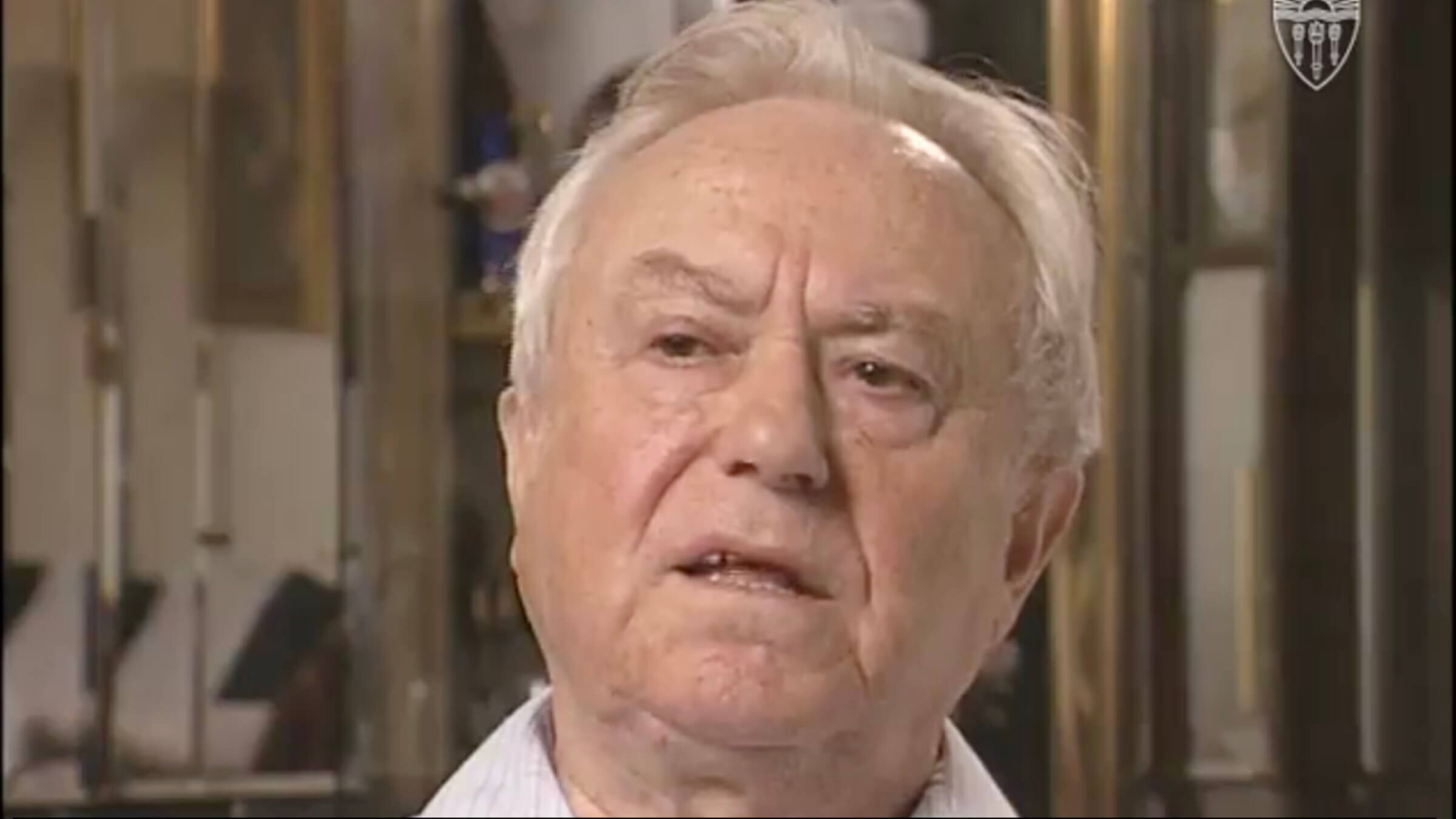
Holocaust survivor Lazar Melamed speaks in Yiddish about his wartime experience. Courtesy of the Collection of the USC Shoah Foundation
Many people today prize the Yiddish of native speakers who grew up in Eastern Europe before World War II, viewing it as a mark of linguistic authenticity.
As a language of daily life that millions of Jews spoke in a range of regional dialects, Yiddish had, over the centuries, become enriched with many words and idioms that were unique to a specific location.
More than 80 years after the end of the Holocaust, very few of those speakers are still around. As a result, the Yiddish they spoke is deemed precious. Thanks to a new online resource, in which dozens of Holocaust survivors talk about their lives before, during and after the war, anyone can now hear the language of that bygone era.
There are already a number of resources that document the Yiddish of these native speakers. Among the earliest examples are 28 audio recordings made by David Boder, a psychologist who traveled from the United States to Europe in 1946 to interview Holocaust survivors. He asked them about their wartime experiences in nine different languages, including Yiddish.
Another valuable source for hearing native Yiddish speakers is the Language and Culture Atlas of Ashkenazic Jewry (LCAAJ). In the late 1950s, linguist Uriel Weinreich launched this project, based at Columbia University, to study Yiddish dialects and folklore. Weinreich and his colleagues taped responses from over 600 European-born Yiddish speakers to a detailed survey of their language, with over 3,000 individual questions, as in, for example: “What games did you play as a child?”
One of the largest number of recordings of these Yiddish speakers can be found in the Shoah Foundation’s Visual History Archive (VHA), launched in 1994. Based at the University of Southern California, the VHA holds almost 50,000 video interviews with Holocaust survivors. Among these recordings, which were conducted in 32 different languages, are more than 600 entirely or partially in Yiddish. Until recently, only people who had access to the VHA, mostly through university libraries, were able to listen to this trove of Yiddish speakers as they relate their life histories. Thanks to a new online resource, known as the Corpus of Spoken Yiddish in Europe (CSYE), anyone can now hear these interviews.
The CSYE is the brainchild of Yiddish sociolinguist Isaac Bleaman who first worked with the VHA’s Yiddish interviews for his doctoral dissertation, where he compared the Yiddish spoken in the 2010s by Hasidim and Yiddishists. Through these recordings, Bleaman was able to explore how these two contemporary forms of Yiddish developed.
After joining the faculty at Berkeley, Bleaman sought a way to make the VHA’s Yiddish interviews more accessible to both linguists and students learning the language. Eventually, he received permission from the Shoah Foundation to use some 200 of its Yiddish videos for this purpose, and in 2022 he was awarded a multiyear grant from the National Science Foundation to establish the CSYE.
Creating this online resource entails manually transcribing the interviews, which are rendered both in transliteration and in the Yiddish alphabet. This is a painstaking process that relies on skilled speakers of Yiddish as well as other languages that the survivors may have included in the interviews. The transcripts, when synced with the videos, enable users of the CSYE to search the interviews for specific terms and topics.
A database on the CSYE lists each survivor’s name, city of birth, gender, age and dialect of Yiddish (Central, Northeastern, or Southeastern). The website also features an interactive map, showing the location of each survivor’s hometown, grouped by dialect. An optional map layer shows where the LCAAJ interviews were recorded in the 1960s. Ranging across Europe, the Americas, Australia and Israel, they reflect the scope of the postwar Yiddish-speaking diaspora.
In this Yiddish interview, for example, Holocaust survivor Lazar Melamed talks about his childhood in a Ukrainian village, his experiences under the Nazis and his post-war life in Brooklyn.
The CSYE also offers an interactive page that enables users to generate their own word maps to explore the geographic range of words or patterns of speech.
To demonstrate how the CSYE can be used for linguistic research and for language learning, the website provides instruction on pronunciation, as well as examples of the East European Yiddish dialects (for example, which of the interviewees said nit for the word “not” vs. those who said nisht). To date, 171 interviews, totaling more than 300 hours, have been transcribed. When this process is completed, the CSYE explains on its website, it will provide public access to “the most extensive source of conversational Yiddish ever compiled,” which will “bring the voices and narratives of native Yiddish speakers into the classroom.”
For the Yiddish student, teacher and researcher, or anyone else who loves the language, the CSYE is an extraordinary resource. Listening to survivors recount their life histories is compelling, both for the experiences they recall and for the cherished language in which they speak.
I’m personally matching all gifts to the Forward, up to $36,000. Can I match your gift now?

Hello, fellow Forward reader! I’m Joel Brown, a Forward reader and supporter for more than 15 years, and currently the chair of the board of directors.
I’m an avid Forward reader because it ticks so many of my essential boxes: excellent journalism, Jewish focus and diverse viewpoints. In today’s political climate, what I most appreciate is the Forward’s independence — made possible by the generosity of its membership.
The Forward is committed to bringing you unbiased, nuanced Jewish news. From my position as board chair, I see an exciting future as we expand our position as the definitive independent voice of contemporary American Judaism.
— Joel Brown, Forward board chair
Support our mission to tell the Jewish story fully and fairly.