New documentary captures the lively history of Yiddish theater in America
The film opens with a superb Yiddish vaudeville number performed by the widely mourned Bruce Adler
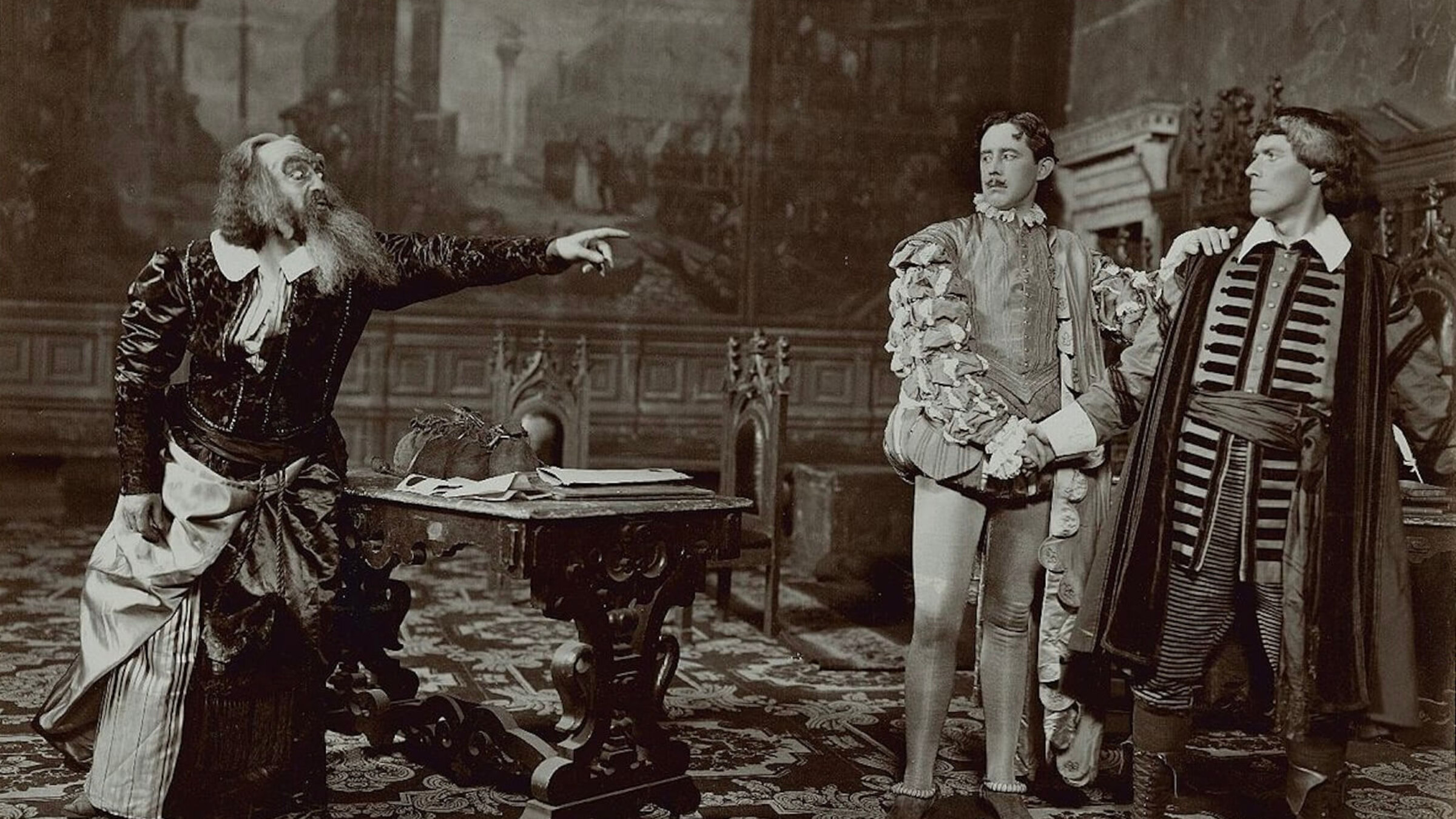
Jacob Adler (left) in “The Merchant of Venice” at the American Theatre in New York, 1903 Photo by the Byron Company
The new documentary Immigrant Songs: Yiddish Theater and the American Jewish Experience, produced by the Milken Archive of Jewish Music, is fast, entertaining and a good introduction to the topic.
Focusing mainly on the musical side of the story, but covering ‘straight plays’ as well, the film opens with a superb ‘warm-up act’: “Hu Tsa Tsa,” a stock Yiddish vaudeville number performed by the widely mourned Bruce Adler, who died in 2008 at age 63. Bursting with charm and talent, Adler, scion of a top Yiddish vaudeville family, demonstrates that Yiddish theater used to be pretty damned lively.
What follows is the oft-told story of the rise and decline of the American Yiddish theater, beginning with its prehistory in the Purimshpiels — the annual performances that for centuries served as the only secular entertainment in the Ashkenazic world. From there the film takes us to Yiddish theater’s 1876 birth in Romania, courtesy of Avrom Goldfadn, a.k.a. “The Father of Yiddish Theater.”
The film also describes Yiddish theater’s arrival in America, which, thanks to massive Jewish immigration, quickly became its capital. We learn of its influence on American theater’s styles of acting and set design. And the film describes the decline of its audience, due to assimilation and the immigration quotas of the 1920s.
There’s an excellent section on “The Big Four” Yiddish theater composers — Joseph Rumshinsky, Alexander Olshanetsky, Abe Ellstein, and Sholom Secunda. All in all, the documentary does a fine job of teaching the aleph-beyz, the ABCs, of the history of Yiddish theater to the uninitiated.
The most impressive aspect of Immigrant Songs is its well-crafted pace. Though there are a few snippets of vintage Yiddish cinema (Yiddish theater’s “kid brother”), most of the film consists of recent concert footage, some well-selected photographs and ephemera, and a lot of talking heads. Almost every prominent Yiddish theater historian was interviewed for it, along with several musicologists, an archivist, Yiddish actors, directors, producers, etc. (Full disclosure: I am one of them.) Director Jeff Janeczko cuts between the interviewees so smoothly — sometimes in mid-sentence — that it feels like they’re in the same room and feeding off each other’s energy. The movie just flies by.
There are a few errors. Marc Chagall is described as an important designer of Yiddish theater; actually he designed one minor production in Russia in 1921, and never did another. In a bizarre, and biblically illiterate, statement, one interviewee claims that Jews hadn’t developed a theater culture earlier because the Second Commandment’s prohibition of “graven images” forbade the construction of sets. (Actually it’s about idol worship.)
Another interviewee claims that the Yiddish play Der Yeshiva Bokher; oder, Der Yudisher Hamlet — The Yeshiva Student; or, The Jewish Hamlet (Yiddish plays then often had subtitles), is closely patterned on Shakespeare’s tragedy. In truth, the play — written by Isidore Zolotarevski, the prolific writer of shund (“trash”) melodramas — is not only awful, but is as close to Shakespeare as baked ham is to your grandmother’s kreplach.
The film’s biggest fault, however, is its short running time (45 minutes). This is a rich topic, and too much is left by the wayside in the interest of brevity. There’s nothing about what shund melodramas felt like, why they appealed to their audiences, and why they became the only thing a lot of people know about Yiddish theater.
There’s also nothing about the World War I-era wave of shtetl plays, which reflected immigrants’ homesickness without indulging in nostalgia, and provided some of Yiddish theater’s shining moments with plays like Green Fields, The Empty Inn and Tevye. And the most important play in the Yiddish canon, The Dybbuk, is never mentioned.
Perhaps most surprisingly, considering the film’s emphasis on music, there is no examination of Yiddish theater’s influence on Broadway’s music. (Cole Porter — ironically, the only gentile among the major composers of Broadway’s Golden Age — had a pronounced Jewish lilt in a number of his songs, and he actually attended Yiddish theater regularly.)
The film’s last section is about the renewed interest in Yiddish that began in the 1970s and ’80s with the klezmer revival. Much of it focuses on the 2018 Yiddish production of Fiddler on the Roof in Yiddish, whose success was predetermined the moment the production was announced.
For the overwhelming majority of American Jews, from the Orthodox to the unaffiliated, Fiddler is all they know about the lives of their ancestors. And though it’s a world-class piece of musical theater, as a work of social history Fiddler is as phony as a glass eye. Nevertheless, for American Jews it’s a sacred text.
Fiddler was a huge hit, but it was a one-off, whose success does little for the future of Yiddish theater. The Yiddish — not the text, but the lines spoken by many of the actors — was often mispronounced and had the wrong intonation. (One elderly gentleman of my acquaintance, a native Yiddish speaker from Czechoslovakia, told me he didn’t understand a word the actors said, and spent the whole evening reading the English supertitles.)
What follows the Fiddler section in Immigrant Songs is mostly bromides. But the best current Yiddish theater reflects the kind of fresh thinking that keeps the form alive. An occasional well-presented museum piece, like the Folksbiene’s 2016 revival of Rumshinsky’s operetta The Golden Bride, is a very worthwhile project.
But the most dynamic contemporary Yiddish theater is, in Jeffrey Shandler’s apt phrase, “post vernacular” — i.e., the use of Yiddish is self-conscious, a deliberate choice rather than something that’s done automatically, as it would have been a century ago when there were a lot more Yiddish speakers in the world.
An example of this is the 2017 neo-realist film Menashe, which could far more easily and conventionally have been made in English. Or a well-known piece done in Yiddish translation, like Shane Baker’s stunning Yiddish translation of Waiting for Godot, can become something much more valuable than a mere stunt. The Yiddish version, under Moshe Yassur’s straightforward direction, humanized the play, stripping it of the encrusted pretentiousness that had hidden its soul. (When it was presented in the International Samuel Beckett Festival in Ireland, multiple audience members approached the cast afterwards with the same reaction: “I don’t speak a word of Yiddish. But I’ve seen Godot five or six times, and this is the first time I understood it.”)
There’s a lot to be learned from Immigrant Songs. If you find yourself hungry for more, you couldn’t do better than to seek out YIVO’s online Yiddish theater course “Oh, Mama, I’m in Love!” But by all means, start with Immigrant Songs. It’s a very entertaining and informative appetizer.
The film, Immigrant Songs: Yiddish Theater and the American Jewish Experience, is now streaming on Amazon Prime.

Hello, fellow Forward reader! I’m Joel Brown, a Forward reader and supporter for more than 15 years, and currently the chair of the board of directors.
I’m an avid Forward reader because it ticks so many of my essential boxes: excellent journalism, Jewish focus and diverse viewpoints. In today’s political climate, what I most appreciate is the Forward’s independence — made possible by the generosity of its membership.
The Forward is committed to bringing you unbiased, nuanced Jewish news. From my position as board chair, I see an exciting future as we expand our position as the definitive independent voice of contemporary American Judaism.
That’s why I’m paying it Forward, by matching $36,000 of reader gifts. It’s an investment in the Forward’s newsroom, to continue telling the American Jewish story with truth and independence.
— Joel Brown, Forward board chair
Support our mission to tell the Jewish story fully and fairly.