In first Sunday address, Pope Leo XIV calls for ceasefire in Gaza, release of hostages
“I am deeply pained by what is happening,” Leo said in his first Sunday blessing as pontiff
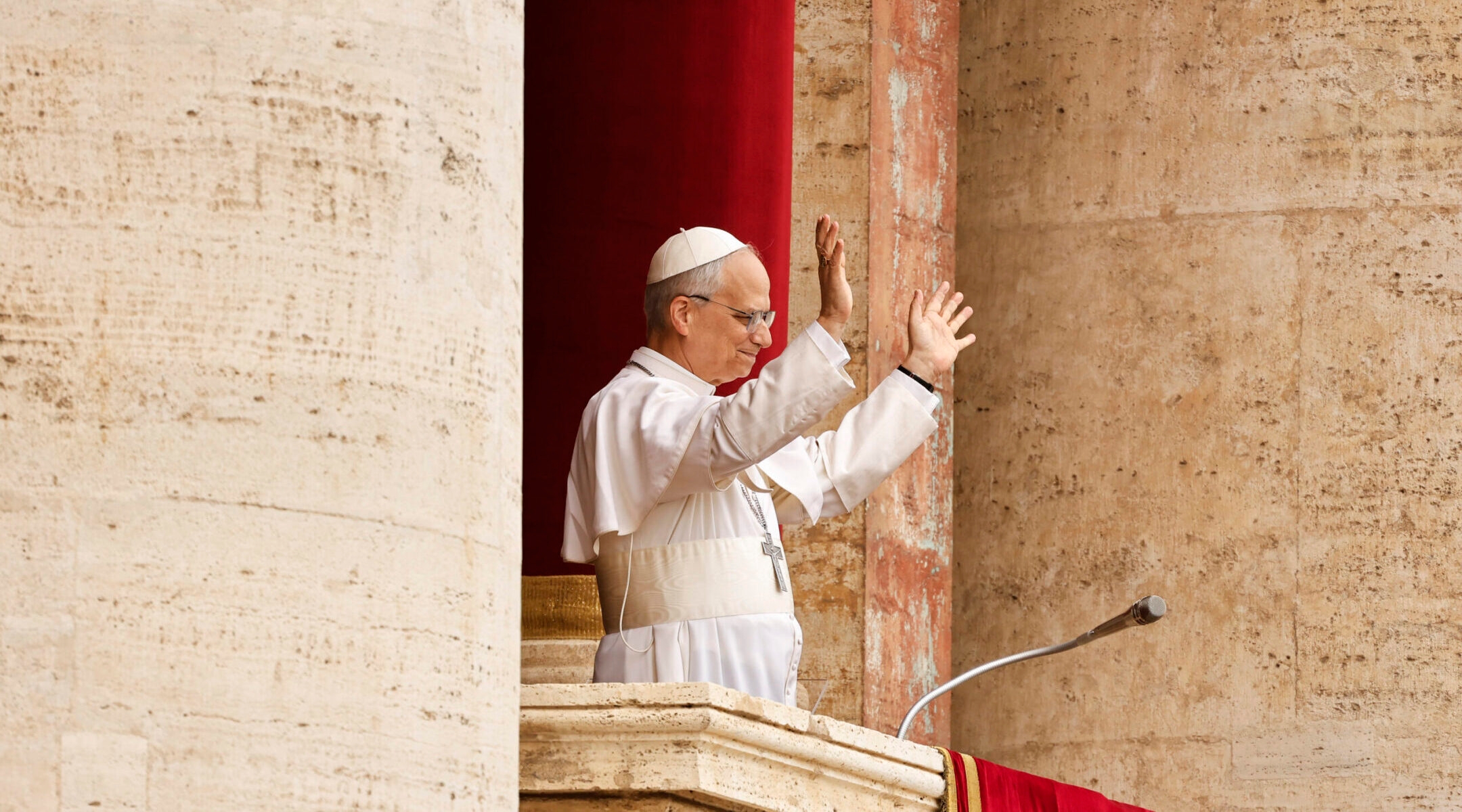
Pope Leo XIV delivers the Regina Caeli prayer from the main central loggia of St Peter’s basilica on on May 11, 2025 in Vatican City, Vatican. (Mario Tama/Getty Images)
(JTA) — Pope Leo XIV spoke directly about Gaza in his first Sunday address since being elected on Thursday, marking his first public comments as pope about the 19-month-old war between Israel and Hamas there.
“I am deeply pained by what is happening in the Gaza strip,” he said, according to translations of the speech, delivered in Italian at the Vatican. “May a ceasefire immediately come into effect. May humanitarian aid be allowed into the civilian population and may all hostages be freed.”
He also decried the war in Ukraine and praised the ceasefire, announced Saturday, in a conflict between India and Pakistan.
The speech — in which Leo proclaimed, “Never again war!” — and other moves by the new pope are being closely watched by supporters of Israel, many of whom felt alienated by Pope Francis’ response to the war in Gaza.
Francis also called for the release of the hostages, whom Hamas abducted from Israel, in his frequent calls for a ceasefire. But he also suggested that Israel could be guilty of “genocide” in Gaza and attended the inauguration of a nativity scene at the Vatican that positioned baby Jesus on a keffiyeh, or Palestinian scarf; last week, the Vatican announced that he had willed his popemobile to the children of Gaza.
On Thursday, after Leo called for peace in his first public address as pope without mentioning Gaza, Rabbi Noam Marans, the American Jewish Committee’s director of interreligious and intergroup relations, emphasized that such calls are standard fare from the balcony of St. Peter’s Basilica. “All popes want peace,” he said.
Did you know that only 2% of Forward readers donate to support our nonprofit newsroom? That 2% make it possible for millions to read the Forward without a paywall or subscription — removing any barriers to the full and fair Jewish story.
But while the Forward is free to read, it isn’t free to produce. Big stories — like deep dives into the antisemitism data, political scoops or reporting trips to college campuses — take months of research and fact-checking. All while we keep you informed of what you need to know each day.
— Rachel Fishman Feddersen, Forward Publisher & CEO
Support our mission to tell the Jewish story fully and fairly.