Nation’s largest teachers union rejects move to cut ties with ADL
The National Education Association rejected a resolution to cut ties with the Anti-Defamation League over its Israel advocacy. Critics say the debate reveals deeper tensions over how schools address antisemitism.
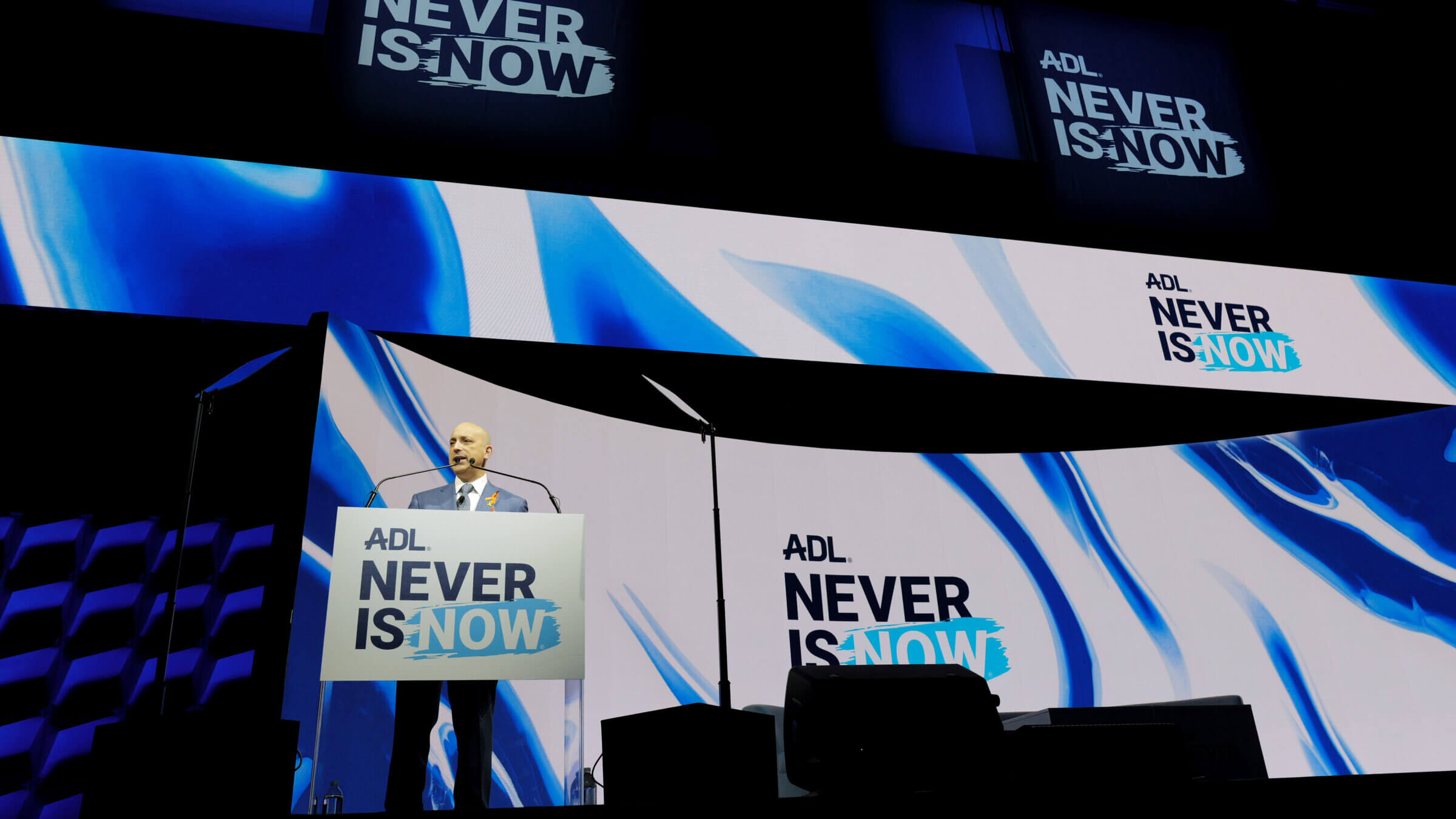
ADL CEO Jonathan Greenblatt speaks onstage the ADL’s national conference in March. Photo by Getty Images for the Anti-Defamation League

By Jacob Kornbluh July 20, 2025
The leadership of the nation’s largest teachers union on Friday voted to reject a resolution severing ties with the Anti-Defamation League — a move that capped weeks of internal debate over the ADL’s stance on Israel and its role in shaping how schools address antisemitism. Major Jewish organizations hailed the decision as a victory for dialogue over division.
Earlier this month, NEA members passed a resolution to stop working with the ADL and prohibit the use of any educational materials, including “its curricular materials or its statistics.” While the resolution did not mention Israel, it reflected a growing rift between progressive organizations and the longtime Jewish civil rights group related to the Israeli-Palestinian conflict and the war in Gaza.
In response, the ADL spearheaded a show of support, rallying nearly 400 Jewish groups from across the political spectrum — including Hillel International, the Jewish Federations, the Reform movement and the Jewish Council for Public Affairs — to sign a letter defending the organization.
It described the resolution as part of a “growing level of antisemitic activity within teachers’ unions” to marginalize mainstream Jewish voices within the nation’s public school system and “to limit the ability of educators to address the growing threat of antisemitism with their students.” JCPA sent a separate letter, saying that “one does not need to align with the ADL on every issue” to continue engagement and dialogue for the broader goal of combating hate.
J Street, the liberal pro-Israel organization often at odds with the ADL over its broad labeling of criticism of Israel as antisemitic, did not sign the ADL-led letter. In a statement, J Street President Jeremy Ben-Ami accused the ADL of devaluing the meaning of antisemitism and said it “runs the risk of fanning its flames” by claiming the vote was driven by “pro-Hamas” activists within the union. Ben-Ami suggested the ADL is no longer a reliable arbiter of antisemitism.
Becky Pringle, the union president, said in a statement that the executive committee determined after “a thorough review process” that the resolution “would not further NEA’s commitment to academic freedom.”
Pringle also met with the ADL’s chief executive, Jonathan Greenblatt, to restate the union’s “commitment to combating the rise of antisemitism in our society.” Nonetheless, the NEA said that the vote to reject the proposal “is in no way an endorsement of the ADL’s full body of work” and urged the ADL to “support the free speech and association rights of all students and educators.”
In a joint statement, the leadership of the ADL, American Jewish Committee, Conference of Presidents of Major American Jewish Organizations and Jewish Federations of North America welcomed the decision and asked the NEA “to communicate clearly with its membership that not only has this measure been rejected, but also how this approach is harmful to educators, students and families concerned about the rise of antisemitism and hate in our schools and communities.”
J Street’s Ben-Ami, in a statement to the Forward, called the NEA statement “excellent and precisely what needed to be said.” He added that “rather than attacking teachers as Hamas supporters or antisemites, perhaps the better approach to those teachers with criticisms of Israel is engagement and dialogue.”
Arno Rosenfeld contributed to this report.

Hello, fellow Forward reader! I’m Joel Brown, a Forward reader and supporter for more than 15 years, and currently the chair of the board of directors.
I’m an avid Forward reader because it ticks so many of my essential boxes: excellent journalism, Jewish focus and diverse viewpoints. In today’s political climate, what I most appreciate is the Forward’s independence — made possible by the generosity of its membership.
The Forward is committed to bringing you unbiased, nuanced Jewish news. From my position as board chair, I see an exciting future as we expand our position as the definitive independent voice of contemporary American Judaism.
That’s why I’m paying it Forward, by matching $36,000 of reader gifts. It’s an investment in the Forward’s newsroom, to continue telling the American Jewish story with truth and independence.
— Joel Brown, Forward board chair
Support our mission to tell the Jewish story fully and fairly.