Argentine lawmaker indicted over anti-Israel social media posts, in a first
Vanina Biasi was indicted over eight social media posts comparing Israel to the Nazi regime
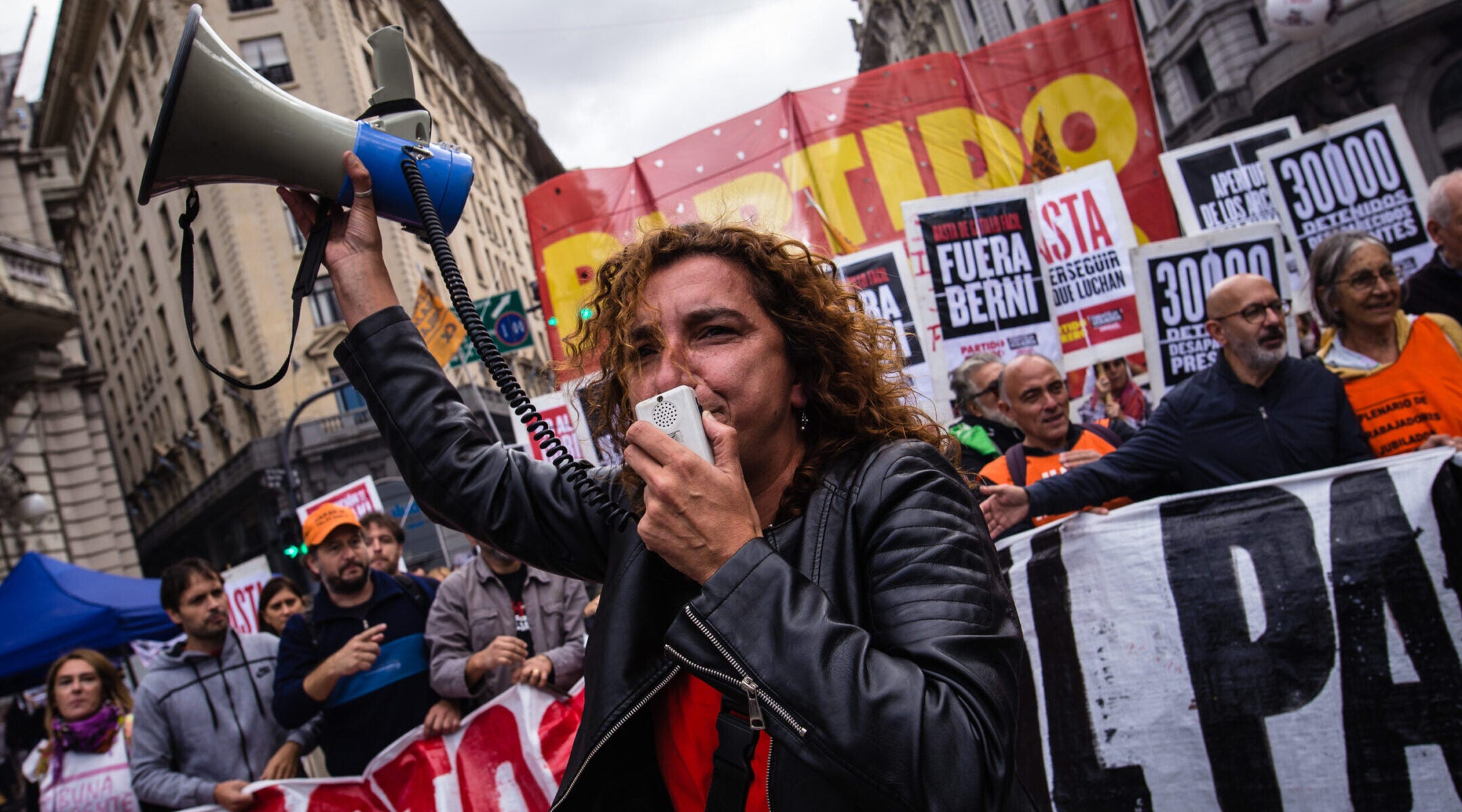
Vanina Biasi, national leader of the Partido Obrero, commemorates the National Day of Memory for Truth and Justice in downtown Buenos Aires, March 24, 2022. Photo by Nacho Boullosa/SOPA Images/LightRocket via Getty Images
(JTA) — BUENOS AIRES — An Argentine lawmaker has been indicted on criminal charges after comparing Israel to the Nazi regime and calling it a “genocide state” on social media.
Vanina Biasi of the left-wing Workers’ Party is the first sitting legislator in Argentina to be indicted for antisemitism, and the case against her marks the first time social media posts demonizing Israel have been legally recognized as antisemitic in Argentina.
The indictment comes as Argentina takes an aggressive stance against antisemitism and anti-Israel activity, fueled by the philosemitism of its populist president, Javier Milei. A prosecutor first lodged charges against Biasi were first filed in late November 2023, days after Milei’s election and before he was sworn in. Biasi lost a series of appeals, leading to the formal indictment on Thursday.
The case against Biasi centers on eight tweets she posted on X between Nov. 27, 2023, and Jan. 29, 2024.
“The Zionist Nazis need to destroy UNRWA humanitarian aid so the extermination can accelerate. They use famine, like in Nazi concentration camps, as a method of extermination,” Biasi wrote in one of the tweets. In another, she wrote, “The Zionist state is Nazi because of its practices and ideology.”
The first prosecutor argued that Biasi’s messages went beyond free speech and constituted hate speech under Argentina’s Anti-Discrimination Law. A federal judge backed that assessment in April, saying that her posts incited hatred against Jews, and ordered a seizure of assets equal to about $7,500.
Biasi’s legal team appealed on free speech grounds.
On Thursday, the Federal Chamber unanimously upheld the indictment and asset seizure. The judges ruled that freedom of expression is not absolute and can be restricted to protect others’ rights, national security, public order, health or morals. They agreed that Biasi exceeded the limits of allowable free speech.
Biasi is a prominent leader of the Workers’ Party, a former national lawmaker, and a recently elected member of the Buenos Aires city parliament. If convicted, she could face a prison sentence of one month to three years.
The case has divided Argentinians, with some arguing that even if her posts might be seen objectionable, they should not be treated as illegal. Others say they are glad the government is taking a strong stance against antisemitism.
The Argentine government adopted the IHRA definition of antisemitism, which defines some forms of Israel criticism as antisemitic, in 2020.
DAIA, Argentina’s main political umbrella group, supported the charges, saying in a statement that the posts reproduced “classic stigmas of modern antisemitism” and that Biasi’s prominence meant their “negative impact and reach” were extended.
Biasi does not appear to have been restrained by the prosecution, which she said was politically motivated. “Now the court confirms the prosecution … when the whole world is talking about nothing but the genocide being perpetrated by the State of Israel,” she tweeted, calling for a mass protest against Israel on Saturday. “There is no greater absurdity than believing they will silence us with judicial persecution.”
Why I became the Forward’s editor-in-chief

You are surely a friend of the Forward if you’re reading this. And so it’s with excitement and awe — of all that the Forward is, was, and will be — that I introduce myself to you as the Forward’s newest editor-in-chief.
And what a time to step into the leadership of this storied Jewish institution! For 129 years, the Forward has shaped and told the American Jewish story. I’m stepping in at an intense time for Jews the world over. We urgently need the Forward’s courageous, unflinching journalism — not only as a source of reliable information, but to provide inspiration, healing and hope.
 , editor-in-chief
Support our mission to tell the Jewish story fully and fairly.