NYC synagogue hosts Catholic archbishop and Sandy Koufax jersey to mark 60-year milestones in American Jewish history
Timothy Dolan participated in Yom Kippur services to mark the anniversary of Nostra Aetate, the landmark Catholic doctrine about the Jews
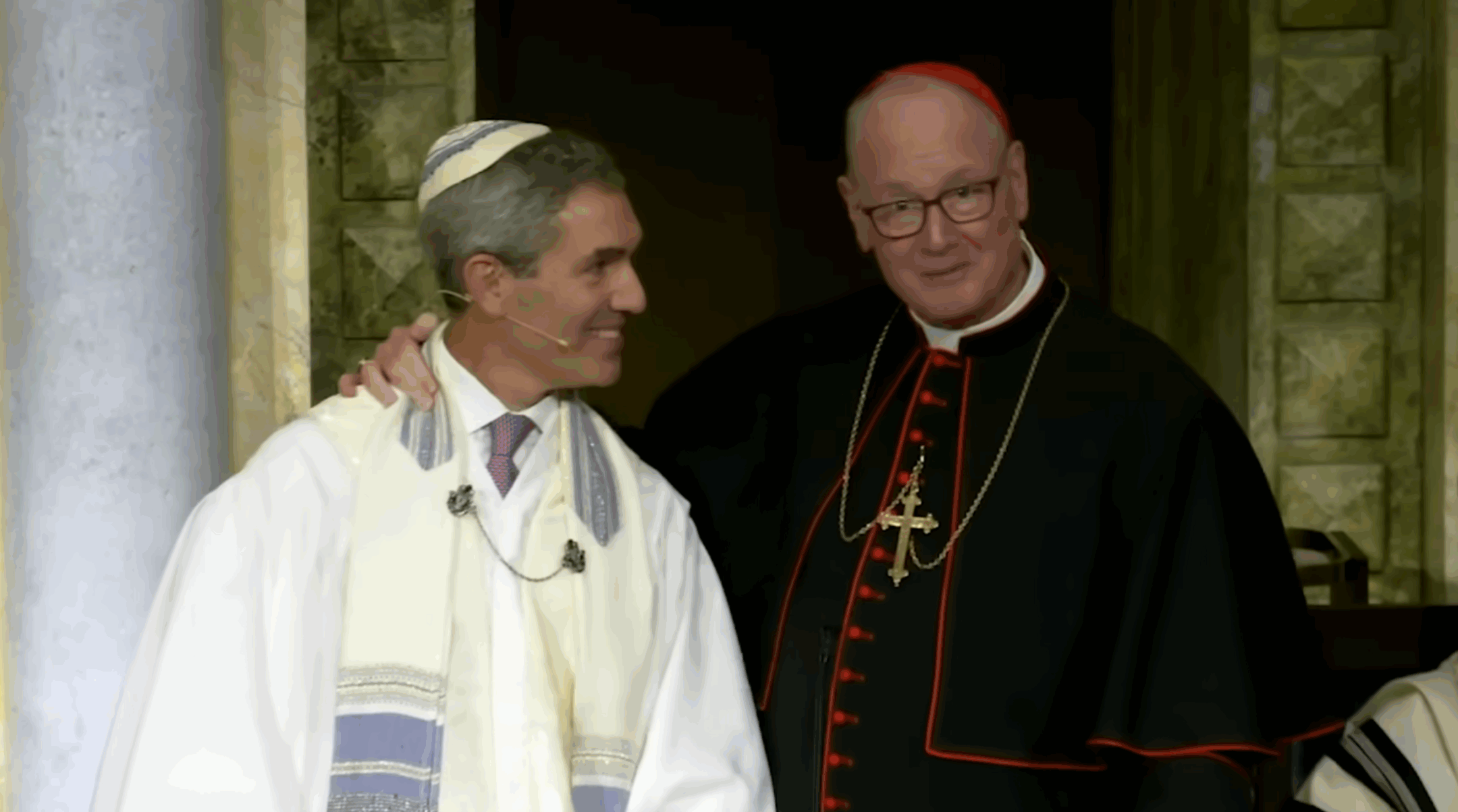
Rabbi Elliot Cosgrove, left, and Archbishop Timothy Dolan speak during Park Avenue Synagogue’s Yom Kippur services in New York City, Oct. 2, 2023. Screenshot of Park Avenue Synagogue
(JTA) — In his first surprise for his congregation on Yom Kippur, Rabbi Elliot Cosgrove brought out one surprise after another that might be anathema for a New York synagogue.
First: a Los Angeles Dodgers jersey. But it wasn’t the version worn last year when the Dodgers defeated both the Mets and the Yankees on their path to a World Series win. Instead, it was the version worn in 1965 by Sandy Koufax when the Jewish ballplayer famously skipped a postseason game for Yom Kippur.
“Sixty years ago, nobody knew where Sandy Koufax was,” Cosgrove said, alluding to contested lore about whether Koufax attended synagogue that day. “But we know where he was not.”
Cosgrove, a Dodger fan himself, said he had studied the episode and determined that “the mythology that came to be associated with it” was more significant than Koufax’s decision not to play. What was most important, the rabbi said, was that American Jews learned that they could embrace their Jewish identity without giving up their hard-fought place in mainstream society.
“Koufax, by way of his unique athletic ability, was at stratospheric levels of American celebrity, and then he chose to remain chosen, to not compromise his religious convictions — a watershed moment,” Cosgrove said. “No longer must Jews remain shy about public Jewish identification. Koufax’s refusal to pitch gave Jewish life a kickstart.”
Soon, Cosgrove revealed a second unexpected surprise, also to mark a 60-year milestone in American Jewish history: Timothy Dolan, the archbishop of New York, joined him on the bimah.
Dolan and Cosgrove spoke for several minutes about Nostra Aetate, the landmark Catholic doctrine approved in October 1965 that declared that Jews were not responsible for the death of Jesus, rejecting ideas that had fueled centuries of violence against Jews. The doctrine is seen as pivotal to dramatically improved Catholic-Jewish relations and a bulwark against antisemitism among Catholics.
Dolan noted that New York’s 300 parishes took up a collection for Israelis devastated by Oct. 7 and raised enough to rebuild a home that was destroyed in Hamas’ attack.
“I thought to myself, this is an affirmation. This is the fruitfulness of Nostra Aetate,” Dolan said. “We’ve got a long way to go, everybody. But you know how much at home I feel here? You know how much akin I feel with you? I don’t know if that would have happened if Nostra Aetate had not been solemnly defined by the highest teaching authority in the church 60 years ago.”
The pair also engaged in a responsive reading of a version of the Jewish priestly blessing revised to tackle Jewish-Catholic relations. But while their conversation was largely solemn in keeping with the tenor of Judaism’s holiest day, Dolan — who is well known for his jovial demeanor — managed to crack some jokes.
“Can I take you out for lunch?” he said before leaving the bimah, soon to be replaced by the American-Israeli freed hostage Keith Siegel. Knowing that Cosgrove was fasting, he added, “That was a safe invitation.”
Cosgrove had already given voice to pipe dream of his own. When he was discussing Koufax, who is famously averse to public appearances, he said he would have preferred to have been in conversation with the legendary ballplayer.
“I tried to get Sandy here,” he said. “Believe me, I tried.”

Did you know that only 2% of Forward readers donate to support our nonprofit newsroom? That 2% make it possible for millions to read the Forward without a paywall or subscription — removing any barriers to the full and fair Jewish story.
But while the Forward is free to read, it isn’t free to produce. Big stories — like deep dives into the antisemitism data, political scoops or reporting trips to college campuses — take months of research and fact-checking. All while we keep you informed of what you need to know each day.
— Rachel Fishman Feddersen, Forward Publisher & CEO
Support our mission to tell the Jewish story fully and fairly.