The vast majority of Israelis are worried about declining US support for Israel, survey finds
Four in ten Israelis said they expected support for Israel among younger American Jews to decline
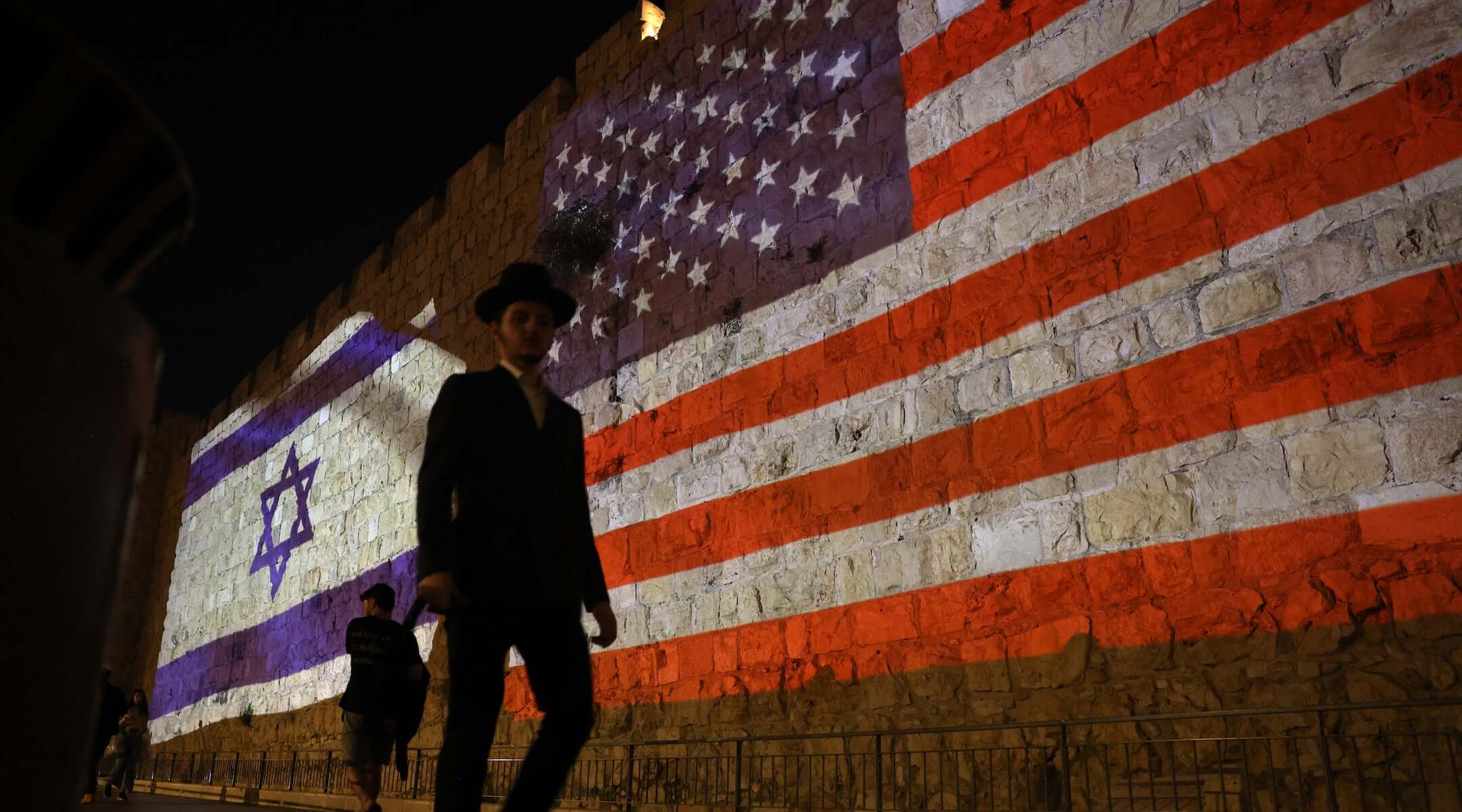
People walk past a projection depicting Israeli and US flags on the walls of Jerusalem’s Old City on Oct. 22, 2025. Photo by Ahmad Gharabli/AFP
(JTA) — The vast majority of Israelis — nearly eight in ten — say they are concerned about a decline in support for Israel among the American public, according to a new survey.
The poll of 1,000 Jewish Israeli adults, conducted Dec. 11 by the Ruderman Family Foundation, comes amid a notable decline in support for Israel across the American political spectrum over the course of the war in Gaza.
In September, a poll conducted by The New York Times and Siena University found that, for the first time, American voters sympathized more with Palestinians than Israelis. While support for Israel has long been a hallmark of the Republican party, a June poll also found that sympathy for Israelis had dropped within the GOP over the previous year.
Among younger Republicans, criticism of U.S. support for Israel has risen in the wake of the Gaza war alongside a growth of antisemitic influence, raising alarm among Jewish GOP leadership.
The June poll also found that sympathy for Israelis among Democrats had dropped to just 12%, while 60% sympathized more with Palestinians.
These changes have left Israelis alarmed, according to the survey. Nearly half of respondents said they were “very concerned” or “concerned” about declining U.S. support, while another 30% said they were “concerned to some extent.” Concern was higher among older and secular Israelis.
But even as the poll found that declining support among Americans overall were a matter of stark concern for Israelis, it focused more on ties between Jewish Americans and Israelis, finding that 44% of Israelis expect support for Israel among younger American Jews to be lower in the future than it is today.
Indeed, an October poll from the Washington Post found that emotional ties to Israel were far lower among younger Jews. While 68% of American Jews over 65 said they were emotionally connected to Israel, among those aged between 18 to 34, that share dropped to 36%.
When asked how Israel’s policies during the Gaza war affected the level of support among American Jews, 43% believed it weakened support while 28% said they believed it strengthened support.
“The data make clear that many Israelis understand something fundamental is changing,” said Jay Ruderman, the president of the Ruderman Family Foundation, which focuses on both mental health and U.S.-Israeli Jewish relations, in a statement. “The growing distance felt among younger generations in the United States did not happen overnight and cannot be dismissed. It reflects a longer-term erosion that requires Israel to pause, listen, and rethink how it engages American Jewry — because this relationship is not symbolic, but a strategic asset for the future of Israel and the Jewish people.”
More than half of respondents said they believed American Jews’ affiliation with the Democratic Party made them less likely to support Israel. And 67% of Israelis said they see President Donald Trump’s impact on Israel as positive.
The survey, which was conducted using an online panel, had a margin of error of ±3.1%.

Did you know that only 2% of Forward readers donate to support our nonprofit newsroom? That 2% make it possible for millions to read the Forward without a paywall or subscription — removing any barriers to the full and fair Jewish story.
But while the Forward is free to read, it isn’t free to produce. Big stories — like deep dives into the antisemitism data, political scoops or reporting trips to college campuses — take months of research and fact-checking. All while we keep you informed of what you need to know each day.
— Rachel Fishman Feddersen, Forward Publisher & CEO
Support our mission to tell the Jewish story fully and fairly.