British Greens battle antisemitism scandal as Jewish leader Zack Polanski targets historic gains in local elections
The Labour Party is expected to post historic losses at the polls
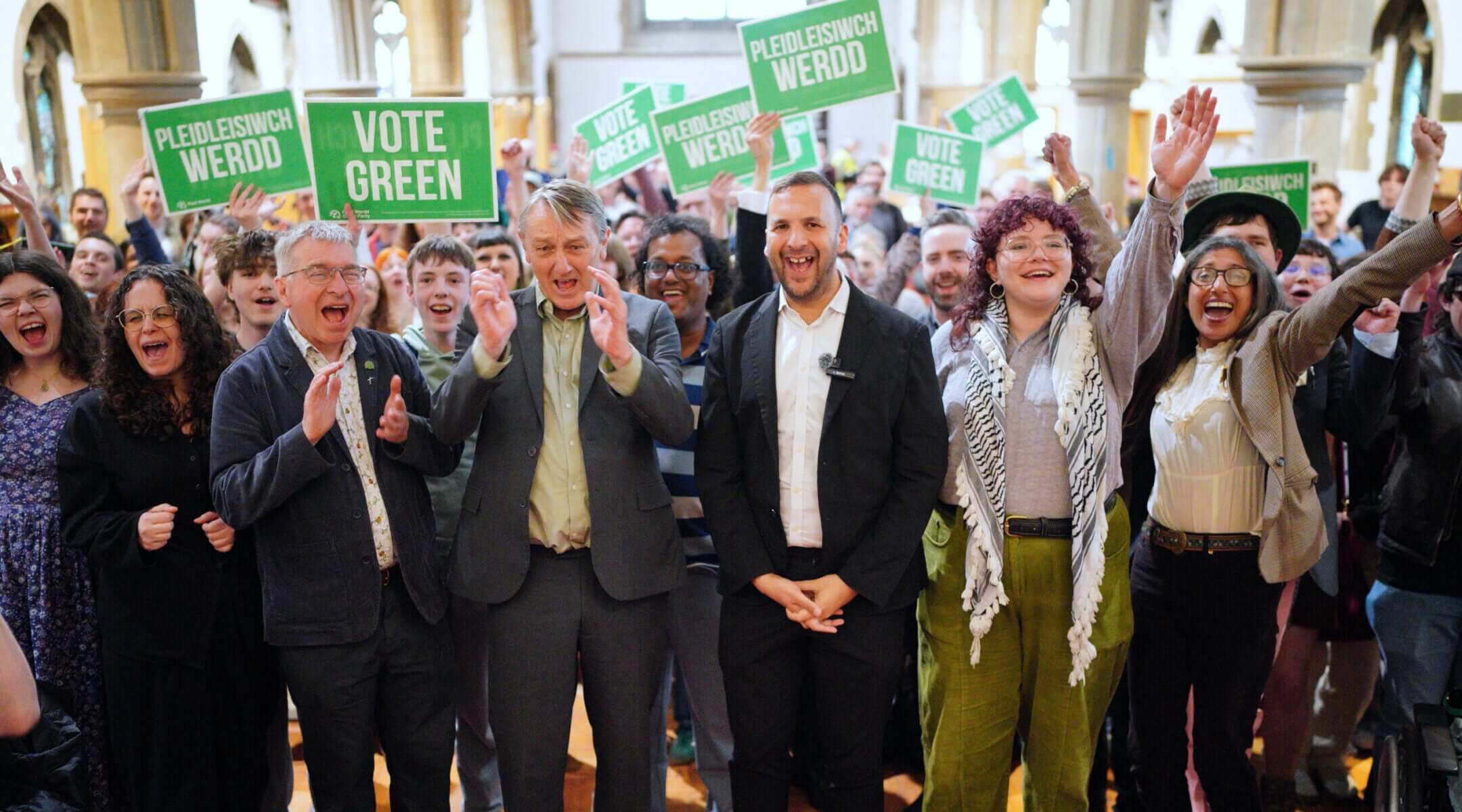
Green Party leader Zack Polanski (center) with party candidates and supporters after making a speech at the Church of Saint John The Evangelist in Cardiff, Wales, ahead of local elections, May 2, 2026. (Ben Birchall/PA Images via Getty Images)
(JTA) — Britons heading to polls in local elections on Thursday will deliver an answer to the question of whether their country’s legacy parties still hold wide appeal.
They will also illuminate just how willing British voters are to overlook antisemitism accusations around a rising left-wing party party — and potentially propel its leader, a 43-year-old Jewish activist who describes himself as “certainly not a Zionist,” into the upper echelon of British politics.
If Zack Polanski delivers the gains to the Green Party’s local leadership that polls have indicated are possible, he will instantly become one of the most high-profile Jewish progressives in the world. But unlike Bernie Sanders, the Jewish U.S. senator who is a doyen of the global progressive movement, Polanski has from the start made pro-Palestinian politics a centerpiece of his party’s platform — a reflection of how the war in Gaza has reshaped politics, and a gateway for antisemitism allegations that have dogged the Greens ahead of the election.
Polanski has said that antisemitism is “completely unwelcome” in the party as accusations thronged dozens of candidates heading into elections. More than 30 candidates are being investigated in an internal party probe.
But Jewish leaders and politicians, as well as London’s top police officer and members of other parties, say Polanski has failed to act strongly enough and runs the risk of inflaming antisemitic sentiment as violence against British Jews surges. And even Jewish members of the Green Party — who are increasing in number — have objected to some of the party’s moves against Israel.
Two Greens candidates in London were arrested last week on suspicion of “stirring up racial hatred online,” according to Metropolitan Police. One of them, Sabine Mairey, said in a post, “Ramming a synagogue isn’t antisemitism, it’s revenge.” The other, Saiqa Ali, shared an image of an armed man wearing a Hamas headband with the slogan, “Resistance is freedom.”
The party also recently dropped support from Tina Ion, a candidate in Newcastle who said that “every single Zionist” should be killed on an account called “thereal.anne.frank.” Two other Newcastle candidates lost their endorsements just days before the elections. Philip Brookes posted that it “takes serious effort not to be a tiny bit antisemitic,” and Mohammed Suleman reposted a video claiming that Jews were willing to bury Soviet prisoners alive under Nazi instruction during World War II.
Polanski told the BBC on Wednesday that these messages were “unacceptable.” He said the party was ensuring a “standardized vetting process” and “compulsory training” for all candidates to “make it clear that antisemitism is completely unwelcome in the Green Party, as it is in society.”
He added, “It is also important to say one case of antisemitism is one too many. This is a handful of cases and actually we have over 4,500 candidates, the vast, vast majority of which are doing amazing work in their communities.”
The scandal comes as Labour is predicted to lose well over half of its 2,500 seats on English local councils, especially to the Greens in London and the right-wing Reform UK in northern England. The two formerly fringe parties have framed the local elections, which select officials who manage municipal services and affairs, as a referendum on legacy politics, a weak economy, poor public services and an unpopular leader in Prime Minister Keir Starmer.
While polls suggest that multiple parties will benefit from the losses by Labour, Starmer’s party, the Greens are being watched especially closely because of what their momentum could signal for the future of the British left.
Polanski is the most prominent Jewish critic of Israel in mainstream U.K. politics. He has called to end all arms sales, trade and diplomatic ties with Israel, and decried Starmer for complicity in what he says is “the very obvious genocide in Gaza.” His pro-Palestinian stance has taken center-stage in the Green Party’s platform, alongside the environment and affordability.
Polanski did not respond to multiple requests for comment from the Jewish Telegraphic Agency made over several months.
Polanski frequently speaks about his pride in being Jewish, which he says led to his support for Palestinians. He said in a TikTok video last year, “When I speak out for Palestinians, I don’t do it in spite of my Judaism. I do it because of it. Because ‘never again’ for one group of people must actually mean ‘never again’ for anyone.”
Polanski is also a member of Na’amod, an organization of British Jews who say they seek “to end our community’s support for Israel’s occupation and apartheid.” He told The Guardian last year that “the most vicious” criticism in his political career came from “so-called mainstream Jewish communities,” which felt betrayed because he was “certainly not a Zionist.” (Polanski was blasted by the Board of Deputies of British Jews, the country’s largest group representing Jews, after he said that British Chief Rabbi Ephraim Mirvis did not represent most British Jews and instead spoke “in the interests of defending the Israeli government.”)
These views diverge sharply from his upbringing. Polanski has described his childhood in a “Zionist household” in Manchester, where he attended the Jewish school King David. He grew up as David Paulden with a mother who reportedly continues to identify as a Zionist.
At 18, he changed the anglicized name to the original name of his Jewish ancestors, who immigrated from Ukraine and dropped their name upon confronting antisemitism in the United Kingdom, he told the BBC in March. (Polanski said he changed his first name because of a negative experience with his stepfather, who was also named David.)
While promising to root out antisemitism from the Green Party, Polanski has said that some allegations “conflate genuine antisemitism with legitimate criticism of an Israeli government which is committing war crimes.”
The Greens face mounting scrutiny amid a wave of antisemitic attacks nationally, including the stabbing of two Jewish men in the London neighborhood of Golders Green last week and a string of arson attacks on synagogues and other Jewish sites. In October, an attacker drove his car into people gathered outside a Manchester synagogue and fatally stabbed one man.
Polanski criticized the police for their use of force in detaining Essa Suleiman, the suspect charged with the Golders Green stabbings. His comments sank his approval ratings in recent days and prompted a swift rebuke from police chief Mark Rowley.
“London’s Jewish communities are scared. They have experienced a series of targeted attacks on the community, and they expect our officers to act, protect them. That is exactly what our officers did yesterday. Your decision to criticise these officers, using your public profile and reach will have a chilling effect,” Rowley wrote in an open letter to Polanski.
“Officers need to know that when they act to protect Londoners decisively, they will be supported. Officers know they must be accountable for their use of force and there are processes for this to happen,” he added. “Your use of your public profile to call their actions into question, hours after a terrorist incident is not the appropriate route.”
The episode sparked a fresh set of antisemitism allegations, this time targeting media treatment of Polanski. Times of London published a cartoon on Saturday that depicted a hooked-nose Polanski kicking one of the police officers, which Polanski called a “vile antisemitic caricature.” Other newspapers similarly published cartoons that elicited accusations of antisemitism.
Sharing, without comment, British newspapers’ depictions of the only Jewish person currently leading a UK political party .
Times. Mail. Telegraph. Sun. pic.twitter.com/F4J1kPaivQ
— Ben Phillips (@benphillips76) May 6, 2026
British Jews, who number close to 300,000, are a politically diverse group that has historically voted mainly for the center-right Conservatives and the center-left Labour. But their support for the two dominant parties fell sharply in recent years to less than 60% combined, according to a report from the Institute for Jewish Policy Research, reflecting both a broad shift in public opinion in Britain and particular concerns for Jewish voters during the war in Gaza.
Some British Jews turned to the pro-Israel Reform, with their support for the party rising from 3% in 2024 to 11% in 2025. But a stronger contingent of disaffected Jewish voters turned to the Green Party. By June 2025, nearly one in five British Jews said they backed the Greens, nine times the rate of the population as a whole, according to JPR. (This data, the latest on British Jewish voters, was compiled before Polanski became the party’s leader in September.)
At the same time, the way British Jews see Israel has fractured. A majority identify as Zionists, but that proportion fell from 72% in 2013 to 65% in 2024, according to Brendan McGeever, a sociologist and co-director of the Birkbeck Institute for the Study of Antisemitism at Birkbeck, University of London, who analyzed JPR data. Meanwhile, the proportion who identified as anti-Zionists and non-Zionists reached 28% in 2024.
McGeever said this polarization reflected the Green Party’s surge with younger Jews, while many other Jews have taken deep offense at his statements about Israel and antisemitism.
“The communal ‘we’ that Jewish communal organizations have spoken about for the last several decades, that communal ‘we’ is now breaking down before our very eyes,” McGeever told the Jewish Telegraphic Agency. “Jews are increasingly divided politically, especially over core issues such as Zionism and Israel.”
Polanski has fierce critics in the British Jewish establishment, such as Daniel Sugarman, deputy editor of the U.K.’s Jewish News and former public affairs director for the Board of Deputies of British Jews. Sugarman has said the “mainstream Jewish community is absolutely furious” with Polanski, whom he accused of “playing politics with the hatred that the Jewish community is regularly experiencing” and “gaslighting those who call it out.”
Zac Goldsmith, a Jewish member of the House of Lords in the Conservative Party, said last week that the Green Party was “one of the greatest threats to Jewish people in the UK.”
Polanski “offered up his Jewishness as a tool for mass laundering of antisemitism,” Goldsmith said on X. “He’s done so not because he is antisemitic, but because he is an opportunist and is tapping into a large and growing market.”
Even within the Greens, some Jews have balked at the strength of the party’s anti-Zionist sentiment. Polanski gave qualified support earlier this year to a party motion called “Zionism is racism,” saying he would back the resolution if its definition of “Zionism” was linked to Israeli Prime Minister Benjamin Netanyahu’s government and its actions in Gaza.
The Jewish Greens group urged their colleagues to vote against the motion. “This is not your run-of-the-mill motion opposing Israel’s actions (something that Jewish Greens would have no problem with), but something much more problematic that is likely to make Jews feel unwelcome in the Green Party,” they said in a statement.
Questions about defining antisemitism and opposition to Israel have plagued politicians across the spectrum, not least in the Labour government, which fought an antisemitism scandal of its own under former leader Jeremy Corbyn. Starmer has said there are “instances” when pro-Palestinian demonstrations could be banned, suggesting that protests and pro-Palestinian chants had a “cumulative effect” on British Jews.
The Greens have split from mainstream U.K. parties by adopting multiple definitions of antisemitism, including both the International Holocaust Remembrance Alliance’s definition and the Jerusalem Declaration on Antisemitism. The former, which most parties use exclusively, has received backlash from the left for classifying some forms of Israel criticism as antisemitic.
Reactions to antisemitism allegations within the Green Party are mixed. Deputy leader Mothin Ali privately told the Greens for Palestine group that candidates who were accused of antisemitism should seek “serious legal advice” against their own party, The Times of London reported.
Other members have loudly condemned the incidents. Former party leader Caroline Lucas, the first elected Green MP, said on X that the recently resurfaced statements from Green candidates were “totally unacceptable & require immediate action.”
“There’s no place for antisemitism or any hate speech in the party. This is a society-wide problem & needs to be rooted out wherever it’s found,” said Lucas.
Meanwhile, as the election neared and online discourse about it escalated, new concerns continued to rear their heads. After the academic Harriet Bradley shared one of Polanski’s videos urging Brits to the polls this week, a Jewish member of the Labour Party tweeted that he recognized her.
Bradley was suspended from a Labour Party local seat in 2019 following antisemitism allegations over her social media posts and subsequently left the party. She was investigated by police over another post two years ago.
“When I organised @JewishLabour’s conference in 2024, we had to report this woman to the Police for threatening to bomb the venue,” wrote Jack Lubner, referring to an incident that was widely reported at the time. He added, “Why are these people attracted to the Green Party? Why does Polanski welcome their support?”
Did you know that only 2% of Forward readers donate to support our nonprofit newsroom? That 2% make it possible for millions to read the Forward without a paywall or subscription — removing any barriers to the full and fair Jewish story.
But while the Forward is free to read, it isn’t free to produce. Big stories — like deep dives into the antisemitism data, political scoops or reporting trips to college campuses — take months of research and fact-checking. All while we keep you informed of what you need to know each day.
— Rachel Fishman Feddersen, Forward Publisher & CEO
Support our mission to tell the Jewish story fully and fairly.