Long Island school district pays $125K to settle lawsuit over erased pro-Palestinian student art
The Half Hollow Hills district was sued after administrators painted over watermelon imagery on a student’s parking spot
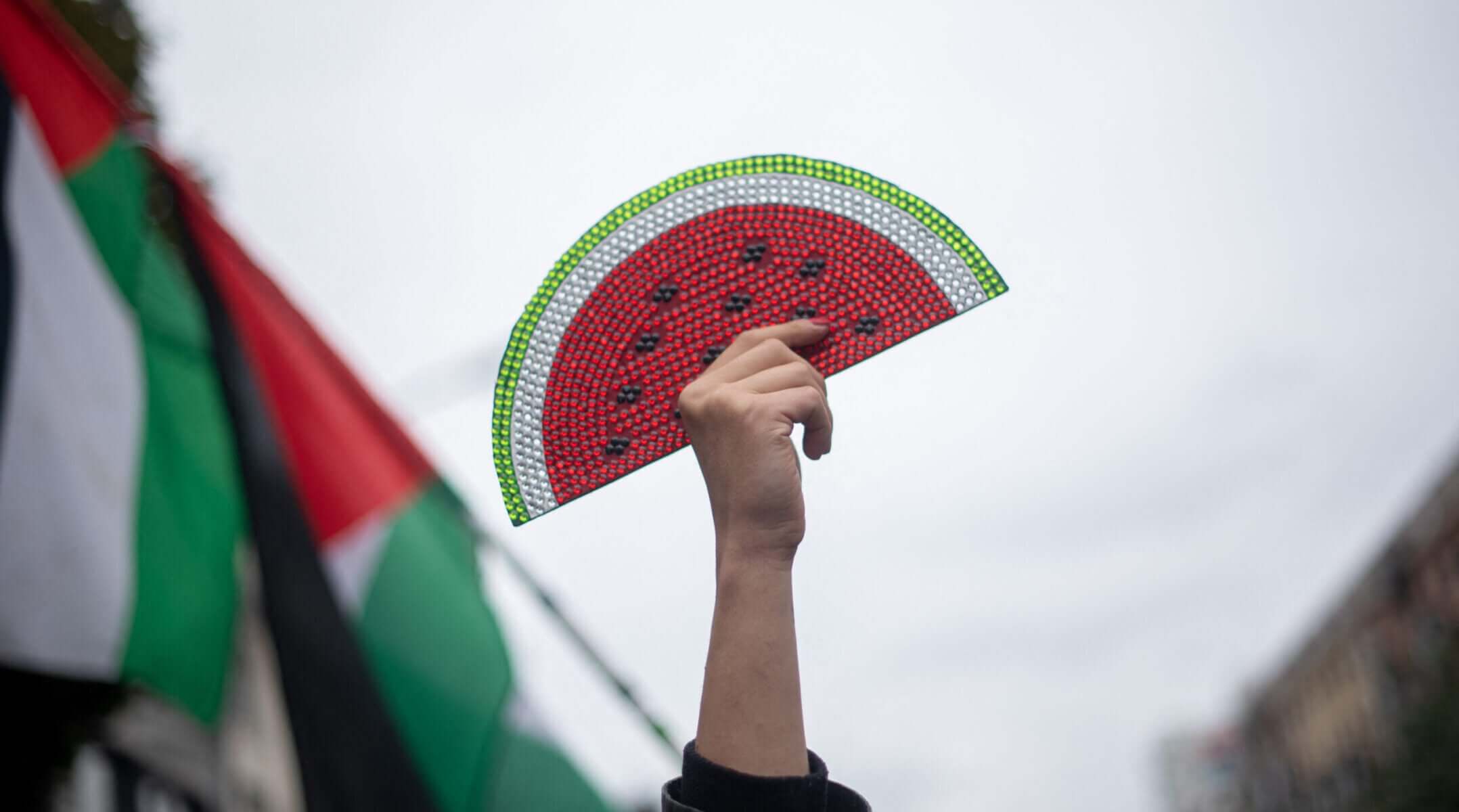
A protester holds a watermelon sign at a rally supporting Palestinians in Gaza, in Berlin, Oct. 6, 2024. (Babak Bordbar / Middle East Images / Middle East Images / AFP via Getty Images)
(JTA) — A Long Island school district agreed to pay a $125,000 settlement to a former student whose pro-Palestinian artwork was painted over in a high school parking lot.
The lawsuit stemmed from a September 2024 incident at Half Hollow Hills High School West, which permitted seniors to decorate their campus parking spots. A Muslim-American student, who was a senior at the time, painted a watermelon featuring a keffiyeh pattern alongside her name in Arabic and the phrase “Peace be upon you” on her space.
At the time, protests against the war in Gaza were at a peak, and the watermelon and keffiyeh, the traditional Palestinian headscarf, are both widely used symbols of Palestinian solidarity. The school painted over the artwork after it drew outcry from some Jewish parents in the district, determining that it had run afoul of the district’s rules barring political designs.
“For the school district, neutrality is the single most important issue when it comes to limiting speech,” the Half Hollow Hills School District’s attorney, Jacob Feldman, said at a school board meeting at the time, according to a contemporaneous Newsday report.
The student, who has not been identified publicly, testified at that meeting last year. “I was told by my principal that the watermelon was being interpreted as antisemitic by anonymous adults,” she said, according to the Newsday footage. “I feel deeply offended that the word antisemitic was used to describe a piece of my artwork.”
In March 2025, the New York chapter of the Council on American-Islamic Relations filed a lawsuit on behalf of the student alongside Stoll, Glickman & Bellina LLP, alleging that the district had violated her free speech rights and caused her emotional distress.
“The whitewash of Plaintiff’s pro-Palestinian speech was not to prevent substantial disruption of any school activity or threatened harm to the rights of others, as Half Hollow permitted and even amplified speech on other equally, even more, controversial issues,” the lawsuit stated, according to the Associated Press.
In court filings, Steven Stern, an attorney appointed by the district’s insurance provider, wrote that the watermelon image “symbolized anti-Semitic hate speech,” arguing that the district should be able to dictate art allowed in the parking lot.
“Any student, teacher, or member of the public could have driven into the parking lot and reasonably understood the school was endorsing a political message — or worse, anti-Semitic hate speech — by allowing it,” Stern wrote, according to Newsday.
The settlement, which was approved by the Half Hollow Hills school board at a meeting on April 21, will be paid by the district’s insurance carrier, according to Superintendent John O’Farrell.
In a statement obtained by Newsday, O’Farrell said that students were no longer allowed to paint their parking spaces “following the incident and the disruption it caused.”
The lawsuit was not the first time that the school district had courted controversy over Israel-related issues. Last year, the district drew scrutiny after a study guide distributed to some 10th graders described Zionism as “an example of extreme nationalism,” prompting condemnation from Rep. Elise Stefanik.
Christina John, a staff attorney for the New York chapter of the Council on American-Islamic Relations, which filed the lawsuit alongside Stoll, Glickman & Bellina LLP, welcomed the outcome in a statement.
“This settlement sends a clear message that viewpoint discrimination and the censorship of Palestinian expression cannot be justified under the guise of neutrality,” John said. “No student should be interrogated, silenced, or punished for peacefully expressing their identity or solidarity with oppressed people.”
Did you know that only 2% of Forward readers donate to support our nonprofit newsroom? That 2% make it possible for millions to read the Forward without a paywall or subscription — removing any barriers to the full and fair Jewish story.
But while the Forward is free to read, it isn’t free to produce. Big stories — like deep dives into the antisemitism data, political scoops or reporting trips to college campuses — take months of research and fact-checking. All while we keep you informed of what you need to know each day.
— Rachel Fishman Feddersen, Forward Publisher & CEO
Support our mission to tell the Jewish story fully and fairly.