What Tuesday’s primaries tell us about Democrats, Republicans and the Israel issue
Opposition to Israel is growing in both parties, but for GOP voters Trump is still what matters
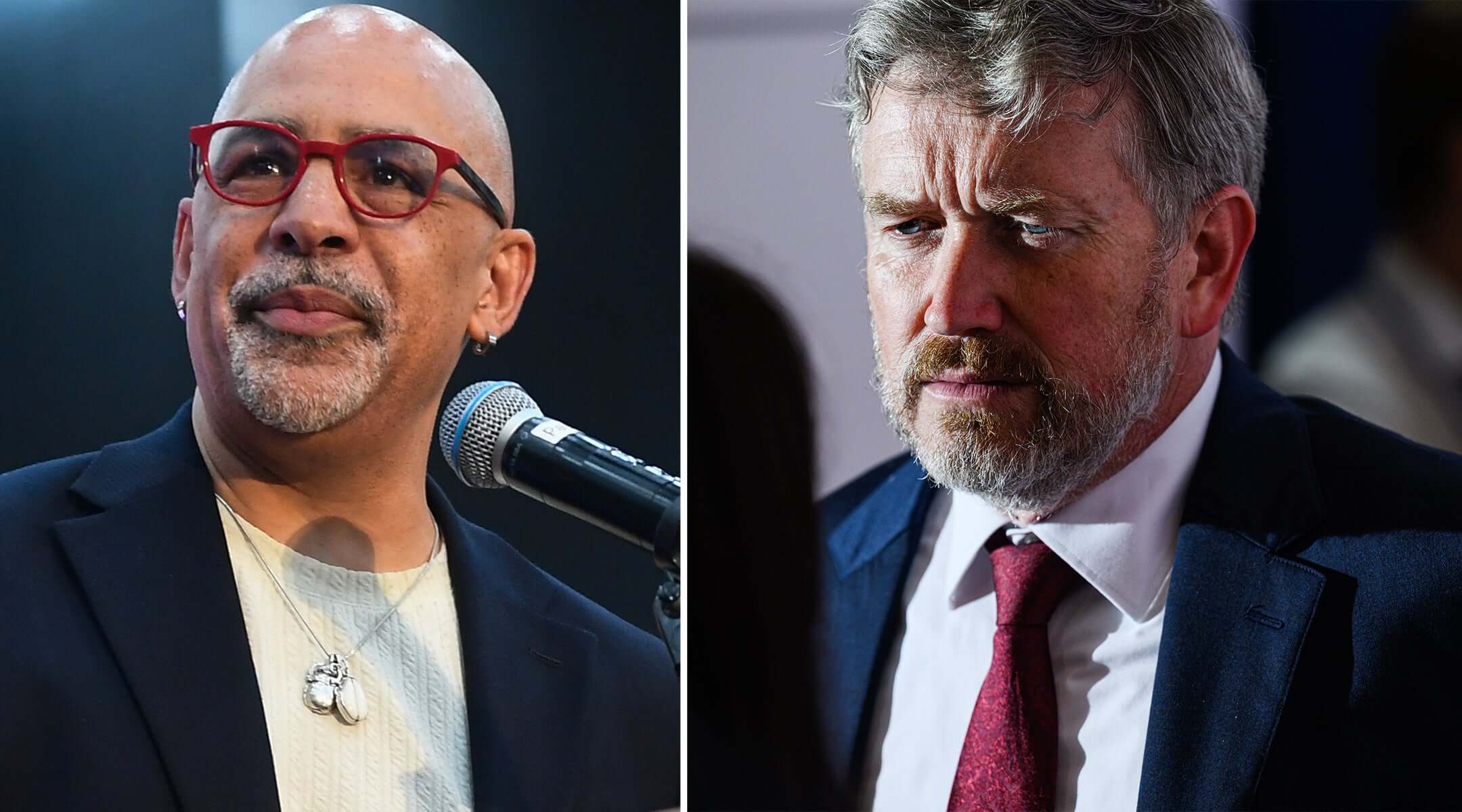
Chris Rabb, L, won a Philadelphia congressional primary on May 19, 2026, while Thomas Massie lost his primary in Kentucky. (Rabb: Matthew Hatcher; Massie: Jon Cherry via Getty Images)
(JTA) — Reading the polls and listening to conservative podcasts, you would understandably think that Republicans are souring on Israel and poised to start voting like Democrats on the issue. At least a little. But the congressional primary results Tuesday in Philadelphia and northern Kentucky tell a more nuanced story (at least for now).
Chris Rabb’s win in the Democratic primary for a congressional seat representing sections of Philadelphia reinforced the view that staunch anti-Israelism is arguably the most potent force in Democratic politics today. The Pennsylvania state representative executed the progressive playbook perfected by New York City Mayor Zohran Mamdani, showing how tough talk on Israel and AIPAC can galvanize the party’s left-wing base.
In Mamdani’s case, however, he was running against several candidates with strong pro-Israel records and deep pro-Israel support – for a position that has long served as a key public cheerleader for Israel in the United States. Rabb, on the other hand, proved that the strategy can be the winning ticket in a race ostensibly having nothing to do with Israel or AIPAC.
Unlike the New York mayor’s race, Tuesday’s primary in Philadelphia consisted of candidates with similar views on affordability issues, while Rabb’s opponents weren’t exactly waiving the pro-Israel flag or raking in major pro-Israel dollars. But, to borrow from 1964 GOP presidential candidate Barry Goldwater, for an increasing swath of Democratic voters (and D.C. lawmakers), when it comes to standing up for the Palestinians and rejecting U.S. support for Israel, extremism is no vice and moderation is no virtue.
On the Republican side, U.S. Rep. Thomas Massie’s flameout in the GOP race for Kentucky’s 4th District suggests that while there may be a gathering storm of discontent over Israel, the main force that matters when it comes to the ballot box remains Donald J. Trump.
Massie tried his best to make his race a referendum on Israel and the influence of pro-Israel money, rather than Trump’s decision to go all in for challenger Ed Gallrein. It didn’t work.
“I’m walking to an airplane to rejoin the most expensive congressional race in U.S. history. It’s turned into a referendum on whether Israel gets to buy seats in Congress,” Massie said a few days before an election that saw record spending by groups both supportive and critical of the Jewish state. After Massie’s defeat, he quipped: “I would have come out sooner but I had to call my opponent to concede and it took a while to find Ed Gallrein in Tel Aviv.”
Despite such rhetoric, the biggest reason Massie will be leaving Congress in January is that Trump wanted him gone – in part over his criticism of the Iran war, but more generally over a range of issues that the Kentucky lawmaker has broken with Trump on. A string of other Republican primary results suggest that the first rule of GOP politics is: If Trump wants you out, you’re cooked – even without a dollar of pro-Israel money going to your opponent.
In his concession speech, Massie lamented that most GOP voters seem to want somebody who will “go along to get along.” But, he added, one group – young voters – stayed with him.
Unfortunately for Massie, the GOP for the time being belongs to Trump and his loyal followers, not the growing number of young conservatives who want an end to U.S. support for Israel. On the bright side for Massie and his fans, they already hold the power in at least one key area. As one popular pro-Trump conservative social media poster put it: “Don’t think of it as losing a Congressman. Think of it as gaining a podcaster.”
The views and opinions expressed in this article are those of the author and do not necessarily reflect the views of JTA or its parent company, 70 Faces Media.
I’m personally matching all gifts to the Forward, up to $36,000. Can I match your gift now?

Hello, fellow Forward reader! I’m Joel Brown, a Forward reader and supporter for more than 15 years, and currently the chair of the board of directors.
I’m an avid Forward reader because it ticks so many of my essential boxes: excellent journalism, Jewish focus and diverse viewpoints. In today’s political climate, what I most appreciate is the Forward’s independence — made possible by the generosity of its membership.
The Forward is committed to bringing you unbiased, nuanced Jewish news. From my position as board chair, I see an exciting future as we expand our position as the definitive independent voice of contemporary American Judaism.
— Joel Brown, Forward board chair
Support our mission to tell the Jewish story fully and fairly.