A stronger shekel has become a pressing problem for Americans building lives in Israel
Dollars aren’t going as far as they used to, squeezing both immigrants and nonprofits depending on U.S. giving
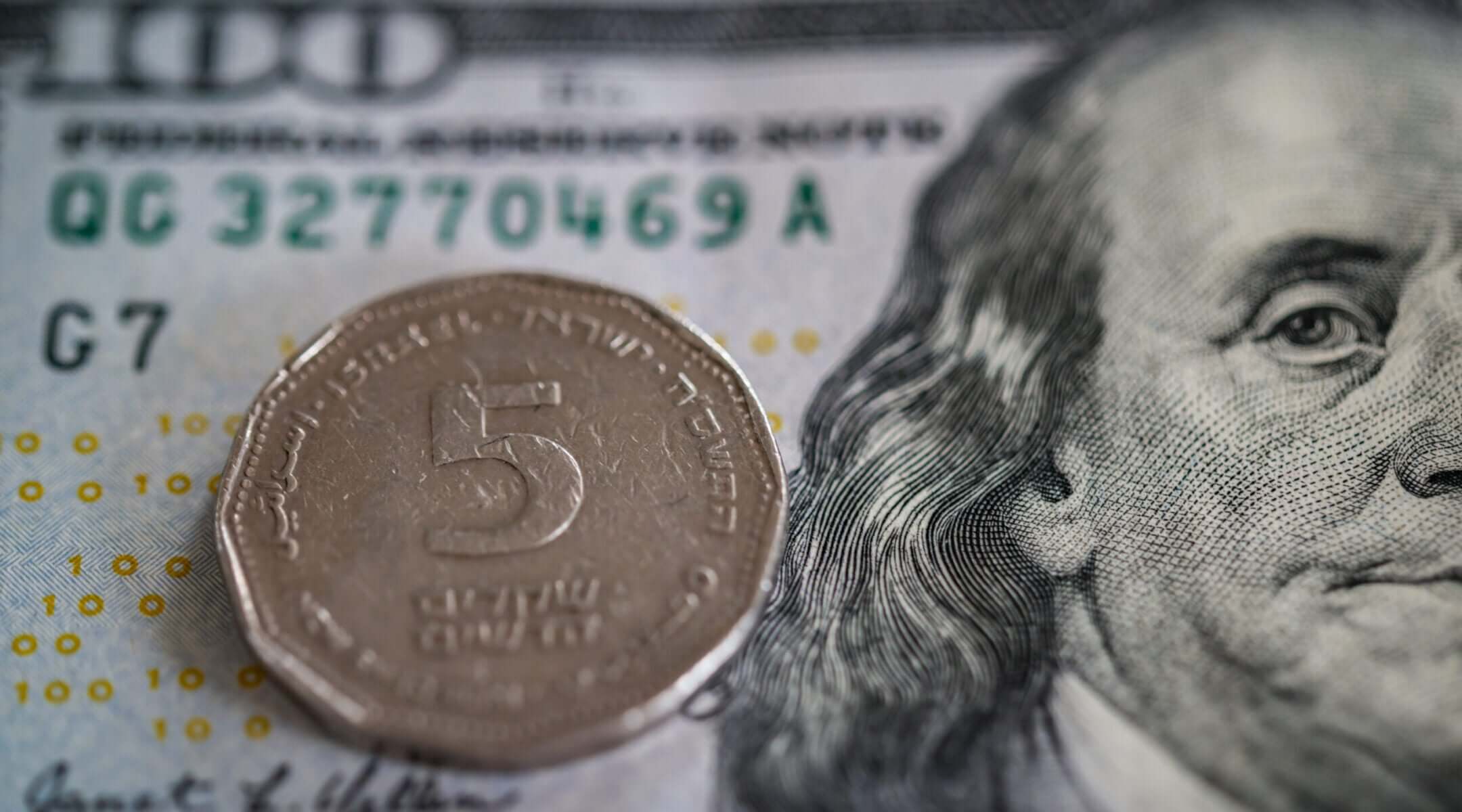
An uncommonly strong shekel is posing challenges for Americans in Israel in May 2026. Photo by Nati Shohat/Flash90
(JTA) — Yisrael HaBahiyir saved for more than a year to make his dream of moving to Israel come true.
But just weeks after leaving upstate New York, where he had been managing operations for a synagogue, he got a cruel reality check when he transferred his rent money from his American bank account to Western Union to pay his Tel Aviv landlord.
“I sent the same amount I normally transfer and went to pick it up. It was about 300 shekels short. I said something to the cashier, like, ‘I think you gave me the wrong rate,’” HaBahiyir recalled. “That’s when I realized the shekel was strengthening.”
It’s an experience that Americans in Israel — and Israelis who depend on American dollars — are increasingly facing, as the Israeli shekel has strengthened to near-record highs. While the currency’s strength has been good news to many Israelis who worried that years of war would harm the economy, it is having wide-ranging and often challenging ramifications for immigrants and Israeli nonprofits.
Many Americans who move to Israel have chosen to keep some or all of their assets in dollars, whether to hedge against shekel volatility, maintain financial ties to the United States or preserve flexibility should they ever return.
When the dollar is relatively strong compared to the shekel, as was the case for much of the past decade, that arrangement is advantageous. Assets held in dollars go further in an Israeli economy priced in shekels, giving American immigrants greater purchasing power for everyday expenses.
But now, with the shekel trading at less than three to a dollar, its most favorable rate in three decades, anyone trying to make a life in Israel using U.S. dollars is feeling the squeeze.
“Before, $1,500 would get me close to 6,000 shekels and cover my bills,” said Lauren Adilav, who works as a freelance editor for American authors. “I’m relying on money from the U.S. to cover my rent. If the shekel gets any stronger, I don’t know if I can.”
The exchange rate isn’t just punishing Americans in Israel. It’s also putting extreme pressure on the many Israeli charities and organizations that depend on donations from Jews abroad. Aish Hatorah, the Orthodox outreach organization based in Jerusalem, announced last month that it had laid off several employees and twice delayed salary payments to staff amid funding shortfalls driven largely by the strengthening shekel.
Leket Israel, the food rescue organization, has also felt the pressure. Its founder, Joseph Gitler, said the shift had made clear that Israeli nonprofits can no longer rely solely on overseas support. Shmulie Russel, director of Makom LaLelev, told JTA that his nonprofit, which provides direct aid to those recovering from addiction, is facing a similar financial crunch and might soon be forced to find ways to cut expenses.
“This is the biggest conversation happening in the Israeli NGO sector right now — how to deal with the strength of the shekel,” said Leah Aharoni, executive director of the group Our People, which helps Russian-speaking Jews immigrate to Israel. The majority of donations to Our People are made in dollars.
So far, Aharoni said, the organization has delayed making new hires. She anticipates more challenges ahead.
“It has made it absolutely impossible to plan,” she said. “This is happening across the NGO sector. We haven’t been forced to cut programs yet, but it’s only a matter of time.”
Aharoni added that she hasn’t wanted to raise the issue with her donors. “Everyone is reluctant to speak out, as donors are already feeling the fatigue of three years of war. Israel just isn’t at the top of their priorities anymore, and now we’re coming back to ask them to make up the difference,” she said. “So we cut where we can.”
The strength of the shekel has come as a surprise to many Israelis, who expected the economy to be weakened by yet another war, this time with Iran, that cratered tourism and heightened instability in daily life. Yet much of the shekel’s gain against the dollar has actually stemmed from the war, as the dollar has weakened and investors have flocked to Israel’s high-tech sector, and particularly its defense industry, which has been buoyed by the conflict.
“The high-tech industry, which historically leads growth in Israel, has been minimally hurt by the war given its reliance on international connections — and it continued to grow even in 2024, the worst year of the war,” said Michel Strawczynski, professor of economics at Hebrew University.
High-tech exports reached $78 billion in 2024, and in the first half of 2025, high-tech accounted for 57% of all Israeli exports, the highest share ever recorded.
For Adilav, who moved from Jerusalem to the West Bank to manage her costs since moving to Israel from upstate New York more than two decades ago, spending in the tech sector is cold comfort.
“The shekel being strong might be good for the 10 billionaires who dream up some app and sell it to Google for $40 billion, but it really affects the rest of us,” she said.
Exporters, meanwhile, have counter-intuitively watched their profit margins dwindle as the shekel gains. They are paid for their products in dollars, so as the shekel strengthens and the dollar weakens, they end up with fewer and fewer shekels to fund their operations and pay workers’ salaries.
The pinch is also coming for Americans who are buying Israeli real estate — a transaction that often happens “on paper,” or with Americans entering a contract to buy an apartment or home that is still being built. Those contracts rarely account for a volatile exchange rate.
“When their upcoming payment might have been 400,000 shekels, now they’re getting hit harder in dollars,” said Nachi Paris, a Jerusalem-based real estate agent who specializes in high-end properties.
Paris said contracts for apartments in development typically prohibit transfers before a buyer takes possession, leaving buyers legally obligated to spend more than they expected when they signed.
He said he believed concerns about antisemitism in the United States could drive middle-class American Jews who cannot afford second properties to make Israel their primary residence instead. But the exchange rate could be an obstacle.
“There’s a point where they can’t afford it,” Paris said. “Right now, it’s still psychological. They can still afford it, and Zionism is involved, and they want to move here, but there comes a point when you can’t afford it.”
With economists warning a stronger shekel can lead to employment drops and other negative consequences, calls have been growing on the Bank of Israel to intervene. But its options are limited, according to Strawczynski, who noted that paused rate cuts and rising inflation from oil prices and flight costs constrain the bank’s ability to act at least until the war ends.
For now, Americans in Israel are paying the price. Judy Diamond moved from New York four years ago with the goal of fully retiring from her career in finance. Not only has she set that aside as an immediate ambition, but she is trying to break her lease in the upscale Katamon neighborhood of Jerusalem because she can see that her savings, in dollars, won’t stretch as far as she anticipated.
“I just can’t afford my rent anymore,” Diamond said. “It’s keeping me up at night. It worked for three and a half years, and now the financial aspect of it has fallen apart.”
For Joel Haber, a Jerusalem-based guide who moved to Israel in 2009, the shekel’s rise has come at an especially painful time, when yet another war stopped the flow of travelers who pay hundreds of dollars for his food tours of his adopted city and its famous market.
“The battered dollar has been more of an added insult to the injury of the war,” he said.
Haber always quotes his prices in dollars, even for visitors not from the United States. “It’s a lot less scary to see a price of $300 than 900 shekels, especially for unfamiliar tourists,” he said.
Now, due to the strength of the shekel, Haber has taken what amounts to a 20% pay cut over the last year. He would like to raise his prices, but with the cost of visiting Israel already so high and a 50% reduction in tourist visits compared to 2022, Haber can’t afford to lose any more customers.
“I want to raise my prices so I can still pay my bills,” he said. “But if I look at it from the tourists’ perspective, it’s getting even more difficult for them to afford Israel. It hurts us both.”
This article originally appeared on JTA.org.

Hello, fellow Forward reader! I’m Joel Brown, a Forward reader and supporter for more than 15 years, and currently the chair of the board of directors.
I’m an avid Forward reader because it ticks so many of my essential boxes: excellent journalism, Jewish focus and diverse viewpoints. In today’s political climate, what I most appreciate is the Forward’s independence — made possible by the generosity of its membership.
The Forward is committed to bringing you unbiased, nuanced Jewish news. From my position as board chair, I see an exciting future as we expand our position as the definitive independent voice of contemporary American Judaism.
That’s why I’m paying it Forward, by matching $36,000 of reader gifts. It’s an investment in the Forward’s newsroom, to continue telling the American Jewish story with truth and independence.
— Joel Brown, Forward board chair
Support our mission to tell the Jewish story fully and fairly.