North Carolina Democrats reject Gaza genocide resolution following campaign by Jewish caucus
“Now we feel like we have a home again,” one local Jewish Democratic leader said following the vote
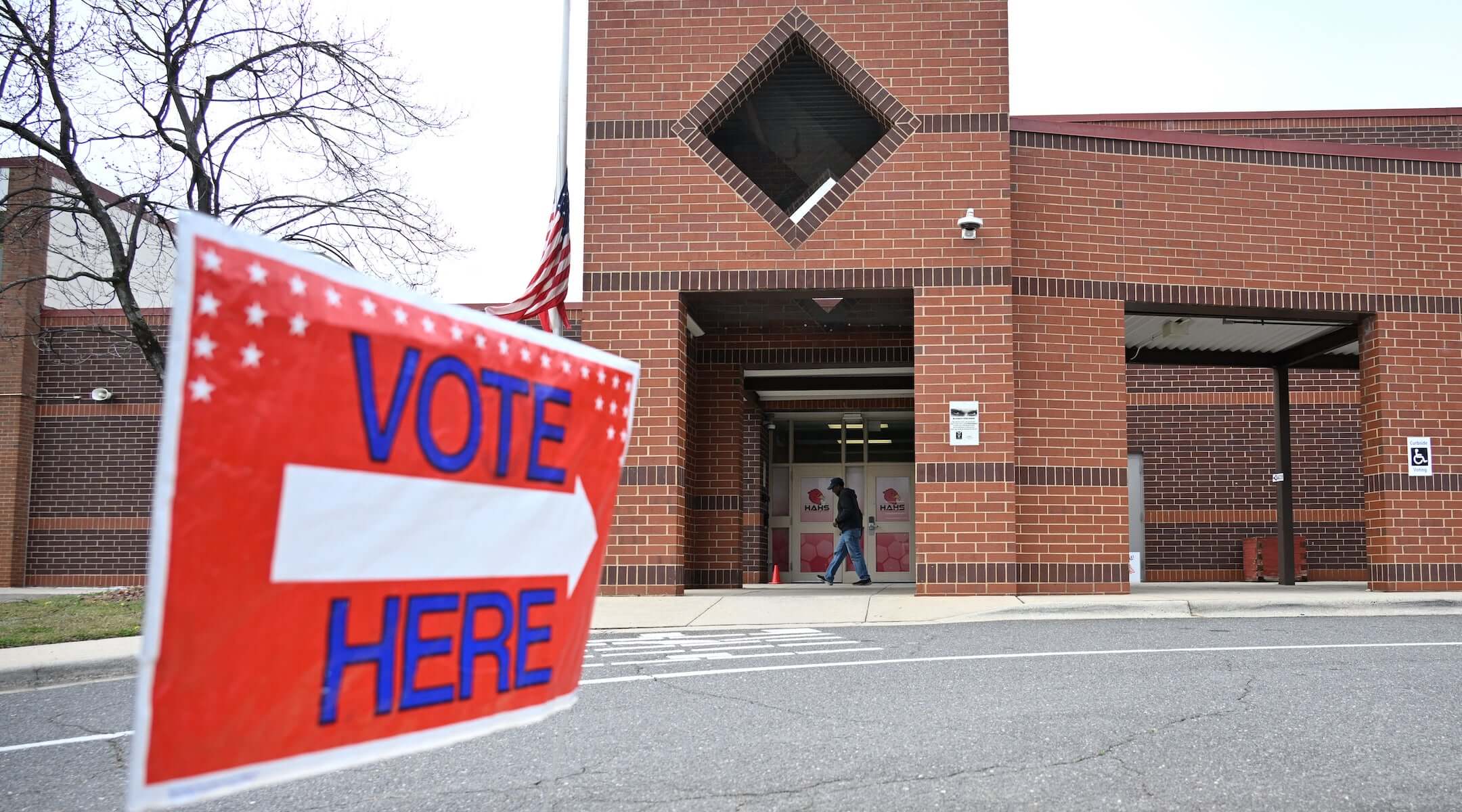
Mecklenburg County voters go to polls for the midterm elections as the Board of Elections receives the ballots in Charlotte, North Carolina on March 3, 2026. Photo by Peter Zay/Anadolu via Getty Images
(JTA) — For weeks, Jewish Democrats in North Carolina worked to block the state’s Democratic Party from passing a resolution declaring Israel’s actions in Gaza a genocide.
On Saturday, they narrowly prevailed.
The measure, titled the “Genocide Accountability Resolution,” was struck down by members of the North Carolina Democratic Party’s State Executive Committee with a vote of 163-130.
For Amy DeLoach, the first vice chair of the North Carolina Democratic Party Jewish Caucus, the victory marked a sign that Jewish Democrats still have a place in the party, even as debates over Israel have roiled Democratic politics across the country.
“Most Jews vote Democratically, and we were feeling abandoned, and now we feel like we have a home again,” said DeLoach, who also sits on the party’s international subcommittee.
The defeat of the resolution comes as support for Israel has dropped dramatically among Democrats, and the U.S.-Israel alliance has increasingly emerged as a third rail within the party.
While resolutions condemning the pro-Israel lobby AIPAC and calling to halt arms sales to Israel have been blocked by the Democratic National Committee over the past year, last June, the North Carolina Democratic Party passed a resolution calling for an immediate arms embargo on Israel.
Joel Wanger, the chief political officer of the Democratic Majority for Israel, welcomed the outcome of the genocide resolution in a statement to the Jewish Telegraphic Agency Tuesday.
“This resolution would have divided Democrats at a time when we should be united in opposing Donald Trump, while doing nothing to advance peace between Israelis and Palestinians,” he said.
The resolution was introduced earlier this year by a member of the progressive, Arab and Muslim caucuses of the North Carolina Democratic Party. It advanced from the precinct level through county, district and state bodies before reaching the State Executive Committee for a final vote Saturday.
The resolution would have added language to the state party platform calling for the “prosecution” and “vetting” of individuals and entities in the United States who “may have participated in or enabled genocide.” The resolution also cited a United Nations Commission of Inquiry that concluded for the first time in September that Israel had committed a genocide in Gaza.
The resolution’s defeat Saturday followed an extensive campaign by the party’s Jewish Caucus to block its adoption.
In a May 27 letter to members of the executive committee, leaders of the Jewish Caucus urged them to reject the resolution, arguing that state parties “should not adopt contested international policy positions” and that its timing would hurt 2026 Democratic candidates and divide voters.
“Jewish, Muslim, Palestinian, Christian, and secular Democrats are united on affordability, public education, healthcare, voting rights, and reproductive freedom,” the letter said. “This resolution forces them to take sides on something most did not join the party to fight about.”
The letter cited “serious factual and legal problems” with the resolution and said Jewish Democrats would support a substitute “affirming NC Democrats’ commitment to ending civilian suffering in Gaza, supporting humanitarian aid, and opposing antisemitism, Islamophobia, and political violence in all forms.”
But the Jewish Caucus was not the only group within the party invested in the outcome of the vote.
Last month, the leaders of the Muslim, Arab, interfaith and progressive caucuses of the North Carolina Democratic Party issued its own a letter calling on members of the State Executive Committee to support the resolution in order to “affirm our party’s commitment to human rights and the protection of civilian life.”
“All too frequently, the burdensome narrative of genocide denial has been heard from those persons and organizations who have 1) either acquiesced to genocide or 2) feared the worst reprisals from those who have supported it,” the letter read. “This silence compromises the faith of many voters in our party.”
The letter, which cited a recent study that found 80% of Democrats have an unfavorable view of Israel, was undersigned by the head of the state party’s Jewish Democrats, a non-Zionist Jewish subgroup within the Interfaith Caucus.
Mark Bochkis, the communications chair of the Jewish Democrats, told JTA that his group and the Jewish Caucus “fundamentally disagree about the divisiveness” of the resolution.
“We believe this is actually an issue that galvanizes the younger base of the party and other other important key voting blocks for the Democratic party,” Bochkis said. “We believe not speaking out on something like this is actually holding the party back.”
Paul McAllister, the chair of the Interfaith Caucus, told JTA that “we don’t want to see anything happen to any member of any community, Jewish or otherwise, but we do want accountability.”
While McAllister said that the language concerning “prosecution” in the resolution could have been “clarified,” he said the Jewish Caucus’ suggestion of an alternative to the resolution attracted little support because he felt it “waters down the need to hold a nation accountable for what it is doing to another people.”
“My major concern is that we have a faction within the party that wants justice for all people equally, Jews and Palestinians, and that there’s some in the party, namely members of the Jewish caucus, who do not comprehend how critical it is that we not only look after our own interest or our own group’s interest, but the interest of others, and this is the struggle,” McAllister said.
DeLoach said the scheduling of the vote last week on Shabbat had bothered members of the Jewish caucus. But she said they had “let that one go” to focus on fighting the resolution.
“We talk about that amongst ourselves, but we’re in a war right now,” she said. “We’re going to pick and choose the battles we fight.”
DeLoach said her group viewed the resolution as a political liability that could potentially force Democratic candidates in the state to either distance themselves from the party or embrace a “difficult divisive issue” on the campaign trail.
“No politician is going to want to run on a platform that includes this,” DeLoach said. “Platforms don’t win elections, and this is going to risk us losing an outrageously important election.”
DeLoach pointed to the campaigns of Roy Cooper, the state’s former governor who’s running for a Senate seat, and Anita Earls, who is running for reelection to the North Carolina Supreme Court.
“Most Democrats in North Carolina really are more concerned about their electric bill right now, and the cost of food,” DeLoach said. “As the vote shows, you know, nobody likes what’s going on in the Middle East. We don’t like what’s going on in the Middle East, but we know that’s not where our focus should be right now.”
Looking ahead, DeLoach said she hoped that the resolution’s defeat would serve as a warning against rhetoric she saw as “adding to a drumbeat of antisemitism that is so prevalent in the country.”
“There’s war crimes on both sides here, but it’s not a genocide, and y’all pounding this drum is making it more and more dangerous for Jews to live in this country,” DeLoach said. “We see the defeat of this resolution not only as a chance for us to start just electing Democrats, but as a hopeful pause, at least, if not a stop to this horrible rhetoric.”
This article originally appeared on JTA.org.
Did you know that only 2% of Forward readers donate to support our nonprofit newsroom? That 2% make it possible for millions to read the Forward without a paywall or subscription — removing any barriers to the full and fair Jewish story.
But while the Forward is free to read, it isn’t free to produce. Big stories — like deep dives into the antisemitism data, political scoops or reporting trips to college campuses — take months of research and fact-checking. All while we keep you informed of what you need to know each day.
— Rachel Fishman Feddersen, Forward Publisher & CEO
Support our mission to tell the Jewish story fully and fairly.