Egypt’s Mohamed Morsi Cleans House
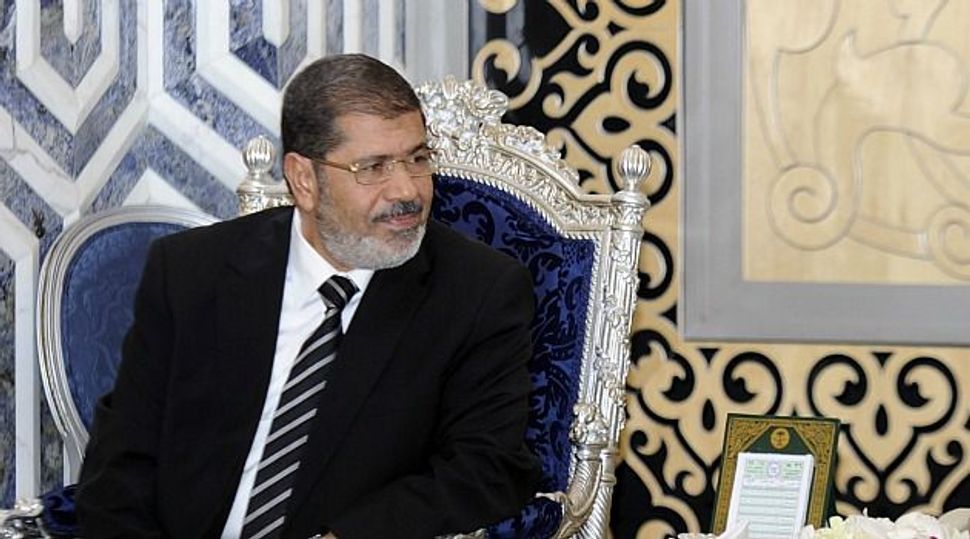
Bump in Road? Egyptian President Mohamed Morsi is moving to assert himself by firing some holdovers from the old regime. Image by getty images

By Nathan Guttman August 18, 2012
Struggling to find their bearings after a surprise move by Egypt’s new president replacing his country’s top military brass, American officials were quick to declare that Egypt’s new faces in command of the military are old friends of America.
“The new defense minister is someone who’s known to us. He comes from within the ranks of the SCAF, and we believe we’ll be able to continue the strong partnership that we have with Egypt,” Pentagon press secretary George Little said in an August 13 press briefing, referring to Egypt’s Supreme Council of the Armed Forces by its acronym.
President Mohamed Morsi announced the removal of Egypt’s longtime defense minister, Hussein Tantawi, on August 12. Tantawi, who also headed the SCAF, was the country’s highest official still serving from the era of Egyptian dictator Hosni Mubarak, who was overthrown in February 2011. The United States, which maintained long and close ties to Tantawi, viewed him and several other commanders whom Morsi ousted as a counterweight to the Muslim Brotherhood, the Islamist group from which Morsi comes.
Along with Tantawi, Morsi fired Egypt’s military chief of staff, Sami Anan, and commanders of the Air Force, Navy and Air Defense Command. Former chief of military intelligence Abdel Fattah al-Sissi replaced Tantawi as defense minister.
Pentagon officials stressed that although the United States was not consulted prior to the move, Secretary of Defense Leon Panetta, who recently visited Cairo, had expected Morsi to name his own military leadership sooner or later.
For decades, Egypt’s military served as America’s prime channel of engagement with Cairo. When the Mubarak regime came to its end, the administration was reassured by the fact that the nation’s transition was overseen by the military through the SCAF. Tantawi’s long-standing relations with American generals and civilian officials made him Washington’s go-to man even after the Muslim Brotherhood won the country’s first democratic elections and Morsi became president. Until his recent move, Morsi allowed these relations to continue undisturbed, making clear that he wanted to focus on domestic issues.
“Up to now, the United States wasn’t forced to choose between the military and the government,” said Geoffrey Aronson, director of research and publications at the Foundation for Middle East Peace, in Washington. “Now, if one side makes an effort to demonstrate that this is a new era in Egypt, then the Americans will be forced to choose.”
But Morsi’s choice of a replacement for Tantawi indicates that America might not be at a choosing point yet. Sissi gained notoriety after defending the practice of “virginity tests” conducted on female protesters in Egypt who were arrested during the Tahrir Square demonstrations that led to Mubarak’s ouster. But for Americans he was a well-known figure years before, thanks to the Pentagon’s close cooperation with Egyptian military intelligence, which Sissi headed. Prior to that, he spent several years training in the United States, as had many other top Egyptian military commanders.
“These new appointees, the new leaders of the military, are all people that we have worked with before,” State Department spokeswoman Victoria Nuland said in an August 13 press briefing.
Statements by officials such as Nuland and others following the events in Egypt made it clear that the Obama administration still viewed the SCAF and the military chiefs as its main interlocutors in Cairo. Most of America’s $1.5 billion in annual assistance to Egypt is given for military purposes and managed by the army.
But while trying to put a positive face on Morsi’s latest move, the administration is watching with concern other moves by the Egyptian president. Morsi took away many of the SCAF’s authorities, which were granted to the military council in a March referendum and were meant to expire only after the nation’s new constitution is adopted.
“Essentially, Morsi has changed Egypt’s constitution by fiat,” David Schenker, director of the program on Arab politics at the Washington Institute for Near East Policy, wrote in a recent article. “[I]n the process, [he] afforded himself control over the military, all legislative powers and the makeup of the assembly that will write the new constitution.”
Schenker further noted that while “curtailing military power may prove popular in Tahrir Square, the constitutional ramifications will likely prolong instability in a country already beset by significant economic, security and political challenges.”
Contact Nathan Guttman at [email protected]
Why I became the Forward’s editor-in-chief
You are surely a friend of the Forward if you’re reading this. And so it’s with excitement and awe — of all that the Forward is, was, and will be — that I introduce myself to you as the Forward’s newest editor-in-chief.
And what a time to step into the leadership of this storied Jewish institution! For 129 years, the Forward has shaped and told the American Jewish story. I’m stepping in at an intense time for Jews the world over. We urgently need the Forward’s courageous, unflinching journalism — not only as a source of reliable information, but to provide inspiration, healing and hope.
— Alyssa Katz, editor-in-chief
Support our mission to tell the Jewish story fully and fairly.