Is there a Messianic Jew on Disney’s ‘Mickey Mouse Funhouse’?
A Jewish character wears a necklace with a Messianic seal at a Hanukkah celebration
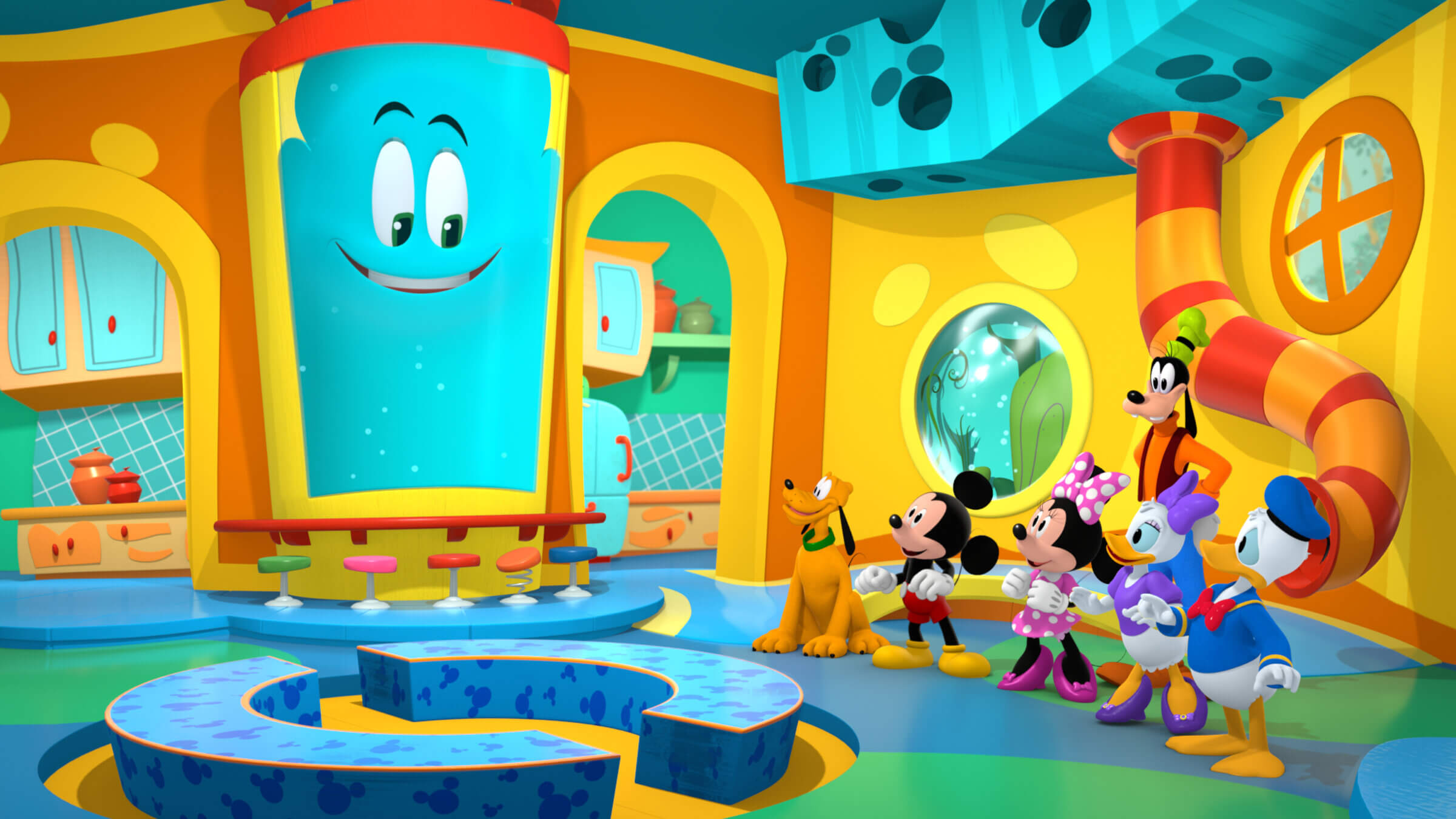
Mickey and friends in the “funhouse.” Courtesy of WDTVPress.com

By Hannah Feuer May 15, 2025
The Jewish character in Disney’s Mickey Mouse Funhouse may be having a crisis of faith.
In the holiday episode “Nochebuena at the Funhouse / Hanukkah at Hilda’s,” Mickey and the gang learn about Hanukkah from their friend Hilda, who is introduced as Jewish. But Hilda, a hippopotamus who speaks with a Southern drawl, may not be quite the Jewish representation Disney had in mind. During the Hanukkah celebration, she wears a necklace with a Messianic seal: a menorah above a Star of David above an ichthys, commonly known as a Jesus fish.
It’s a confusing accessory, to say the least. The symbol seems to imply Hilda identifies as a Messianic Jew, many of whom believe Jesus is the Messiah. All mainstream Jewish religious movements consider that a form of Christianity.
The inclusion of the messianic seal was accidental, according to a source with knowledge of the matter. Although the Hanukkah episode underwent several rounds of review by Jewish cultural and religious advisers, including rabbis, the symbol was not flagged.
If not for sharp-eyed viewers, Disney almost could have gotten away with the theological curveball. The episode dropped last December without much fanfare, save for a piece in Kveller appreciating Disney’s earnest, if slightly flawed, attempt at Jewish representation. That article referred to Hilda’s jewelry as a “menorah necklace.”
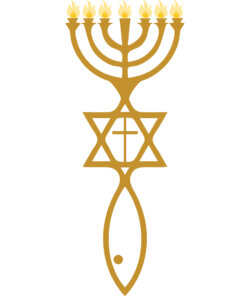
But this week, a Reddit user posted a still from the episode to r/Judaism, pointing out Hilda’s unusual choice of jewelry. The user was excited for their daughter to see a Jewish character on Mickey Mouse Funhouse — that is, until they saw a symbol representing Jesus hanging from Hilda’s neck.
As it turns out, a lot of Jews have made the same mistake Disney did.
“I bought one of those bracelets and had no idea!” one Reddit user commented in r/Judaism.
“I wore it to my son’s bar mitzvah FFS…oy,” another wrote.
Plus, the actor who voices Hilda, April Winchell, is Jewish. And honestly, I can’t say that I was familiar with the symbol before seeing it on Hilda, either.
For what it’s worth, the episode does get a lot right about Hanukkah. Hilda proudly tells the group that her menorah was a gift from her bubbe and zayde. She correctly lights the candles from left to right (though recites no prayer) and exclaims “Chag sameach!” She serves latkes and sufganiyot and tells her friends about the miracle of the oil lasting for eight nights.
Other details are less compelling. In the episode, friends stop by Hilda’s house to deliver Christmas cookies, oblivious to her Jewish faith. When a snowstorm forces the group to shelter in place, Mickey suggests celebrating Christmas at Hilda’s house.
“Christmas? Here? Well, my, that does sound different,” Hilda replies in her thick Southern accent. “I’ve never celebrated Christmas before.”
“What?! Really?! You don’t celebrate Christmas?” the gang replies, horrified.
Hilda explains the basics of Hanukkah to the group. She mentions that some Jewish families give gifts all eight nights of Hanukkah, a fact that delights Donald Duck. (On this point, Disney producers may have been wise to consult comedian Alex Edelman, who has a bit debunking the eight gifts myth.)
Still, the core message of the episode is about friends celebrating and accepting each other’s faiths. Hilda tries Christmas cookies, and the other characters try sufganiyot and latkes. Some view the Messianic seal as representing the strong connection between the Jewish and Christian faiths. In that sense, then, the symbol could be on theme.

Hello, fellow Forward reader! I’m Joel Brown, a Forward reader and supporter for more than 15 years, and currently the chair of the board of directors.
I’m an avid Forward reader because it ticks so many of my essential boxes: excellent journalism, Jewish focus and diverse viewpoints. In today’s political climate, what I most appreciate is the Forward’s independence — made possible by the generosity of its membership.
The Forward is committed to bringing you unbiased, nuanced Jewish news. From my position as board chair, I see an exciting future as we expand our position as the definitive independent voice of contemporary American Judaism.
That’s why I’m paying it Forward, by matching $36,000 of reader gifts. It’s an investment in the Forward’s newsroom, to continue telling the American Jewish story with truth and independence.
— Joel Brown, Forward board chair
Support our mission to tell the Jewish story fully and fairly.