Apple TV’s ‘Your Friends & Neighbors’ just gave us a stunningly authentic Jewish episode
At a time when Jews are nervous about their public perception, seeing shmura matzah on TV was a balm, writes a rabbi and cultural commentator
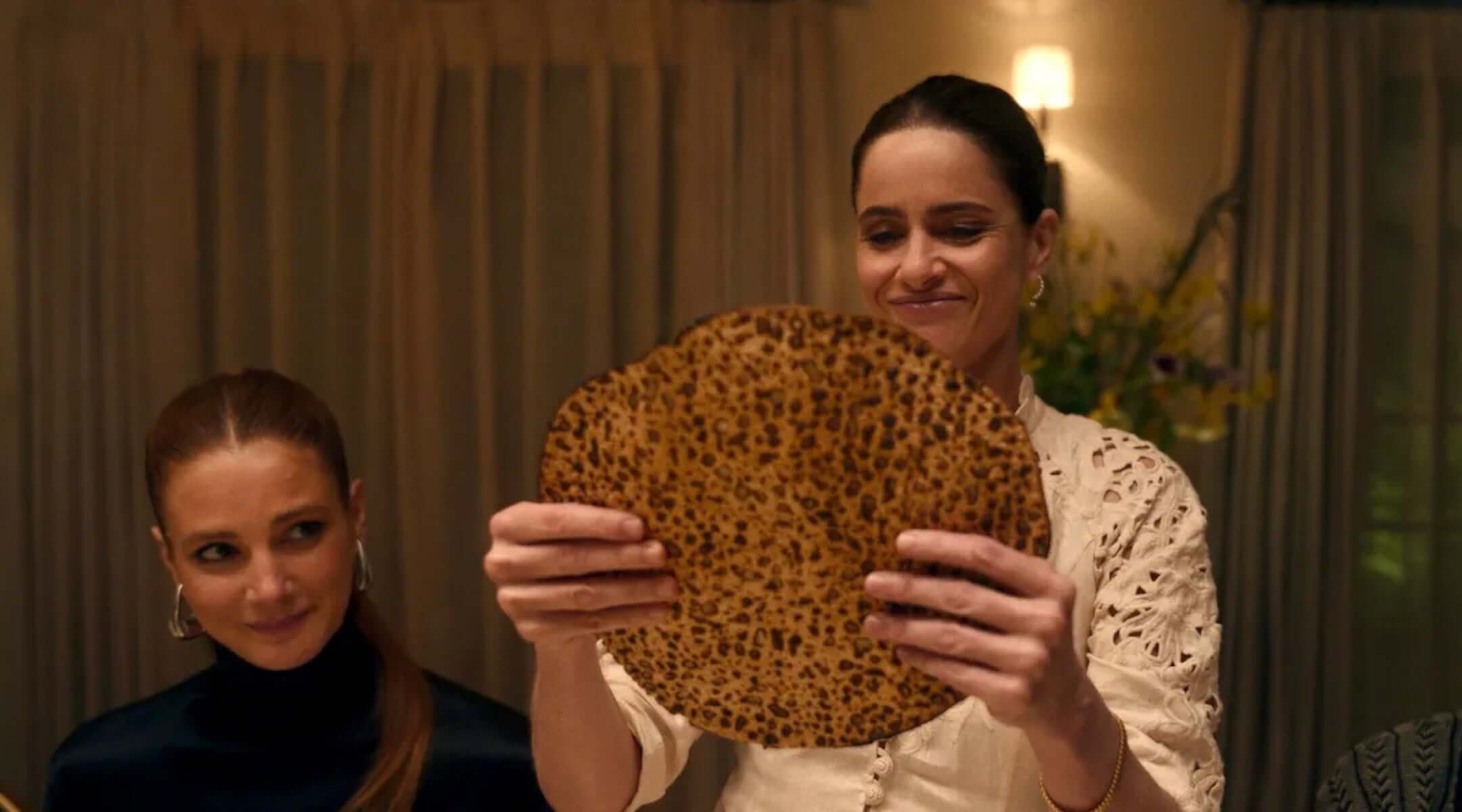
Actress Amanda Peet breaking the middle matzo on ‘Your Friends & Neighbors.’ Courtesy of Apple TV
By Rabbi Yael Buechler April 27, 2026
(JTA) — Matzo is not something I typically give much thought to in the days following Passover. Yet I cannot stop thinking about a piece of shmura matzo I recently encountered.
The encounter came on Apple TV’s “Your Friends & Neighbors,” where the handmade round matzo (that always tastes a little burnt) just had a major cameo — perhaps its debut on a national TV series — in the episode that dropped on Friday.
“Your Friends & Neighbors” stars Jon Hamm as a suburbanite who takes to theft, roiling his community. The entire show is packed with rounds of golf and all-you-can-eat buffets at a WASPy country club — I hadn’t gotten the sense that anyone was Jewish. Until I saw that the fourth episode of the second season was called “The Bread of Affliction.”
Perhaps I should have known: The show is based (and filmed) in Westchester County, just north of New York City, where I work as a rabbi and where many secular families include Jews. And there was a “L’chayim” in the previous episode, but that phrase has practically entered the English lexicon. I never saw the matzo coming.
I’ve carved out a social media niche critiquing portrayals of Judaism in pop culture. So I have to give credit where credit’s due — what transpired on “Your Friends & Neighbors” was no less than a modern miracle: Judaism done right.
I was sold at “Good yontif,” the words recited by Hari Sahni (played by Manu Narayan), one of the hosts, as guests entered his gorgeous, towering home for the seder.
What soon transpired was not your traditional hodgepodge of a Passover table: no scattered Hebrew school projects or random plastic frogs. We viewers got an aspirational seder, with an aesthetic somewhere between cottagecore and, well, upscale Westchester. The seder table was a canvas filled with floral arrangements, votive candles, and beautifully scripted place cards. For those playing insider Jewish baseball, there was even a place card for Elijah (no last name).
There was also drool-worthy matzoball soup being stirred in a giant, seder-sized pot, and caviar on matzo, an atypical yet perfectly kosher combination.
And then, the kiddush. Gretchen Reagan (played by Miriam Silverman, a Jewish actress and Broadway star), who is married to Hari, recited a full version of the Passover blessing — not the one-liner everyone knows from Hebrew school — and with the right nusach (tune). That tune, that beautiful, trembling holiday version, is one that most traditional households don’t even quite land as well as she did.
All of the guests at the table held (in unison) a classic yellow-and-maroon haggadah, first published in 1949. This nostalgic haggadah, which also appeared in the Passover episode of “Curb Your Enthusiasm” back in 2005, is still used at many seders today. It’s known for its simplicity, black-and-white drawings and helpful directions.
Following that epic kiddush, Mel and Coop’s teenage son, Hunter, struggles to sing “Ma Nishtanah.” Honestly, an all-too-accurate portrayal, too — he probably hadn’t practiced since Hebrew school. He was soon backed up by another Jewish actress and Broadway star, Rebecca Naomi Jones, who plays Suzanne Haber, a neighbor in the series’ fictional Westmont Village community.
Yet what blew me away the most was that shmura matzo. Square matzo famously occupies supermarket kosher sections year-round, but shmura matzo tends to appear only right before the holiday.
Where did the props department find an intact piece? Most boxes of shmura matzo come cracked. And once they had one, how many tries did it take for Amanda Peet to break it neatly in half? The notable Jewish actress plays Mel Cooper, the Jewish ex-wife of Andrew (Coop) Cooper (Hamm), who is not Jewish. Peet’s role has been central across both seasons, as she navigates challenging family dynamics, many of which play out at the seder.
As the seder continued, guests dipped pinkies in wine (ever so daintily) for the Ten Plagues. They went around the table, each reciting one plague in English — a genuinely engaging idea. And of course, there is an epic afikomen hiding spot. I won’t spoil details about its discovery, but let’s just say the afikomen was located exactly where it gets hidden in most households.
This episode was like manna from heaven. It literally just dropped. No hype, no press conference, no rounds of Jewish podcasts that project Jewish pride, sometimes a little too hungrily.
This may be the best thing that happened to Passover since 1995 — i.e., a “Rugrats Passover.” That episode still has the edge because it not only portrayed the seder and intergenerational family drama accurately, but it actually told the story of the Exodus in a way that felt new: accessible, funny and memorable. (Plus, it gave us the line “Let my babies go!”)
I wonder whether my excitement is simply because the standard is just that low for Judaism on-screen. It is. But this episode went above and beyond — even explaining that “Shanah Tovah” is not the appropriate greeting for Passover, or that afikomen means “dessert.”
The episode comes in stark contrast to another trending “Jewish show”: “Nobody Wants This.” I’m still not over Rabbi Noah Roklov (played by Adam Brody) trying to make “Mazel” a greeting. It’s not. Nor is Tu Bishvat a mourning holiday (thank you, Rabbi Neil, played by Seth Rogen).
Where does that leave the future of Judaism on TV? The bar has certainly been leavened, and I’m here for it.
From a material culture perspective, we’ve been living in an era where it has been dayenu — enough — just to have something on the shelves for Hanukkah or Passover, even if it was riddled with errors that could have been fixed by asking one person familiar with Hebrew or Jewish symbols.
And at a time when many people fear being Jewish in public, seeing Judaism on screen as a given — and portrayed correctly — is so affirming. At a moment when I, as a Jewish content creator, am flooded with antisemitic comments, direct messages, and screenshots of my “Jewish” nose, seeing Judaism in the wild is a reminder that they have not “won.”
This episode makes me hopeful that Judaism can be once again celebrated and talked about — not hidden. Now, I’m ready for a Rosh Hashanah episode in Season 3!
This article originally appeared on JTA.org.
I’m personally matching all gifts to the Forward, up to $36,000. Can I match your gift now?

Hello, fellow Forward reader! I’m Joel Brown, a Forward reader and supporter for more than 15 years, and currently the chair of the board of directors.
I’m an avid Forward reader because it ticks so many of my essential boxes: excellent journalism, Jewish focus and diverse viewpoints. In today’s political climate, what I most appreciate is the Forward’s independence — made possible by the generosity of its membership.
The Forward is committed to bringing you unbiased, nuanced Jewish news. From my position as board chair, I see an exciting future as we expand our position as the definitive independent voice of contemporary American Judaism.
— Joel Brown, Forward board chair
Support our mission to tell the Jewish story fully and fairly.