Jewish witchcraft isn’t as weird as it sounds
A new exhibit showcases a long history of Jewish psychics, palm-readers, healers and more
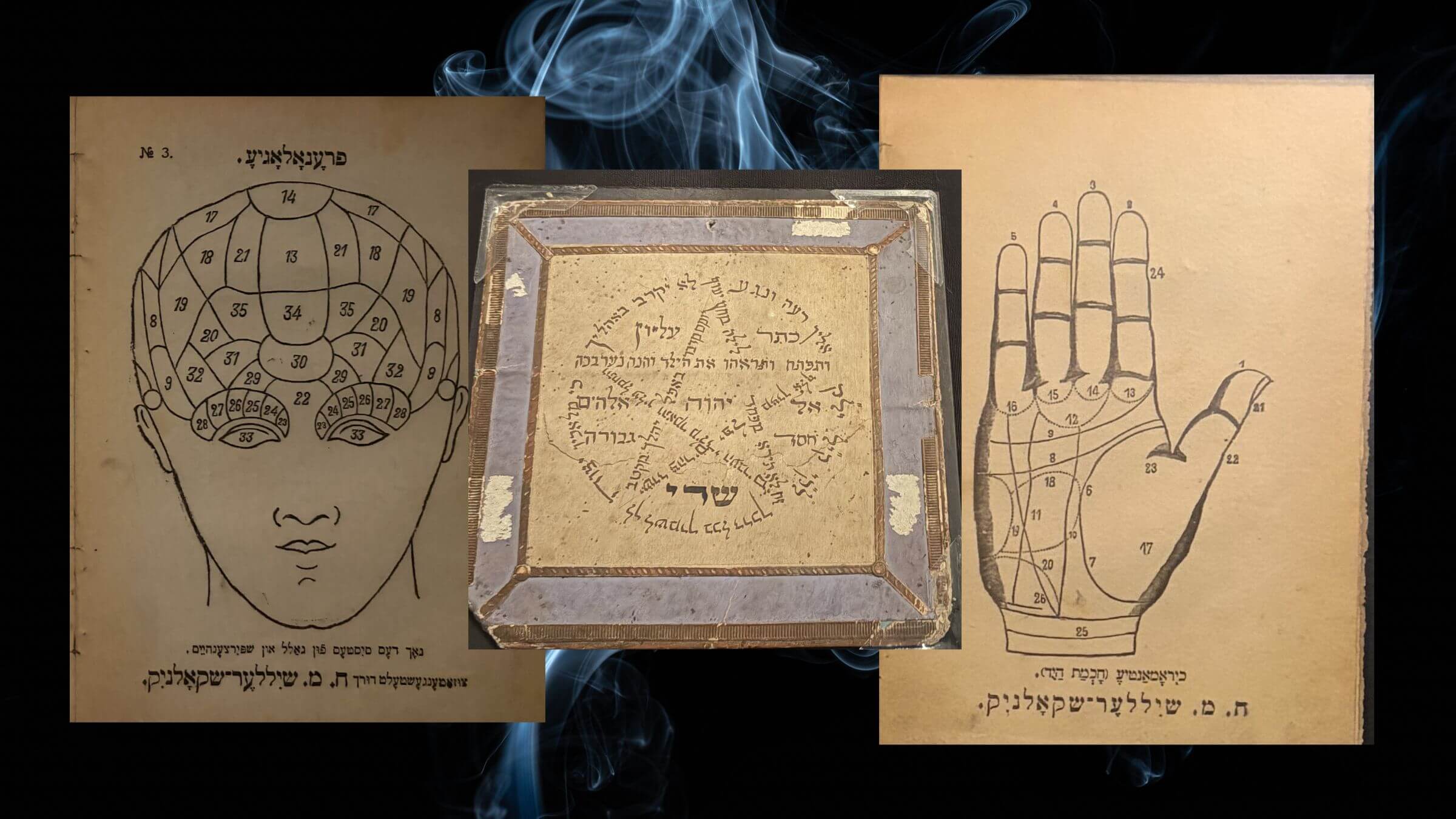
A few pieces of the Jewish magic on display, including palmistry charts and an amulet for the protection of a child. Courtesy of YIVO / Mira Fox

By Mira Fox June 3, 2026
Madonna, incongruously, may be largely responsible for introducing the public to a mystical, magical image of Judaism — one that went beyond old men bent over books, studying laws for keeping kosher or Shabbat. Her red string bracelet and her studies of kabbalah gave the religion a new air of mystery and occultism.
But Judaism has always been full of mystical, magical traditions. Jews made amulets to protect against the evil eye, or for luck and prosperity. They beseeched and pacified the dead. Rabbis wrote protective charms for their flock. Psychics and palm readers told the fortunes of Jews and non-Jews alike.
A new exhibit, “Jews are Magic: Occult Practices from Palmistry to Psychics” from YIVO and installed at the Center for Jewish History, delves into the history of the occult in Ashkenazi Judaism. The display, which pulls from YIVO’s archives, has examples of occultism drawing from two Jewish communities: the shtetl and the city.
One side of the exhibit showcases letters to great rabbis asking for blessings and remedies, as well as written spells and amulets protecting against demons like Lilith. The other features photos and biographies of professional Jewish clairvoyants and fortune tellers, who worked mostly in urban areas serving both Jews and gentiles with seances, palmistry and the like, advertising in newspapers and performing on stages.
It’s a lot to cover, and it’s complicated not only by the history but by a quote from Deuteronomy, highlighted in the exhibit. It explicitly forbids those who “useth divination” as well as those who are an “enchanter, or a witch, or a charmer, or a consulter with familiar spirits, or a wizard or a necromancer.” It is a comprehensive list, and doesn’t mince words, calling all of these magicians “an abomination.” Yet even great rabbis and Talmudists wrote charms. How could magic be so pervasive in Judaism when it is so expressly prohibited?
This is the fundamental question of the exhibit, but the show is small and has limited space to fully examine the contradictions. Its artifacts span so much time that it is difficult to intuit the connections between, say, Terfren Laila — a traveling psychic born Else Terese Frenkel who wore a ruby-adorned turban and pretended to be from Singapore by way of India (despite her Yiddish accent) — and letters asking a Talmud scholar to heal a loved one.
Thankfully, to open the exhibition, YIVO held a panel discussion between two scholars, Rokhl Kafrissen, an expert in Ashkenazi women’s folk magic, and Samuel Glauber, whose expertise is Jewish occultism in the late 1800s and early 1900s. Moderated by YIVO’s Eddy Portnoy, the panelists discussed the ways that superstitions arose in shtetls and were mined by those looking to make a few shekels.
Kafrissen explained that magic was a normal part of Jewish life for centuries, largely practiced by women; their domain was the home, encompassing everything from health to wealth, including charms and remedies. And just because these women’s rituals weren’t a “normative” part of Judaism — which is to say, institutional or recorded by official religious texts — they were certainly a normal part of life. Women led rituals such as cemetery measuring, a practice in which string was used to encircle the graveyard while praying and later used to make “soul candles” for Yom Kippur, and removed the evil eye from anyone concerned they had been cursed — what Kafrissen called “everyday Ashkenazi magic.”
But over time, these rituals — long central to Ashkenazi life — were pushed out as some Jewish leaders hoped to modernize their religion. Science rose to take the place of folk magic, and people began to dismiss these practices, which were rarely written down, as mere superstition.
This sense that Judaism was full of magic, however, fed easily into Christian suspicions about Jewish witchcraft, and perhaps encouraged some of the urban psychics and spiritualists to lean on Judaism to increase their mystery.
Glauber’s research focuses on this latter, urban category, a far cry from the shtetl folk magic. These Jewish men and women took part in a craze that enraptured far more than just Jews — seances and fortune-telling were trendy throughout the Victorian era and beyond, and its Jewish performers did not only serve Jews. (Though those suspected to be Jewish were covered hungrily by the Jewish press.) They worked magic on stage and sold their services to eager consumers hoping to speak to the dead or know the future.
Some of these performers tried to hide their Judaism, like the turban-wearing Laila, who managed to become famous enough to tell the fortunes of celebrity clients in Los Angeles and London. Another was trusted by Stalin.
Others, such as Abraham Hochman, were open about their Judaism; Hochman helped the Jewish immigrant community in New York by using his supposed psychic abilities to help women who had arrived in the city find runaway husbands. (The problem was so pervasive that the Forverts had a “Gallery of Missing Husbands” column to do the same.) One branded himself a mystical rabbi, leaning into Judaism’s mystique, which led to an audience, Glauber said, made up mostly of Christian barmaids.
Much of this information discussed by Glauber and Kafrissen is not included in the exhibit, which largely consists of fragments of papers from YIVO’s archives. The end of their discussion touched briefly on yet another rich source of magic: modern Hasidism. But neither the discussion nor exhibit had space to expand on this topic, making it hard to find the throughline between demon-warding amulets and today’s Judaism.
Still, no exhibit or discussion can capture the subject in its entirety. What “Jews are Magic” does best is spark curiosity, and a desire to learn more. That, in itself, is a kind of Jewish magic.
The exhibit ‘Jews are Magic’ is on display from May 26 to Dec. 31 2026 at the YIVO Institute for Jewish Research inside the Center for Jewish History in New York City.

Did you know that only 2% of Forward readers donate to support our nonprofit newsroom? That 2% make it possible for millions to read the Forward without a paywall or subscription — removing any barriers to the full and fair Jewish story.
But while the Forward is free to read, it isn’t free to produce. Big stories — like deep dives into the antisemitism data, political scoops or reporting trips to college campuses — take months of research and fact-checking. All while we keep you informed of what you need to know each day.
— Rachel Fishman Feddersen, Forward Publisher & CEO
Support our mission to tell the Jewish story fully and fairly.