‘The Naked Woman’ asks — what would Jewish Chekhov look like?
The tragicomedy takes inspiration from the Russian master, giving him an American spin
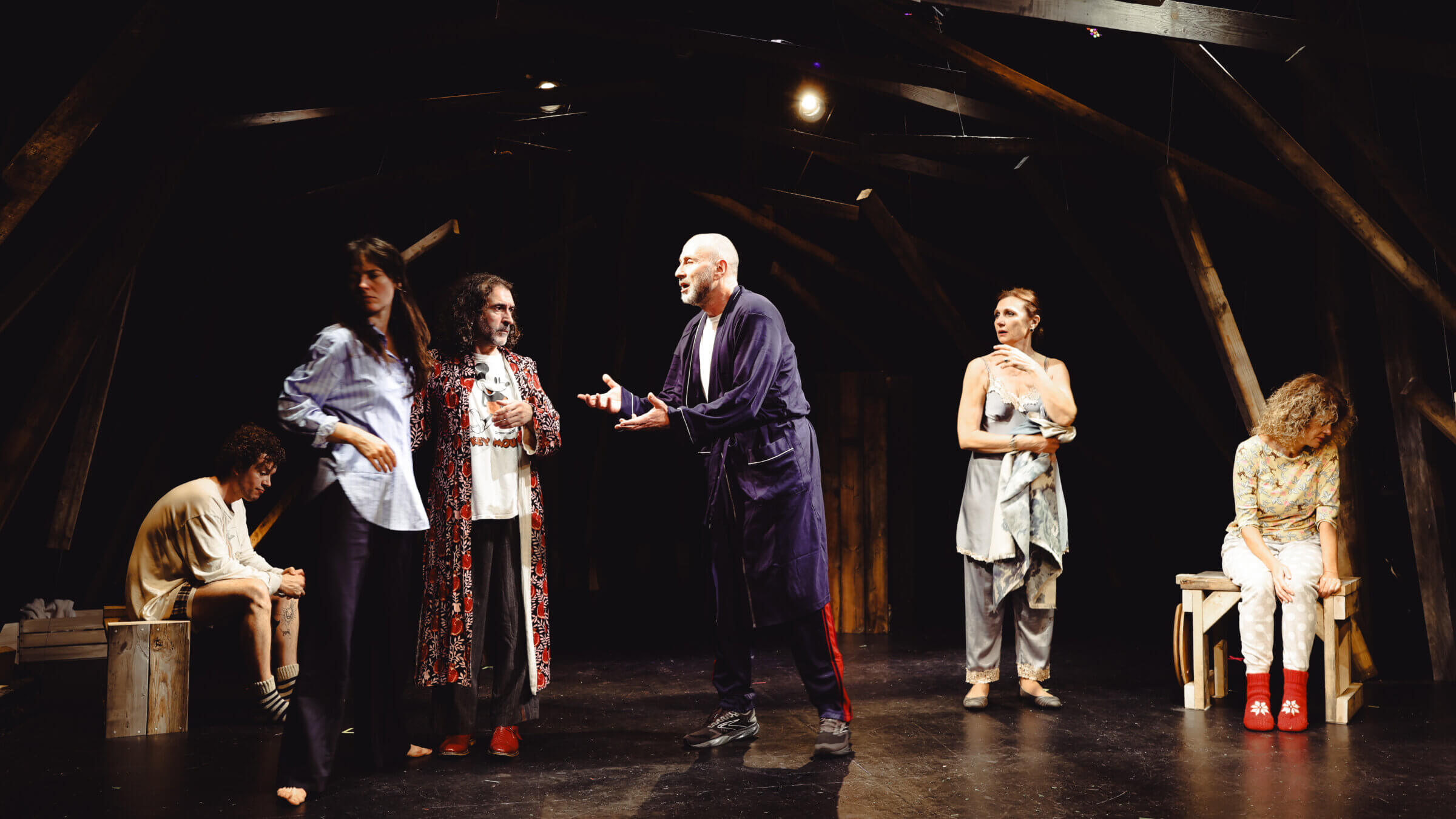
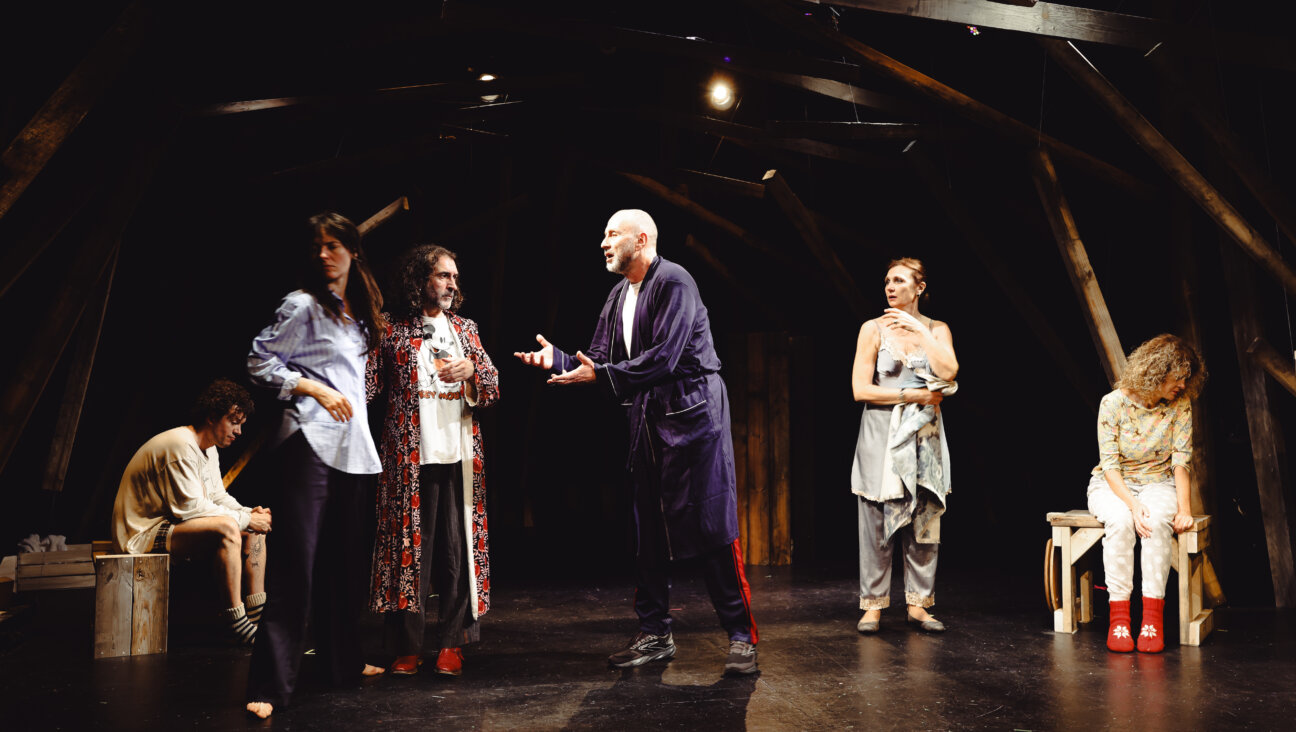
The cast of Alia Azamat Ashkenazi and Allie Avital’s The Naked Woman. Photo by Alia Azamat Ashkenazi

By PJ Grisar June 8, 2026
Earlier this year, a lauded revival of Anton Chekhov’s overlooked opus Ivanov occasioned the question: What if Chekhov, that great chronicler of overeducated depressives, was a bit more Jewish?
That show has a substantial Jewish subplot, with the title character’s wife subjected to antisemitic smears.
For Jewish Russians, Chekhov, like his great interpreter Stanislavsky, is a part of the culture they still claim. For that reason expat companies, like Igor Golyak’s Arlekin Players, have long been in the business of reinterpreting him. Novelist Gary Shteyngart, in his pandemic novel, Our Country Friends, took things a step further, transmuting Chekhov’s dachas into the Belleville bungalow colony where he, and many ex-Soviet Jews, would summer.
Allie Avital and Alia Azamat Ashkenazi’s The Naked Woman, now in a limited run at 154 Theater, returns this proposition to the stage with some usual markers of the Russian master: characters brought low by their own inertia, a love triangle, frustrated ambitions and failures to launch. Into the mix they add the following staples of first generation Jews: immigrant parents’ expectations and the tension between the generation that recalls the weight of repression and the rising one that has only ever known American freedom. There are obligatory references to rabbis; the word “mensch” is dropped, but this is not a Shabbat-observing crew. If you know this specific demographic, there’s no doubting the affiliation.
Misha (Ilia Volok and Roman Freud alternate the role — Freud played him my evening), a successful architect, who moved to the U.S. decades before for a better life. For the New Year, and his birthday, he has made camp at his upstate country home. Some creaky exposition — on Pili Weeber’s set of floating timber, the Empire State’s answer to birch trees — sets up the interpersonal tensions that will go off in later acts like Chekhov’s proverbial gun.
Misha’s 35-year-old daughter Dasha (MaryKate Glenn) tells him his last check for her grad school tuition bounced. She’s there with her all-American boyfriend and is secretly pregnant. His bohemian older brother Grisha (Dima Koan), ever-clad in funky sweaters and kerchiefs by costume designer Kostya Goncharuk, resents Misha for their parents’ decision to only pay for his higher education and for being dependent on him for income. Rina (Natasha Goubskaya), Misha’s long-suffering wife is quietly working to save the family from financial ruin.
With these pieces set in place, the holiday is interrupted by, as advertised, a naked woman, screaming for help. Dismissing her as a “druggie in the woods,” Misha does nothing, a choice that brings questions of insularity and assimilation to the fore.
Dasha can’t get over her father’s inaction.
Rina explains it: “This American obsession with caring about strangers It’s all words and ideas. It’s THEATER. It doesn’t mean anything.”
The play is based on a short film by Avital, an accomplished director of visually-striking music videos for the Yeah Yeah Yeahs, Olivia Rodrigo and Moses Sumney. In that more abridged version, with mostly Russian dialogue, the Naked Woman stands in for the forces of mortality.
As one character in that film notes, in Russian, the word for death is “in the feminine, and therefore death is a woman. When death doesn’t hide, doesn’t wear a disguise, then it’s naked.”
Here the character is a more elusive metaphor: an avatar for Misha’s selfishness, the rift between his and Dasha’s concern for others or maybe her perception of herself as vulnerable and in need of saving. She could also be Rina’s aching feeling of neglect.
Avital and Ashkenazi’s background in film — Ashkenazi has a long resumé as a script supervisor and directed the short Esther’s Choice — is evident in the drama’s pacing. The piece doesn’t have the patience of Chekhov, who lets the action settle around the samovar and steep in subtext. This makes the show more dynamic, but more superficial in its psychology.
“I’ve always wondered why no one can truly love me, why they always leave me,” Dasha tells her father, coming off a monologue that hits the ear like a stilted translation of The Seagull’s yearning actress Nina or Vanya’s tragically dutiful Sonya. “But now I understand why. Because I’m just like you.”
It’s a tidy thesis, from creatives whose film work lives on the power of suggestion, with cinematography and movement being the major narrative force. Though Avital’s staging is capable, the script is crying out for an injection of subtlety that perhaps only a closeup can deliver.
This play is something of a proof of concept for a forthcoming feature film to be directed by Avital. If the short is any indication, its words and ideas may translate better taking a step away from the theater.
It may not be the natural medium for Chekhov, but it’s well-suited to his heirs.
Allie Avital and Alia Azamat Ashkenazi’s The Naked Woman is playing through June 14 at Theatre 154 in Manhattan. Tickets and more information can be found here.
I’m personally matching all gifts to the Forward, up to $36,000. Can I match your gift now?

Hello, fellow Forward reader! I’m Joel Brown, a Forward reader and supporter for more than 15 years, and currently the chair of the board of directors.
I’m an avid Forward reader because it ticks so many of my essential boxes: excellent journalism, Jewish focus and diverse viewpoints. In today’s political climate, what I most appreciate is the Forward’s independence — made possible by the generosity of its membership.
The Forward is committed to bringing you unbiased, nuanced Jewish news. From my position as board chair, I see an exciting future as we expand our position as the definitive independent voice of contemporary American Judaism.
— Joel Brown, Forward board chair
Support our mission to tell the Jewish story fully and fairly.