In the beginning was the word — and the word was whisky
In ‘The Whisky Bible,’ Noah Rothbaum sings the praises of a surprisingly Jewish holy spirit
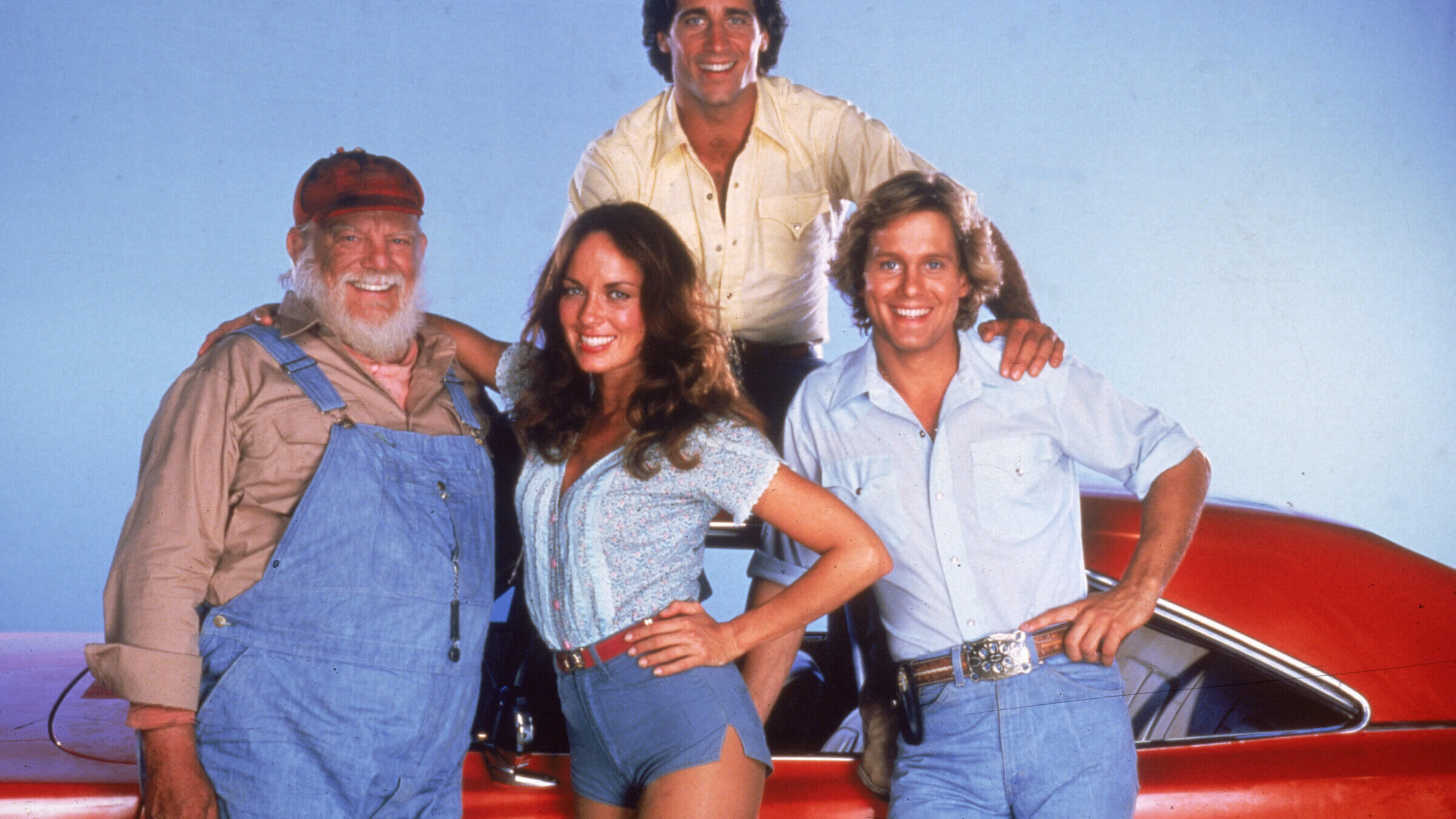
Americans tend to associate whisky with figures like ‘Uncle Jesse,’ played by actor Denver Pyle, seen here at left with the cast of ‘The Dukes of Hazzard.’ Photo by Fotos International/Courtesy of Getty Images

By Dan Friedman December 24, 2025
The Whiskey Bible: A Complete Guide to the World’s Greatest Spirit
By Noah Rothbaum
Workman, 640pp, $40
Ask an American to picture the origin of whisky and they will probably conjure up a bearded man in overalls emerging from the Appalachian woods, clutching a jug of moonshine with three Xs on the side.
Noah Rothbaum, the author of The Whiskey Bible, has a name for that cliché: the “Uncle Jesse theory” of whisky history, after the chaotic moonshiner on The Dukes of Hazzard. It’s also, he argues, almost completely wrong.
“For one thing, moonshine only exists because of tax law,” he told me when we spoke about the book. “You don’t get bootleg without a government to evade.”

Real American whisky — the kind that fills warehouses and balance sheets and, until 1933, doctors’ prescription pads — was an immigrant industry, built in cities and river towns and railroad hubs. It grew when America stopped being a rum-drinking colony and became a rye-drinking republic.
Before 1776, the young colonies distilled molasses from Caribbean sugar into rum. After independence, that molasses was politically tainted — too bound up with the British Empire and its trade routes. American farmers had land and grain, not sugar cane. So they turned to whisky.
Then a tiny insect changed everything. When phylloxera destroyed vineyards across Europe in the 19th century, wine and brandy became scarce. Doctors who’d been happily prescribing cognac as a cure-all suddenly needed alternatives. Medical journals in Britain began recommending whisky as a respectable substitute. Demand soared. As Rothbaum writes in his Bible, phylloxera “transformed whiskey from a farm product to an international best seller.”
“Right at the moment when whisky is taking off, you also have this massive wave of Jewish immigration to America,” Rothbaum told me. “And they bring with them exactly the skill set the new industry needs.”
A Jewish story
What’s a nice Jewish boy doing writing a Bible? Or writing about booze at all? There’s nothing actually sacrilegious about the title of The Whiskey Bible in a series whose expert guides include The Wine Bible and The Beer Bible. More transgressive, perhaps, is how close it hews to a kind of competition — Jim Murray’s best-selling, canonical, annual tasting guide, the Whisky Bible. But having a Jewish critic in the top tier of American whisky coverage is actually deeply appropriate.
Indeed when I asked Rothbaum, the spirits editor at Men’s Journal, about it, he was enthusiastic about a personal historical connection to the industry: “Looking back, part of my family ran a restaurant in Warsaw and others in the Ukraine ran a boardinghouse so my conjecture is, maybe it had a distillery or at least, you know, in my looking back romanticizing the past, perhaps they were making some kind of booze there, too.”

But even if his conjecture has no basis in family reality, his story is no outlier. Rothbaum’s Whiskey Bible is a readable introduction and encyclopedic guide to the “world’s greatest spirit” that has its own tag at the Forward. The “Bible” is also a highly engaging guide to a surprisingly broad swath of history and science from George Washington (“America’s first celebrity distiller”) to bovine digestion – bourbon has to be made in a certain way to ensure that its leftovers can be used in feed lots for cows. As Rothbaum recently told a crowd at the 92Y, “everything through the lens of whisky is more fascinating.”
It’s a coffee table book, definitely released to be part of the holiday gift market. But, unlike much of that tranche, it’s a reference book that you — or your giftee — will actually enjoy referring to for years to come. It doesn’t taste test each distillery’s expressions (for that you need Murray) but it has all the background you could need. Want to know about Japanese whisky, there’s a section on that. Want to know whether whisky should be spelled with an “e” or not, there’s a very sensible section on that (spoiler: it doesn’t matter, but you should stick to one). Want to know about how Metallica’s Blackened whisky uses sonic waves in its maturation process — there’s a section on that too.
Part of the broader story — which Rothbaum stressed during his visit to the 92Y — is that Jews have been central in the American whisky story. Looking at POLIN: Museum of the History of Polish Jews in Poland you can see how Jews were disproportionately represented in the hospitality trade. That’s because in the Pale of Settlement, Jews were often barred from owning land, so they gravitated to the things they were allowed to touch: money, grain and booze.
“You see it over and over,” Rothbaum told the 92Y audience. ”Because of antisemitism in Europe, Jews were pushed into roles like collecting taxes, running inns, and overseeing alcohol production for the local noble. When they get to America, suddenly that work is not only useful — it’s welcome.”
In America, Jews were often merchants who later set up a distillery to supply their distribution network. Alternatively, existing distillers needed a liquor expert to scale up their business and Jews were cheap and ready to bring over European know-how. That first pattern repeats: A young man arrives, peddles wares from a pack, graduates to a general store, then to wholesaling and, eventually, to owning or running a distillery. Whichever way they were pushed, the Jews comprised such a major part of American whisky production that by the early 20th century, many of the biggest liquor companies in the country were owned or run by Jews.
Rothbaum rattles off the names the way other people recite old team lineups or film casts:
- The Bernheim brothers, who built one of the largest distilleries in America in the 1800s and launched the I.W. Harper brand — which is still on shelves today.
- The Shapira family in Kentucky, peddlers turned five-and-dime proprietors turned co-founders of Heaven Hill after Prohibition, makers of Evan Williams, Elijah Craig, and Rittenhouse Rye among others.
- The Rosens and Rosenstiels, running Schenley (long absorbed by Diageo the corporate drinks giant) by a few different names.
- The Bronfmans who ran the Seagram’s empire until they didn’t.
- The Goldring family, still at the helm of Sazerac, owners of Buffalo Trace.
“In all these little towns in Kentucky and the Midwest, Jews are a tiny percentage of the population,” Rothbaum says. “But a huge percentage of the booze business.”
Jews become so identified with alcohol that some of the most antisemitic, anti-immigrant figures of the early 20th century seized on Prohibition as a way to drive them out. Henry Ford and his allies, Rothbaum notes, didn’t just hate liquor; they hated the people who made it.
“That’s how famous Jews were for making alcohol,” he told me. “The people who didn’t like Jews tried to shut down alcohol to drive them away.”
And yet, when people lift their glasses today, almost no one thinks of whisky as a Jewish story.
The rule, not the exception
If Jews were so central to the industry, how did they vanish from its mythology? Part of the answer lies right on the label (another topic that Rothbaum wrote about in The Art of American Whiskey: A Visual History of the Nation’s Most Storied Spirit, Through 100 Iconic Labels).
“Somebody like Bernheim, in the late 1800s, can’t put ‘Bernheim’ on a bottle and expect it to sell,” Rothbaum explains. “So you get I.W. Harper instead — something that sounds safely Anglo.” Almost no one knew then or even knows now that I.W. comes from the initials of the founder Isaac Wolfe Bernheim.
For reasons of marketing and survival, Jewish distillers and owners hid behind WASPy brand identities. Despite its name, Old Fitzgerald is not the legacy of a charming Irishman but of Jewish distiller Solomon S.C. Herbst. The name “Old Fitzgerald,” Rothbaum argues, is practically a caricature of Irish respectability — a Gentile mask on a Jewish business.
After Prohibition, when all booze acquired a gangster sheen, there were even more incentives for upwardly mobile Jews to downplay the connection. Any Jewish involvement in illicit liquor trading was attributed to the useful religious exemption for kiddush wine.
So the Jewish role was sanded off both ends: Jews soft-pedaled their attachment to liquor; the whisky world packaged itself with mythologies of Scottish workmen, Irish storytellers, and, in America, the Uncle Jesse myth — that shirtless guy in the Appalachian holler. “When I first started writing about whisky, I knew about a couple of big Jewish names — the Shapiros, Louis Rosenstiel,” Rothbaum says. ”What I didn’t realize was that they weren’t the exceptions. They were the rule.”
I myself had bumped into the deep connection between Jews and whisky in North America when I noticed in 2010 that Glenmorangie was getting an Orthodox Union hecksher to prove it was kosher and set out to investigate. I went all the way to the Highlands the following spring to write about kosher scotch. Rothbaum told me that the key to that whole story was Glenmorangies ambassador David Blackmore and a whisky tasting a scant few miles from the Forward offices:
He’s Scottish, his wife is Jewish and from New Jersey. And Blackmore was doing a whisky tasting in Borough Park. It was a Friday afternoon, and all these Orthodox Jews were buying a ton of whisky. He was like, “does this go on every Friday?”
When the answer was a resounding “Yes!” Blackmore asked himself what would help his brand stand out and the result was kosher certification on flagship single malts that — because they are made of barley, water and yeast only — do not even need one.
There are now scores of whiskies across the continents that have heckshers on them, whether from OU, Star-K, or local boards. One rabbi in Kentucky even branched out from his day job heckshering bourbon to bottle his own.
Part of Rothbaum’s mission in The Whiskey Bible is to separate real history from romantic marketing slop. Even the famous spelling debate — “whisky” versus “whiskey” — turns out to be newer and messier than most enthusiasts think.
“If you look back at government documents from the early 1900s, you see all kinds of spellings,” he told me. “Brands in Scotland and America both use ‘whisky’ and ‘whiskey’ more or less interchangeably. A lot of what we treat as sacred rules were invented in the last 25 years.”
Even our contemporary practice of reverently sipping neat brown liquor is historically unusual. Scotch conquered America as a highball: Scotch and soda.
“It’s funny,” Rothbaum says. “The entire Scotch industry in the U.S. is built on whisky and seltzer. And 120 years later, people will tell you it’s somehow sacrilegious to add soda.”
Although the marketers and the hipster artisans want to sell you the ritual or the expensive specialty products, the most important ingredient to set your whisky glass straight is information. Beyond that it is just a case of trying different expressions — and there are some great $30 bottles — working out what you like, and how you like to drink it.
From language, to history, to science, to the way we approach the many varieties of the drink itself, Rothbaum’s Bible is no-nonsense, helpful, and engaging — the perfect accompaniment to a nice glass of Scotch.
This is a moment of great uncertainty. Here’s what you can do about it.
We hope you appreciated this article. Before you go, we’d like to ask you to please support the Forward’s independent Jewish news this Passover. All donations are being matched by the Forward Board - up to $100,000.
This is a moment of great uncertainty for the news media, for the Jewish people, and for our sacred democracy. It is a time of confusion and declining trust in public institutions. An era in which we need humans to report facts, conduct investigations that hold power to account, tell stories that matter and share honest discourse on all that divides us.
With no paywall or subscriptions, the Forward is entirely supported by readers like you. Every dollar you give this Passover is invested in the future of the Forward — and telling the American Jewish story fully and fairly.
The Forward doesn’t rely on funding from institutions like governments or your local Jewish federation. There are thousands of readers like you who give us $18 or $36 or $100 each month or year.
Support our mission to tell the Jewish story fully and fairly.