In Elie Wiesel’s latter years, he and I discussed the effects of the Holocaust. Those conversations are now an opera.
‘The Dialogue of Memories,’ based on conversations between Wiesel and Howard Reich premieres next month in Seattle
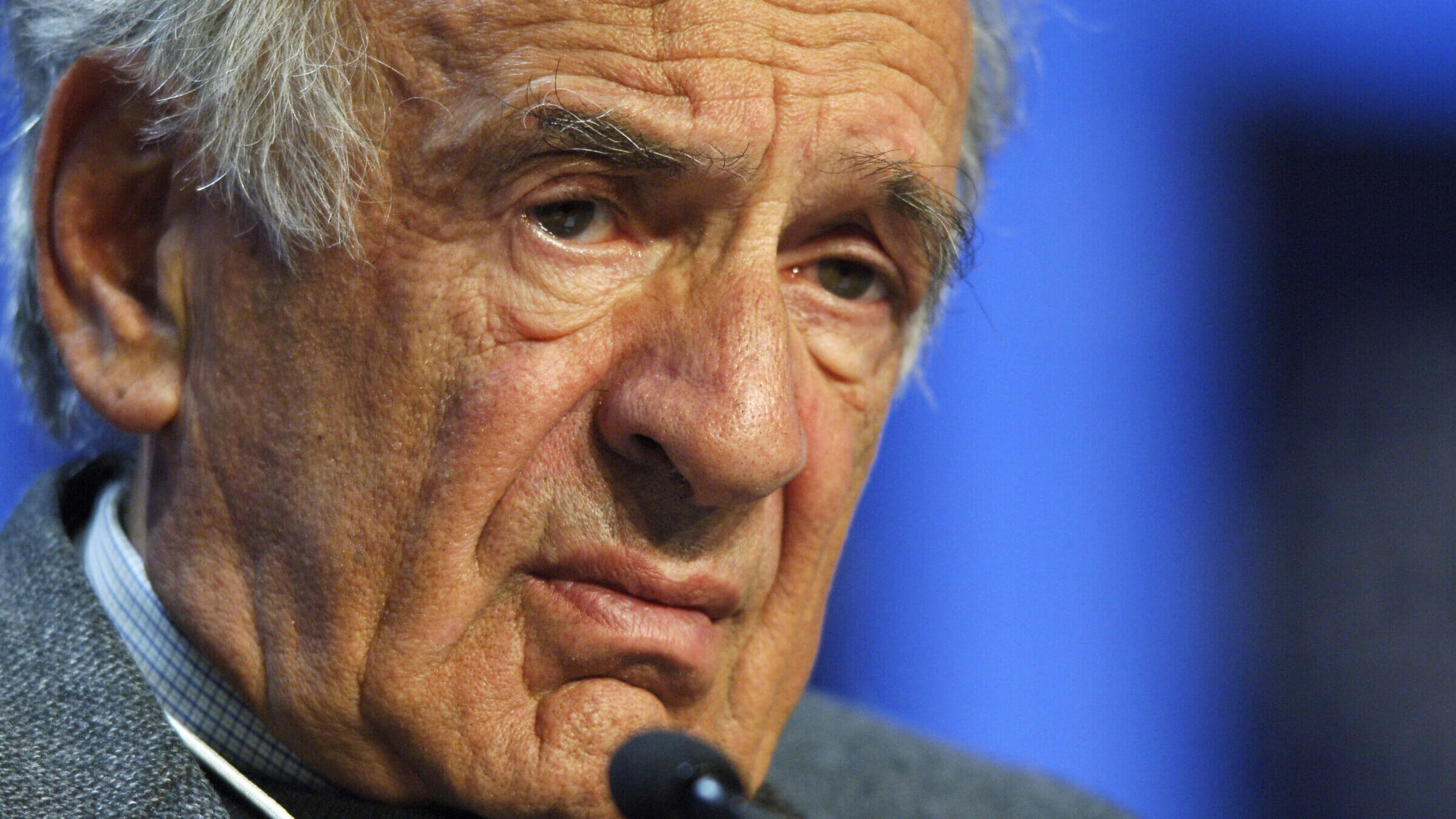
Elie Wiesel at the World Economic Forum in Davos, 2006. Photo by Eric FEFERBERG/AFP via Getty Images
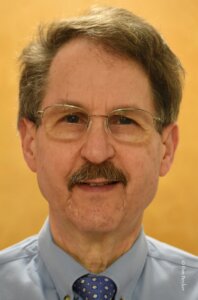
By Howard Reich April 14, 2026
Back in 2012, while on assignment as the Chicago Tribune’s longtime music critic, I received a phone call from my editor that would change my life.
Elie Wiesel had just accepted the newspaper’s annual Literary Prize. Would I be interested in interviewing him for the paper?
Would I?!
There was only one minor problem: I had never read a word Wiesel had written, not even his revered Holocaust memoir Night. Holocaust education was not required in the 1950s and ’60s when I was growing up – not even in Skokie, a nexus of Holocaust survivors where I lived with my family. As the son of two survivors, I considered Holocaust books, films and TV programs emotionally overwhelming and something to be avoided, if possible.
My avoidance ended abruptly in 2001, when my then 69-year-old mother began re-experiencing her unspoken Holocaust childhood in the form of delusions. This prompted me to unearth her hidden story and tell it in a Tribune article and a subsequent book and a documentary for PBS – all aptly titled Prisoner of Her Past.
I assumed that work was the reason the Tribune tapped this music critic to interview Wiesel.
After a few weeks of reading everything he wrote that I could lay my hands on, I flew to New York and found myself seated inches away from him in his Manhattan office. Within minutes, we were speaking with a degree of comfort and intimacy I had not anticipated.
Even more remarkable, after Wiesel and I held a public conversation before 2,500-plus people in Chicago’s Symphony Center — a longstanding feature of the Tribune’s Literary Prize proceedings — he suggested that we stay in touch.
That’s when I realized we had the beginnings of a book: two generations — a survivor and a son of survivors — trying to come to terms with what happened to our families and to our people. For the next four years, I visited Wiesel regularly in New York and Florida and spoke with him often on the phone. The utterly unexpected privilege of these conversations ended suddenly with his death July 2, 2016, at age 87.
In effect, Wiesel had spent the last four years of his life communing with me about the Holocaust and its apparently never-ending after-effects, my tape recorder rolling all the while. These proved to be his final thoughts on the subject, which I took as precious lessons on a fraught subject. For Wiesel had given me answers to questions I never had been able to ask my parents. To them, the Holocaust was a subject not to be discussed with me or my sister, presumably to spare us the burden of such tragedy.
Wiesel poignantly addressed what I needed and wanted to know: How does the second generation deal with feelings of guilt over our parents’ unrelieved sufferings? How do we live up to our parents’ expectations of us, without suppressing our own dreams? How do we even speak of this terrifying subject? How religious must we be? How politically active? How do we cope with the enormity of it all?
And more.
I packed the answers – and our reflections on them – into my 2019 book The Art of Inventing Hope: Intimate Conversations with Elie Wiesel, which is the basis of the new opera: The Dialogue of Memories, which premieres next month in Seattle.
Why an opera?
Though I was glad to have captured on paper my treasured experiences with Wiesel, I wanted to share the wealth — to let others see and feel and hear what it was like to be in the room with him. I wanted audiences to witness Wiesel explaining and illuminating my own past to me. And like Wiesel, I’ve always believed in the indescribable but unstoppable power of music to go where words alone cannot.
In 2024, the Seattle-based non-profit Music of Remembrance commissioned composer Jake Heggie and librettist Gene Scheer to write Before It All Goes Dark, an opera based on my Mac’s Journey stories in the Tribune about a Vietnam vet who learns he’s heir to a priceless collection of art looted by the Nazis (I had identified and located him).
After that opera’s success, I suggested to Music of Remembrance founder Mina Miller that my years with Wiesel represented a story of profound enlightenment that could be powerful onstage. Miller wasted no time commissioning the eminent American opera composer Tom Cipullo to write the music, with libretto by me with Cipullo.
The opera features three characters: Wiesel (sung by baritone Daniel Belcher); my mother, Sonia Reich (mezzo-soprano Megan Marino); and me (tenor Dominic Armstrong). Past and present, memory and prophesy, delusion and reality intermingle in its words. And Cipullo’s music lifts those words into the realm of sublime drama as only opera can do.
I don’t know how I’ll feel watching singers portraying Wiesel, my mother and myself confronting demons that have haunted all three of us, and millions of others around the world.
But as we mark Yom HaShoah, I do know that moments once shared by Wiesel and me alone now will be available to everyone. I hope that Wiesel’s brilliant insights and my mother’s tragic experiences will help others who — like me — have long struggled with dark and enduring histories.
The Dialogue of Memories plays May 17 at Benaroya Hall in Seattle; May 20 at the Presidio Theatre in San Francisco; and May 23-24 at the Studebaker Theater in Chicago. For details and tickets visit www.musicofremembrance.org. Howard Reich can be reached at [email protected].

Hello, fellow Forward reader! I’m Joel Brown, a Forward reader and supporter for more than 15 years, and currently the chair of the board of directors.
I’m an avid Forward reader because it ticks so many of my essential boxes: excellent journalism, Jewish focus and diverse viewpoints. In today’s political climate, what I most appreciate is the Forward’s independence — made possible by the generosity of its membership.
The Forward is committed to bringing you unbiased, nuanced Jewish news. From my position as board chair, I see an exciting future as we expand our position as the definitive independent voice of contemporary American Judaism.
That’s why I’m paying it Forward, by matching $36,000 of reader gifts. It’s an investment in the Forward’s newsroom, to continue telling the American Jewish story with truth and independence.
— Joel Brown, Forward board chair
Support our mission to tell the Jewish story fully and fairly.