A new documentary challenges stereotypes about Orthodox Jewish women — and their wigs
‘Sheitel: Beauty in the Hidden,’ dives deep into Jewish women’s experience of covering their hair
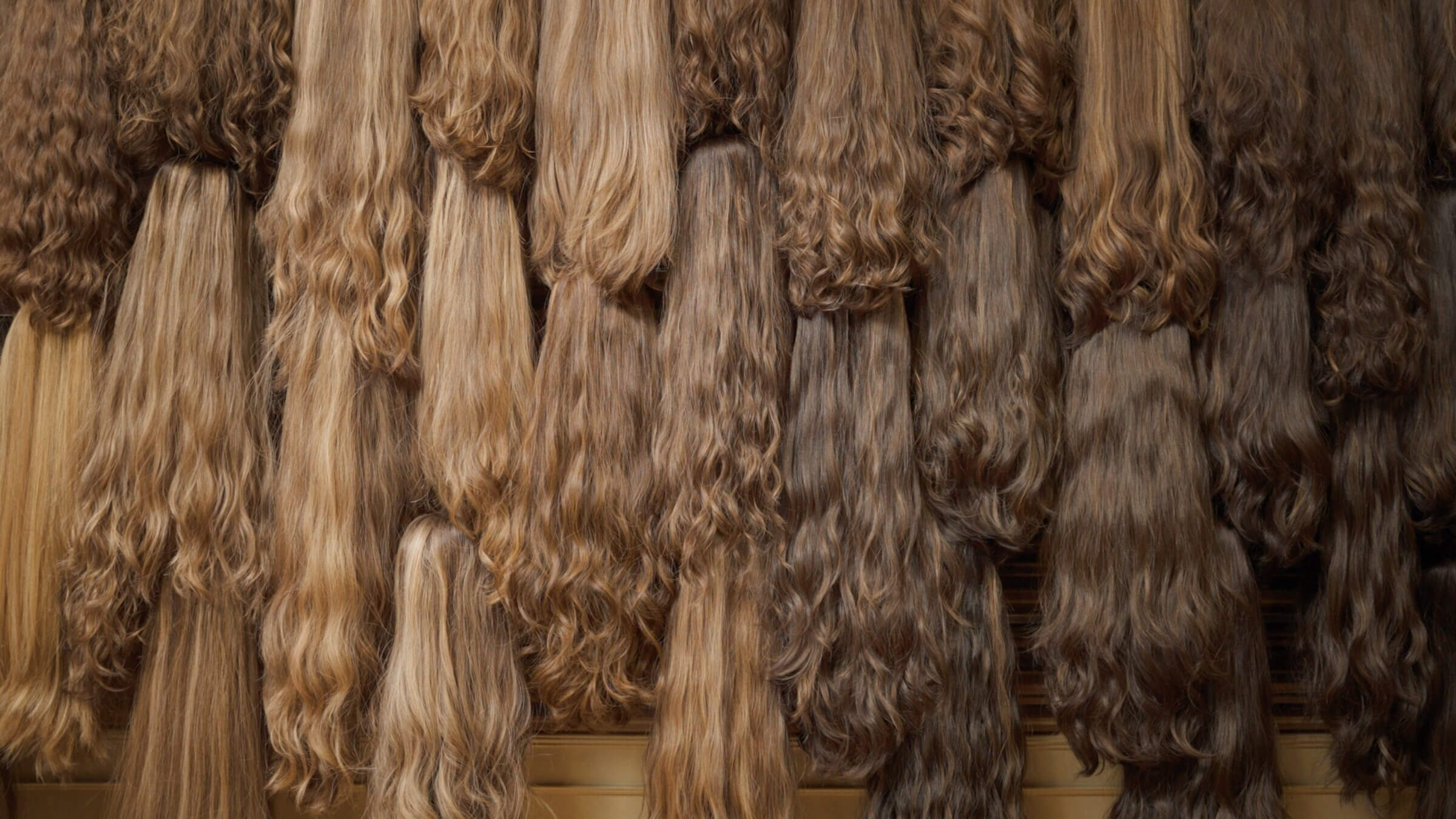
A wall of sheitels in the documentary. Photo by Lynda Medjuck-Suissa
Many among the secular, including me, grew up believing the sheitel, the ritual wig worn by married Orthodox and Hasidic women, was not intended to be attractive. Indeed, its purpose was largely to make sure the women were undesirable and thus of no interest to men on the street, or worse, in the synagogue.
Yet even this admittedly reductive spin was awash in assumptions about men’s sexuality, the patriarchal dynamic between men and women in general and within marriage in particular.
Sheitel: Beauty in the Hidden, an insightful documentary, takes a deep dive into this complex topic. It explores the unexpectedly wide-ranging cultural, religious and deeply personal significance of hair covering among Orthodox and Hasidic women — from Miami to Jerusalem; from New York to Los Angeles; from Toronto and Montreal to, of all places, Halifax, Nova Scotia, director Lynda Medjuck-Suissa’s home base. (Her first film, Camp Kadimah—The Story of Our Lives, examined the history and ongoing impact of a well-known Canadian Jewish summer day camp.)
In Sheitel, her sophomore effort, she reveals how wigs, scarves and other hair coverings serve not only as symbols of faith and tradition, but also political identity and female empowerment. The movie confronts widespread misconceptions and stereotypes — including my own parochial thoughts on the subject — and also offers a rare look into the global wig industry.
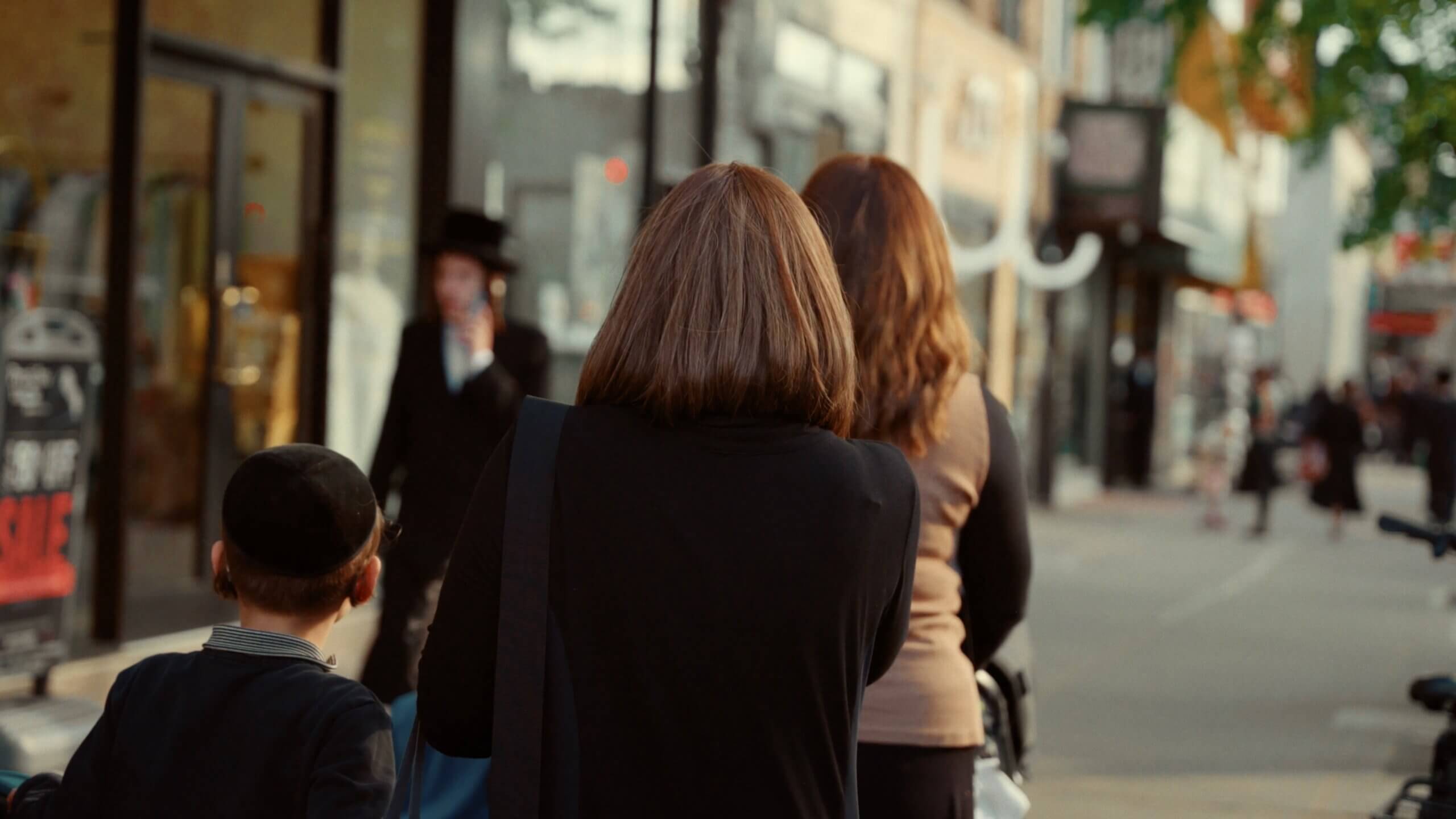
The opening sets the historical tone with shots of the cobble-stoned, winding and congested streets of ancient Jerusalem, filled with many large families headed by sheitel-sporting women, and men in long black coats and payos, or curled sidelocks. Later, we’re in Borough Park, Brooklyn with its store fronts boasting signs in Yiddish. But modernity is present too, including scenes in the uber-contemporary, slick high-rises of Miami with its bustling ultra-religious communities.
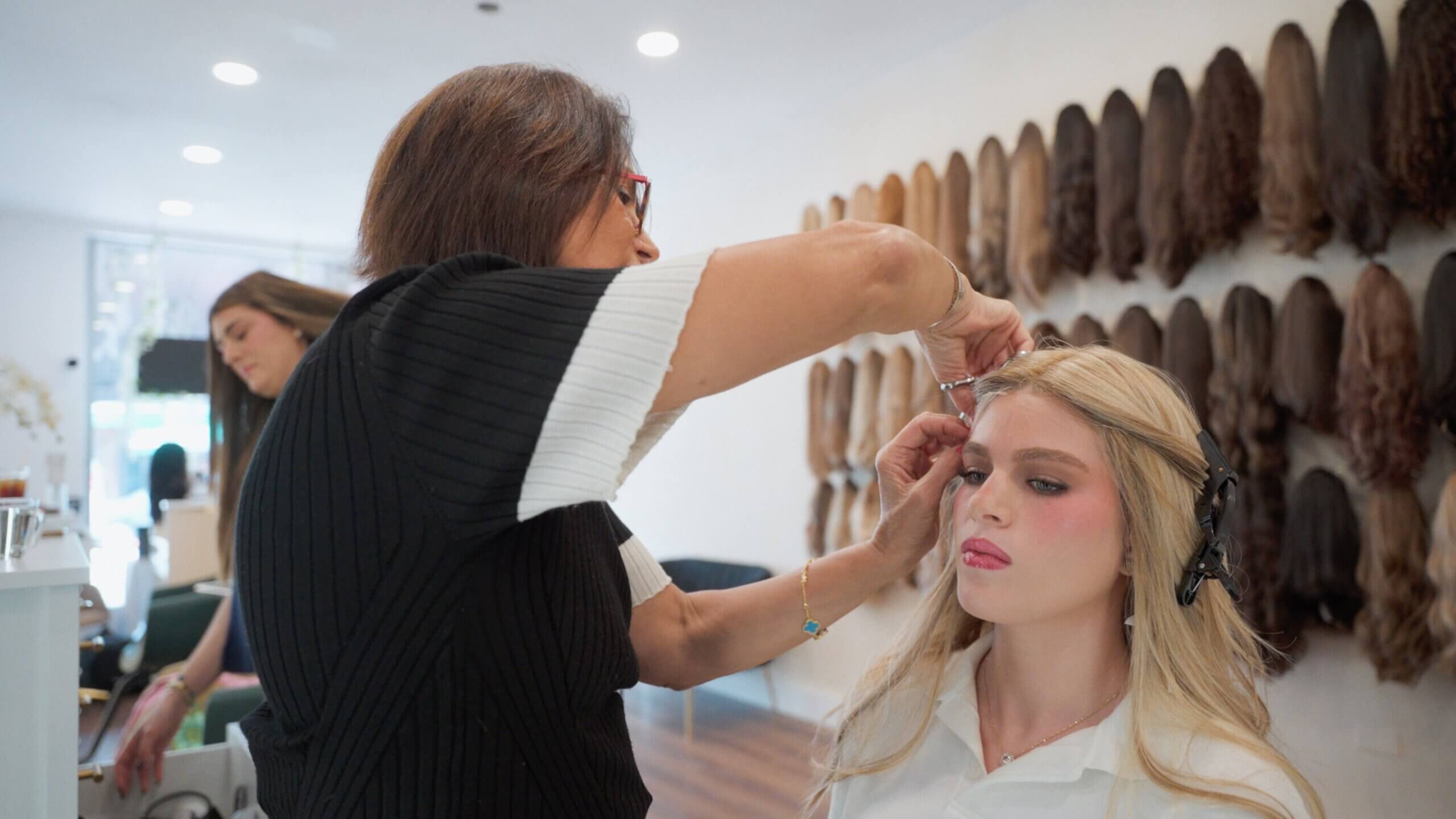
This vivid documentary interweaves segments of women being fitted for wigs and interviews featuring dozens of Jewish wives. Some are sitting alongside their husbands, who offer their opinions as well. The stores and salons presented are lined with wigs in various shades and styles and textures. Women are seated on salon stools as hair dressers color, and highlight and trim the wigs they’ve purchased, an arduous, detailed and time- consuming process.
Some women are having a fine time as they consider the fashion possibilities and are fussed over. Others, especially the brides to be, are apprehensive. Nobody claims that wearing these head coverings is comfortable. But all are committed to the practice.
Donning an uncomfortable wig reflects a higher calling than creature comforts, one woman explained.
On the flip side, the wigs don’t require much work once they’ve been fitted, though periodically they need to be brought in for shampoos and touch-ups. The women are encouraged to have more than one wig, and one woman slyly noted that she has so many wigs and accompanying personas that her husband thinks he’s married to many, many women.
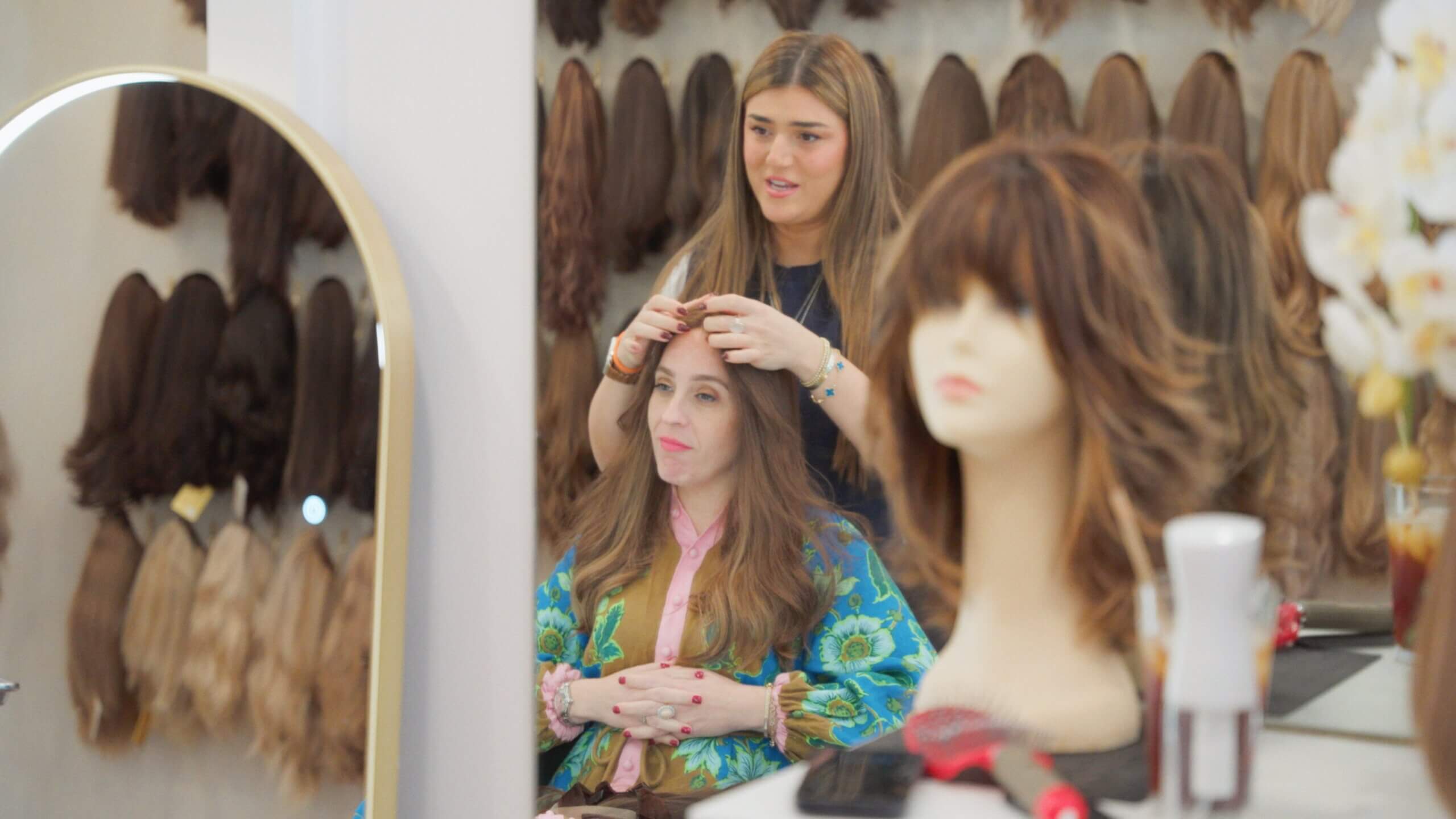
What emerges right off the bat, and is reiterated throughout, is that today sheitels are designed to be attractive, although there is an aesthetic range, mostly depending on cost, from the least expensive to the most pricey. (The wigs start around $1,500 and go over $10,000.) The craftsmanship involved, but even more important the materials used — synthetic hairs, fully natural strands or a mix — determine the expense and appearance.
The particular kind of head covering a woman wears depends on the traditions of her religious community — some wear only wigs, others sports wigs and hats, and still others don hair-covering head scarves. But equally important, and in some cases more so, it’s the woman’s individual tastes that define the look. Every woman interviewed maintained their sense of autonomy and agency. They are not subjugated by anyone. They choose to wear the sheitel.
The women interviewed include, among many others, influencers, podcasters, businesswomen, a champion marathon runner and New York State Supreme Court Justice Ruchie Freier, whom I profiled in 2018. Wife and mother of six, she was the first Hasidic woman judge in America, if not the world. Everyone interviewed in the film, representing a cross-section of Jewish Orthodoxy, is highly articulate.
Judge Freier stressed that the sheitel is part of a much larger picture that celebrates modesty, arguing that modesty does not exclude beauty. “But it’s a way for women to not use their bodies to affect the world,” she says.
The subtext is the assumption that a man cannot see a woman’s uncovered head because he’d be so aroused he’d be unable to control his sexual impulses and not able to focus on important things like prayer.
But not all of the women shared this idea. Sarah Guigue, a New Jersey-based influencer whose Instagram followers tops 60,000, said that she, herself, found that thought “toxic” and could not accept it.
“I believe the Torah is divine and that idea is not divine,” Guigue said. Her own signature wig, matching her cheerful outspoken style, is long, straight hair crowned by a large, brimmed hat.
(The film does not address, and I wish it did, the question of why unmarried women are not required to cover their heads, though their hair is often tied back as an expression of modesty.)
Contrary to my initial assumptions, a thematic motif in Sheitel is that beauty and godliness are interconnected: that God wants you to be the best you can be, and that includes physical attractiveness. Nothing in the Torah, the Rabbis concurred, says that a woman, even a married woman, shouldn’t be attractive.
(In fact, there’s nothing in the Torah that dictates that a married woman must cover her head, though it’s arguably a gray area; more than one of the women cited a section in the Talmud that references an unholy woman, possibly an adulteress, removing her wig — implying, by contrast, that a holy woman wears one.)
Indeed, far from feeling unattractive, several women talked about feeling a heightened sexuality while wearing the sheitel, feeling a thrill inherent in that which is hidden. The sheitel represents a woman’s bond with God and her husband. When she removes her wig in the bedroom and exposes her real live hair — while the wig, by contrast, is dead hair — it is a manifestation of intimacy with her husband that she shares with nobody else.
One interviewee likened the devout married Jewish woman to a thermos bottle: “Cool on the outside, hot on the inside.”
The women also talked about a mystical, not easily articulated, connection to God they feel when they wear their sheitels. Some noted that to don a sheitel is to perform a mitzvah that, in turn, will generate blessings for themselves and their families. They are sanctified.
One American-born secular woman, who had lived the life of a party gal, said she was overwhelmed with a sense of peace when she transitioned to Orthodoxy and became what is known as a Baalat Teshuva. She said she had never felt such a strong sense of identity, community and belonging as when she sported a sheitel.
Choosing to be an outlier, part of an insular world symbolized by, among other things, covering one’s head, is also a political statement that is tied in with survival, one woman implied. “It’s a way to make sure we don’t disappear,” she said.
The informative film also touches on the evolution of the sheitel.
Emma Tarlo, an emeritus professor of anthropology at Goldsmiths, University of London, talked about the significance of hair coverings throughout history and across cultural divides, which she explored in her latest book, Entanglements: The Secret Lives of Hair.
“In Europe during the Middle Ages Christian women covered their hair,” she said in Sheitel. “But it wasn’t until the 16th and 17th centuries that women started covering their hair with wigs. Wigs were worn by royalty, and so they were associated with high status and high fashion. Jewish women wanted to participate in it and the Rabbis didn’t like it. They felt it was too gentile, to which the Jewish women said: ‘But we’re covering our hair.’ So right from the outset, there has been a conflict between religion and fashion.”
Later, at the turn of the 20th century as Jewish immigrants flocked to America, the sheitel was increasingly viewed as a symbol of old world poverty and superstition. Many women tossed theirs overboard to celebrate their new found liberation and assimilation into a new land. (See Joan Micklin Silver’s wonderful 1975 narrative film, Hester Street.)
In the 60s and 70s the sheitel enjoyed a renewed cachet thanks in part to the burgeoning wig industry that found a large fashionista market, among both Jews and gentiles. Enter the iconic Lubavitcher rebbe, Menacham Mendel Schneerson, who took advantage of the trend to promote sheitels, a tenet he was adamant about.
Perhaps the most lovely, yet oddly unsettling, anecdote about the power of a sheitel came from Amanda Spiro, a once-secular Jewish woman from Montreal, who started wearing a wig while undergoing chemotherapy for cancer.
She “grew fascinated by the Haredi women who chose to wear it, finding beauty from within,” she said.
It was a transforming realization. After Spiro completed her treatment, she removed her wig as her own hair grew back, knowing she “wanted the experience of taking it off and then putting it back on as a true Jewish woman.”
And she did. Now she is Orthodox, married and a mother of three children, as well as 10 years cancer-free.
“I never thought I could have children,” Spiro said.
Is it a divinely sanctioned miracle? Is there a connection between the trajectory of her life and her donning the sheitel? It’s a feel-good coda. I’d like to believe it.
The film Sheitel will be at the Manhattan JCC on the UWS on May 11. For more listings check out the website.
I’m personally matching all gifts to the Forward, up to $36,000. Can I match your gift now?

Hello, fellow Forward reader! I’m Joel Brown, a Forward reader and supporter for more than 15 years, and currently the chair of the board of directors.
I’m an avid Forward reader because it ticks so many of my essential boxes: excellent journalism, Jewish focus and diverse viewpoints. In today’s political climate, what I most appreciate is the Forward’s independence — made possible by the generosity of its membership.
The Forward is committed to bringing you unbiased, nuanced Jewish news. From my position as board chair, I see an exciting future as we expand our position as the definitive independent voice of contemporary American Judaism.
— Joel Brown, Forward board chair
Support our mission to tell the Jewish story fully and fairly.