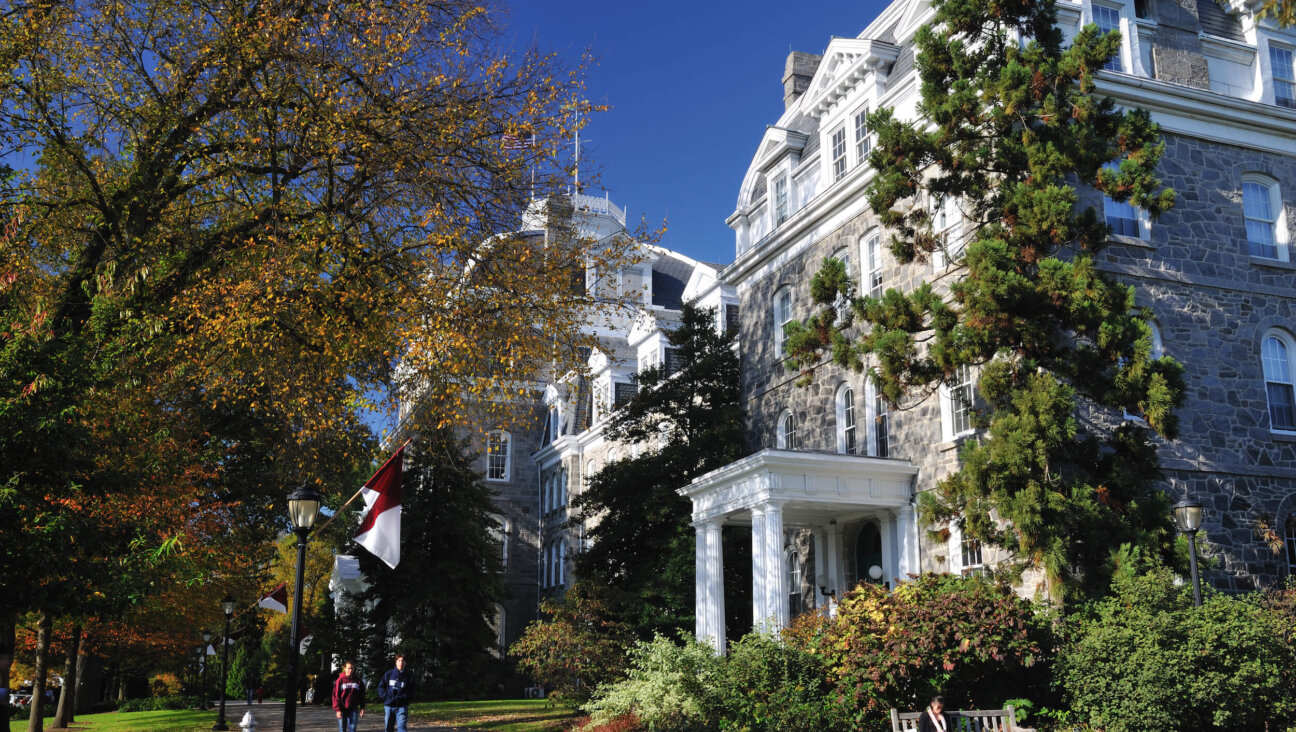
Hundreds Retrace Elie Wiesel’s Steps To Deportation In Romanian Hometown

Image by Getty Images
More than 70 years after fascists took Elie Wiesel to the train station of this sleepy city in Romania, hundreds of its residents retraced his steps in a march to protest against anti-Semitism.
The march Sunday night, organized by local authorities and the Limmud FSU Jewish learning group, began at the home where Wiesel, arguably the world’s most famous Holocaust survivor and a Nobel prize laureate who passed away last year at the age of 87, was born and ended where in 1944 he boarded with his family a train to the Auschwitz death camp.
The march drew participants, Jews and otherwise, from far and wide. Dozens of them wore traditional clothing in a bid to emphasize that Wiesel is no less a part of the local heritage than its other elements,
Sighet Mayor Horia Vasile Scubli said. At the end of the march, the local train station was renamed after Wiesel.
The event in Sighet was a “powerful reminder that we are not alone as we used to be,” said Chaim Chesler, founder of Limmud FSU. “When fascists marched Elie Wiesel and his family with the knowledge of the local population, they were isolated, branded and silenced. Now we walk united, loud and hand in hand.”
Why I became the Forward’s Editor-in-Chief

You are surely a friend of the Forward if you’re reading this. And so it’s with excitement and awe — of all that the Forward is, was, and will be — that I introduce myself to you as the Forward’s newest editor-in-chief.
And what a time to step into the leadership of this storied Jewish institution! For 129 years, the Forward has shaped and told the American Jewish story. I’m stepping in at an intense time for Jews the world over. We urgently need the Forward’s courageous, unflinching journalism — not only as a source of reliable information, but to provide inspiration, healing and hope.
Support our mission to tell the Jewish story fully and fairly.