Trump’s ‘Liberation Day’ includes 17% tariffs on Israeli imports, even as Israel cancels tariffs on US goods
The tariffs could increase prices on kosher food and Judaica
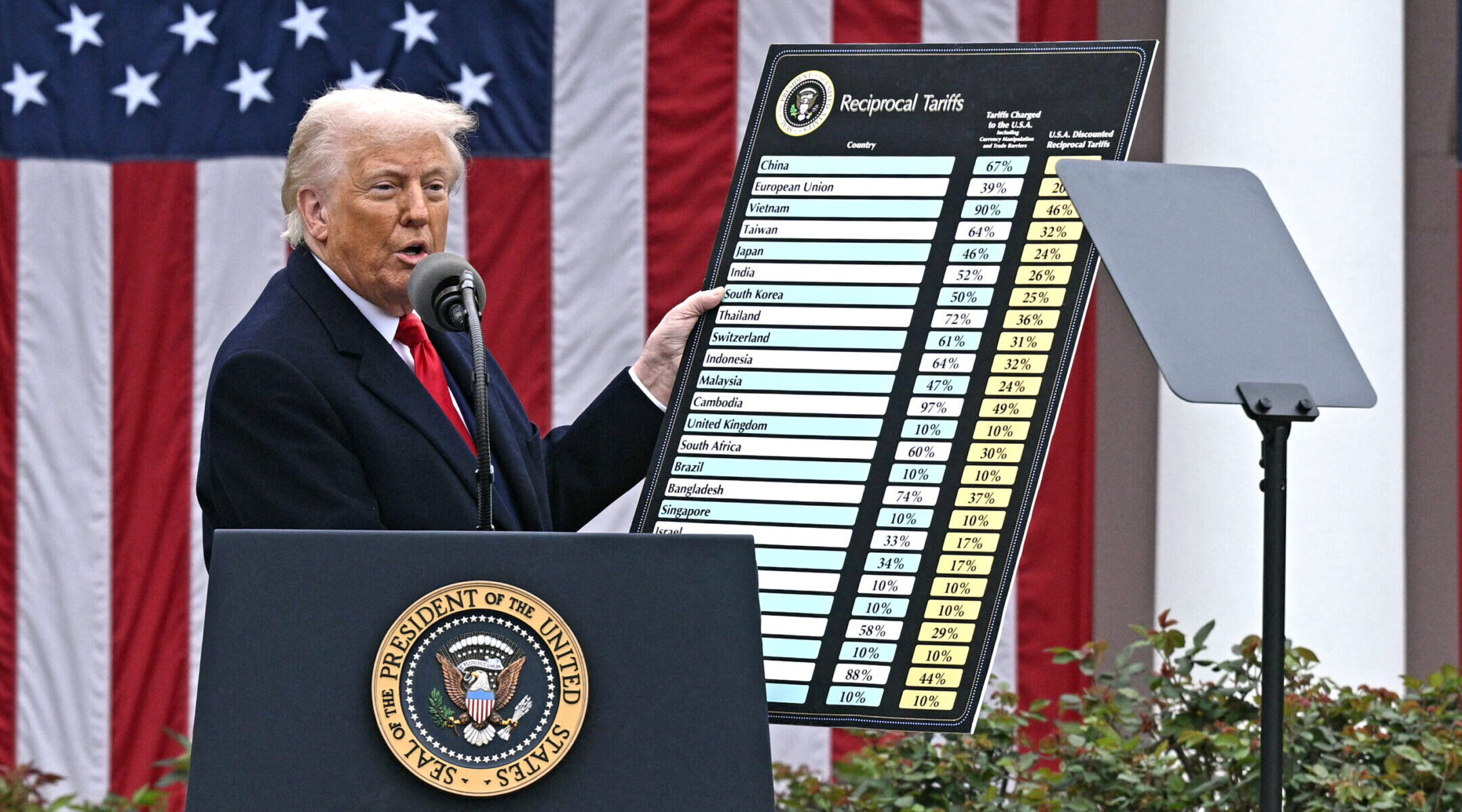
President Donald Trump delivers remarks on reciprocal tariffs during an event in the Rose Garden entitled “Make America Wealthy Again” at the White House in Washington, DC, on April 2, 2025. (Brendan Smialowski/AFP via Getty Images)
(JTA) — The United States will impose 17% tariffs on goods imported from Israel under a sweeping new tariffs system that President Donald Trump unveiled on Wednesday.
The tariffs on Israeli goods are less than some Trump rolled out but greater than the 10% baseline that he is assessing on all imported products. They fall into the “reciprocal tariffs” bucket and represent half of the 33% tariffs that Israel has until now assessed on some U.S. goods. Many imports from the United States have not been taxed under a 1985 free-trade agreement.
Attempting to avert Trump’s targeting, the Israeli government on Tuesday abolished all tariffs on U.S. goods. It was not immediately clear whether Trump would adjust the tariffs on Israeli goods as a result, as he did for other countries that previously eliminated tariffs on U.S. goods under Trump’s trade pressure.
When Prime Minister Benjamin Netanyahu announced the decision on X, owner and Trump’s governing partner Elon Musk tweeted a two-emoji response: the American and Israeli flags, side by side.
The decision could raise prices on consumer goods including kosher food and Judaica that are produced in Israel. Israel is also a major exporter of technology, precious stones and medical supplies, sending products valued at more than $22 billion to the United States in 2024.
Trump argues that the tariffs are needed to reclaim money and respect that other countries have taken from the United States. His critics, including most mainstream economists, say they will wreak havoc on the global economy and translate largely into higher prices for U.S. consumers.
I’m personally matching all gifts to the Forward, up to $36,000. Can I match your gift now?

Hello, fellow Forward reader! I’m Joel Brown, a Forward reader and supporter for more than 15 years, and currently the chair of the board of directors.
I’m an avid Forward reader because it ticks so many of my essential boxes: excellent journalism, Jewish focus and diverse viewpoints. In today’s political climate, what I most appreciate is the Forward’s independence — made possible by the generosity of its membership.
The Forward is committed to bringing you unbiased, nuanced Jewish news. From my position as board chair, I see an exciting future as we expand our position as the definitive independent voice of contemporary American Judaism.
— Joel Brown, Forward board chair
Support our mission to tell the Jewish story fully and fairly.