Trump administration says 2nd phase of Gaza ceasefire is underway, despite Israeli hostage remaining
Middle East envoy Steve Witkoff said the second phase entailed “demilitarization, technocratic governance, and reconstruction”
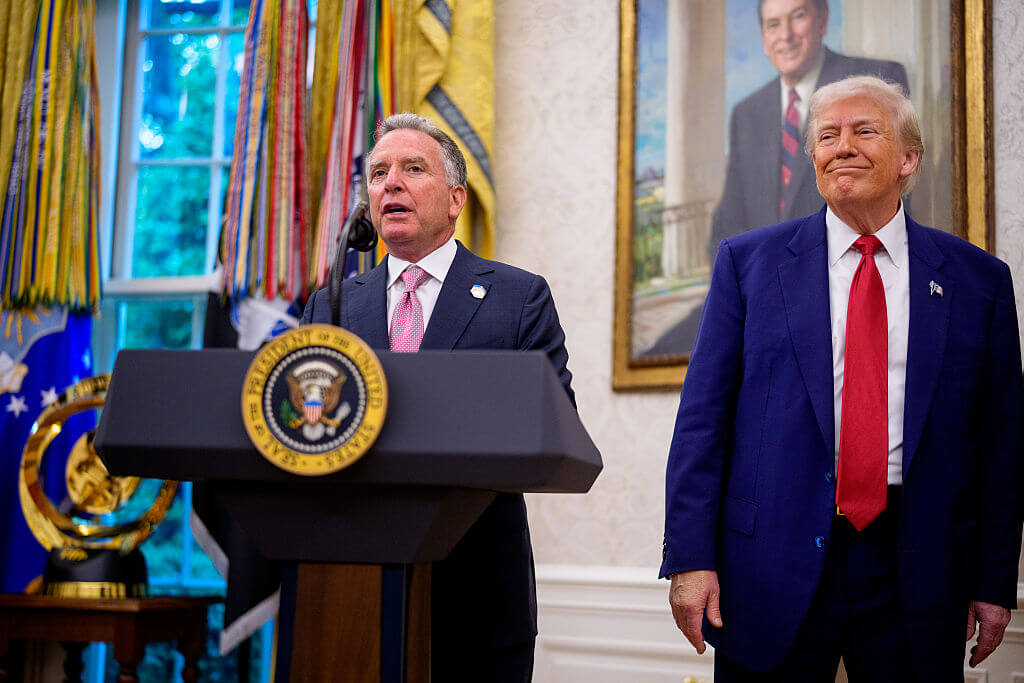
Middle East Envoy Steve Witkoff and President Donald Trump at the White House in May 2025. Photo by Andrew Harnik/Getty Images
(JTA) — Middle East envoy Steve Witkoff announced on Wednesday the beginning of the second phase of the U.S.-brokered ceasefire deal between Israel and Hamas, which includes a transitional Palestinian committee to oversee Gaza’s governance.
The announcement drew alarm from the family and advocates of Ran Gvili, a police officer murdered on Oct. 7, 2023, who is the final Israeli hostage remaining in Gaza.
“Moving to phase two at this moment, while the efforts to return Ran have yet to be exhausted, is a loss of the most significant leverage and may be a sentence of eternal disappearance for Ran,” Gvili’s mother, Talik, said in a statement. “Until Ran is returned, the State of Israel will not be able to close its most bloody wound and will not be able to begin the rehabilitation and healing that it so desperately needs. Phase two must not be implemented as long as Ran has not returned home.”
Israeli officials have reportedly assured the family that the advance in the U.S.-engineered plan for Gaza does not undercut pressure to return Gvili’s body. The second phase was supposed to start as soon as all living and dead hostages had been returned, which the original agreement struck in October said should happen immediately.
Witkoff’s announcement follows repeated signals from President Donald Trump that the second phase was imminent, despite allegations of truce violations from both Israel and Hamas.
“Today, on behalf of President Trump, we are announcing the launch of Phase Two of the President’s 20-Point Plan to End the Gaza Conflict, moving from ceasefire to demilitarization, technocratic governance, and reconstruction,” Witkoff wrote in a post on X.
Witkoff said the second phase established a “transitional technocratic Palestinian administration in Gaza,” and would begin the “full demilitarization and reconstruction of Gaza.” The leader of the administration is a former Palestinian Authority deputy minister named Ali Abdel Hamid Shaath.
In a joint statement, the other mediators of the ceasefire deal — Egypt, Turkey and Qatar — wrote that the second phase was an “important development … aimed at consolidating stability and improving the humanitarian situation in the Gaza Strip.”
The details of how Hamas will be disarmed — a requirement for a permanent peace — remain unclear. Hamas has not agreed to lay down its arms, and fighting in Gaza has continued in fits and starts, including in areas controlled by Israel.
Last month, Israeli Prime Minister Benjamin Netanyahu met with Trump at his Mar-a-Lago estate where the president said that Hamas would be given “a very short period of time to disarm.”
Witkoff indicated in his post that the move to phase two did not preclude consequences for Hamas. He did not specify any, but Israeli officials are reportedly preparing for a potential major Gaza City operation this spring.
“The US expects Hamas to comply fully with its obligations, including the immediate return of the final deceased hostage,” Witkoff wrote. “Failure to do so will bring serious consequences.”
Israeli officials offered a muted response to Witkoff’s announcement, which comes as Israel is preparing for a possible new confrontation with Iran. Netanyahu reportedly sought to cast the announcement as symbolic only.
Some liberal pro-Israel groups offered cautious praise while emphasizing that more needed to be done for a lasting peace.
Brian Romick, the president and CEO of the Democratic Majority for Israel, called the second phase a “welcome step,” but called for the return of Gvili’s remains and increased aid in Gaza. He also called for Hamas to be “fully disarmed” and have no role in Gaza’s governance.
“The Trump administration and the international community must remain focused on enforcing demilitarization, supporting responsible governance, and ensuring that this effort delivers lasting security for Israel and the region,” Romick said.
The president of the liberal Zionist advocacy and lobby group J Street, Jeremy Ben-Ami, also welcomed the announcement in a statement, but called for “prioritizing civilian protection, ensuring the steady flow of humanitarian aid and establishing accountable governance and security arrangements.”
“We support the plan’s focus on Hamas’ demilitarization, Palestinian technocratic governance and reconstruction, and believe that serious diplomacy and international cooperation are essential to saving lives and keeping open a path toward a better future for Israelis and Palestinians rather than endless war,” said Ben-Ami.

Did you know that only 2% of Forward readers donate to support our nonprofit newsroom? That 2% make it possible for millions to read the Forward without a paywall or subscription — removing any barriers to the full and fair Jewish story.
But while the Forward is free to read, it isn’t free to produce. Big stories — like deep dives into the antisemitism data, political scoops or reporting trips to college campuses — take months of research and fact-checking. All while we keep you informed of what you need to know each day.
— Rachel Fishman Feddersen, Forward Publisher & CEO
Support our mission to tell the Jewish story fully and fairly.